
Call us
301-363-4651 (Available 9 a.m. to 5 p.m. CST from Monday to Friday)

| Code | CSB-RA950380A0HU |
| Size | US$210 |
| Order now | |
| Image |
|
| Have Questions? | Leave a Message or Start an on-line Chat |
| Application | Recommended Dilution |
|---|---|
| IHC | 1:50-1:200 |
Lactoferrin, encoded by the LTF gene, is a multifunctional iron-binding glycoprotein with diverse biological activities spanning antimicrobial defense, immune modulation, and cell growth regulation. Beyond its well-characterized role in iron homeostasis, lactoferrin undergoes proteolytic processing to generate bioactive peptides including lactoferricin-H and kaliocin-1, which possess distinct antimicrobial and immunomodulatory properties. The protein's involvement in both cardiovascular biology and cancer research has made it an increasingly important target for investigators studying inflammatory processes, tumor microenvironments, and innate immunity.
This recombinant monoclonal antibody, clone 6B6, offers the reproducibility and consistency that demanding research applications require. Developed using a synthetic peptide immunogen derived from human lactoferrin, the antibody is produced in rabbit host cells and purified by affinity chromatography to ensure high specificity. Because the antibody sequence is defined and preserved, researchers can expect uniform performance across experiments and over time, eliminating the lot-to-lot variability that can complicate longitudinal studies or multi-site collaborations.
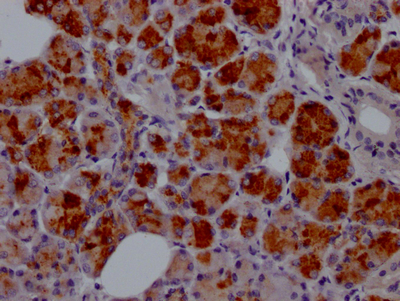
Validation testing confirms reliable performance in immunohistochemistry applications, with recommended working dilutions of 1:50 to 1:200. Staining of paraffin-embedded human salivary gland tissue at 1:100 dilution demonstrated clear detection using citrate buffer antigen retrieval and standard polymer-HRP visualization, consistent with lactoferrin's known expression in exocrine glandular tissues. The antibody is also validated for ELISA, providing flexibility for researchers who need to quantify lactoferrin levels alongside tissue localization studies.
For investigators exploring lactoferrin's roles in cardiovascular disease mechanisms or cancer biology, this antibody provides a dependable tool for characterizing expression patterns in human tissues and experimental systems.
There are currently no reviews for this product.





