
Call us
301-363-4651 (Available 9 a.m. to 5 p.m. CST from Monday to Friday)

| Code | CSB-RA697089A0HU |
| Size | US$210 |
| Order now | |
| Image |
|
| Have Questions? | Leave a Message or Start an on-line Chat |
| Application | Recommended Dilution |
|---|---|
| IHC | 1:50-1:200 |
Lactoferrin, encoded by the LTF gene, is a multifunctional iron-binding glycoprotein with diverse biological activities spanning antimicrobial defense, immune modulation, and cell growth regulation. Beyond its well-characterized role in iron homeostasis, lactoferrin undergoes proteolytic processing to generate bioactive peptides including lactoferricin-H and kaliocin-1, which contribute to its antimicrobial properties. The protein's involvement in cancer biology and cardiovascular processes has made it an increasingly important target for researchers investigating disease mechanisms and potential therapeutic interventions.
This recombinant monoclonal antibody, clone 5A5, offers significant advantages for researchers requiring consistent, reproducible results across extended studies. Developed using recombinant technology in a rabbit host system, this antibody provides the sequence-defined specificity and lot-to-lot consistency that traditional hybridoma-derived antibodies cannot guarantee. The defined molecular composition ensures that experiments performed today will yield comparable results months or years later, supporting both longitudinal studies and collaborative research efforts.
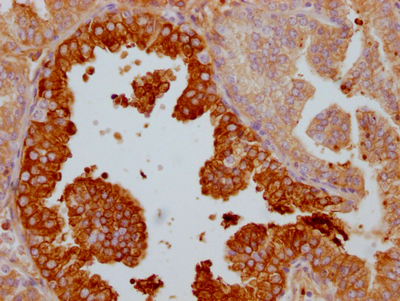
Validation testing has confirmed this antibody's performance in immunohistochemistry applications, with successful staining demonstrated in paraffin-embedded human prostate cancer tissue. Using a Leica Bond system with citrate buffer antigen retrieval and detection via HRP-conjugated secondary antibody, clear visualization was achieved at a 1:100 dilution, with a recommended working range of 1:50 to 1:200 providing flexibility for optimization across different tissue types. The antibody is also validated for ELISA applications, expanding its utility across experimental workflows.
For investigators exploring lactoferrin's roles in cancer progression or cardiovascular disease, this antibody provides a reliable tool for characterizing protein expression patterns in human clinical specimens.
There are currently no reviews for this product.





