
Call us
301-363-4651 (Available 9 a.m. to 5 p.m. CST from Monday to Friday)

| Code | CSB-RA202969A0HU |
| Size | US$210 |
| Order now | |
| Image |
|
| Have Questions? | Leave a Message or Start an on-line Chat |
| Application | Recommended Dilution |
|---|---|
| IHC | 1:50-1:200 |
SOX9 serves as a master transcriptional regulator essential for chondrogenesis, sex determination, and neural crest development. This SRY-related HMG-box transcription factor orchestrates the expression of cartilage-specific genes and plays critical roles in maintaining stem cell populations across multiple tissue types. Dysregulation of SOX9 has been implicated in skeletal malformations, campomelic dysplasia, and various malignancies, making it a compelling target for researchers investigating developmental pathways and disease mechanisms.
This recombinant monoclonal antibody, generated from clone 5H12 in rabbit host, offers the reproducibility and consistency that demanding experimental workflows require. Because the antibody sequence is defined and production occurs through recombinant expression rather than traditional hybridoma methods, researchers can expect minimal lot-to-lot variation, ensuring that optimization efforts translate reliably across extended studies. The antibody has been raised against a synthetic peptide derived from human SOX9 and purified through affinity chromatography to deliver high specificity for your target.
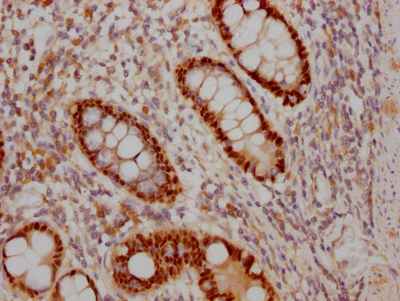
Validation in immunohistochemistry demonstrates robust nuclear staining in paraffin-embedded human colon cancer tissue at dilutions ranging from 1:50 to 1:200. The IHC protocol employed citrate buffer antigen retrieval under high pressure conditions, with detection achieved through a goat anti-rabbit HRP polymer system and DAB visualization. This validation confirms the antibody's suitability for formalin-fixed samples and cancer tissue analysis.
Researchers working in epigenetics, neuroscience, developmental biology, and stem cell research will find this antibody particularly valuable for investigating SOX9-mediated transcriptional programs. The validated IHC and ELISA applications provide flexibility for both tissue-based studies and quantitative protein detection in human samples.
There are currently no reviews for this product.





