
Call us
301-363-4651 (Available 9 a.m. to 5 p.m. CST from Monday to Friday)

| Code | CSB-RA002270A71phHU |
| Size | US$210 |
| Order now | |
| Image |
|
| Have Questions? | Leave a Message or Start an on-line Chat |
| Application | Recommended Dilution |
|---|---|
| WB | 1:500-1:5000 |
| IF | 1:20-1:200 |
ATF2 serves as a critical transcription factor in cellular stress responses, functioning downstream of MAP kinase signaling pathways where it regulates genes involved in cell growth, DNA damage repair, and apoptosis. Phosphorylation at threonine 71 represents a key activation event that enhances ATF2's transcriptional activity, making detection of this specific modification essential for researchers investigating stress-activated signaling cascades and their downstream consequences.
This recombinant monoclonal antibody, developed using rabbit host immunization against a synthetic phosphopeptide corresponding to the human phospho-ATF2 (T71) region, offers the reproducibility that phosphorylation studies demand. The sequence-defined nature of recombinant production ensures consistent performance across experiments, eliminating the lot-to-lot variability that can confound longitudinal studies of dynamic phosphorylation events.
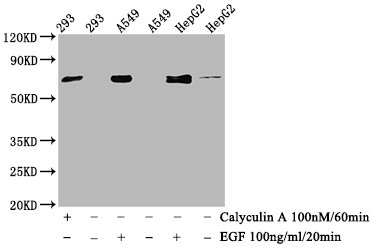
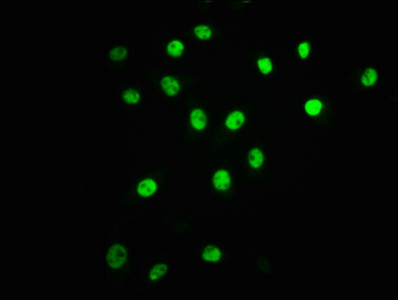
Validation studies confirm reliable detection in western blot applications, where the antibody recognizes a band at the expected 70 kDa molecular weight across multiple human cell lines including 293, A549, and HepG2 cells. Notably, signal enhancement was observed in HepG2 cells following treatment with Calyculin A or EGF, demonstrating the antibody's sensitivity to physiologically relevant changes in ATF2 phosphorylation status. For immunofluorescence applications, the antibody successfully detected nuclear phospho-ATF2 accumulation in A549 cells stimulated with EGF, enabling visualization of signaling dynamics at the single-cell level.
With validated performance in western blotting and immunofluorescence, this antibody supports researchers exploring epigenetics and nuclear signaling pathways, particularly those examining how extracellular stimuli translate into transcriptional responses through ATF2 activation.
There are currently no reviews for this product.





