
Call us
301-363-4651 (Available 9 a.m. to 5 p.m. CST from Monday to Friday)

| Code | CSB-RA007556A209phHU |
| Size | US$210 |
| Order now | |
| Image |
|
| Have Questions? | Leave a Message or Start an on-line Chat |
| Application | Recommended Dilution |
|---|---|
| WB | 1:500-1:5000 |
| IHC | 1:50-1:200 |
Eukaryotic translation initiation factor 4E plays a central role in cap-dependent translation initiation, serving as a critical node where cellular signaling pathways converge to regulate protein synthesis. Phosphorylation at serine 209 represents a key regulatory modification that enhances EIF4E's affinity for the mRNA cap structure, directly influencing translational output. This phosphorylation event, mediated by MNK kinases downstream of MAPK and mTOR pathways, has become an important marker for studying oncogenic signaling, stress responses, and translational control mechanisms.
This recombinant monoclonal antibody, generated from clone 1F3 in rabbit, offers the reproducibility and consistency that phospho-specific detection demands. Because recombinant production ensures a sequence-defined binding region, researchers can expect reliable performance across experiments and between lots—particularly valuable when tracking subtle changes in phosphorylation status under different treatment conditions.
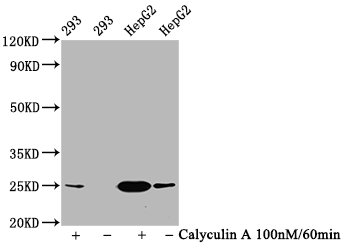
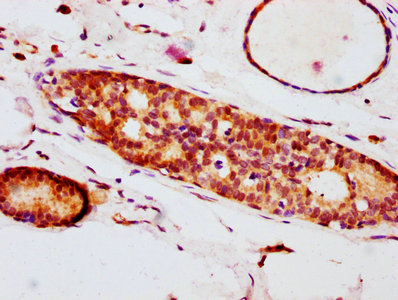
Validation studies confirm robust performance in western blot applications, where the antibody detects a band at the predicted 25 kDa molecular weight in 293 and HepG2 whole cell lysates. Notably, testing in HepG2 cells with and without Calyculin A treatment demonstrates the antibody's ability to distinguish phosphorylation-dependent signal changes, supporting its utility in phosphatase inhibitor studies. For tissue-based investigations, immunohistochemistry validation in paraffin-embedded human breast cancer sections shows clear staining patterns, enabling researchers to examine phospho-EIF4E distribution in clinical specimens.
With verified applications spanning ELISA, western blot, and immunohistochemistry, this antibody provides flexibility for researchers investigating translational regulation, MAPK signaling dynamics, and the role of cap-dependent translation in cancer biology and cellular stress responses.
There are currently no reviews for this product.





