


Call us
301-363-4651 (Available 9 a.m. to 5 p.m. CST from Monday to Friday)

| Code | CSB-RA002272A0HU |
| Size | US$210 |
| Order now | |
| Image |
|
| Have Questions? | Leave a Message or Start an on-line Chat |
| Application | Recommended Dilution |
|---|---|
| WB | 1:500-1:5000 |
| IHC | 1:50-1:200 |
| IF | 1:20-1:200 |
| IP | 1:200-1:1000 |
ATF4 serves as a master regulator of cellular stress responses, orchestrating transcriptional programs that determine cell fate under conditions of endoplasmic reticulum stress, amino acid deprivation, and oxidative damage. As a key effector of the integrated stress response pathway, ATF4 has become an essential target for researchers investigating cancer biology, metabolic disorders, and neurodegenerative diseases where stress adaptation plays a critical role.
This recombinant monoclonal antibody, generated from clone 9E1, offers the consistency and reliability that demanding experimental workflows require. Because the antibody sequence is defined and produced recombinantly, researchers benefit from lot-to-lot reproducibility that ensures comparable results across extended studies and collaborative projects.
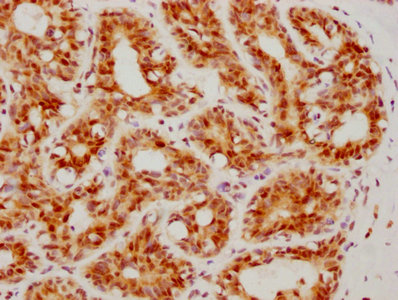
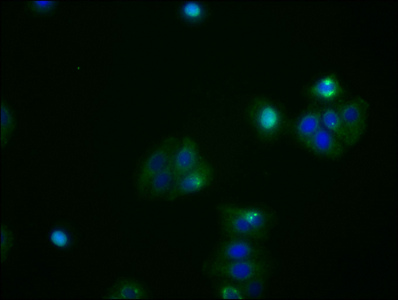
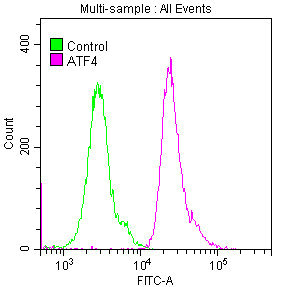
Extensive validation demonstrates this antibody's versatility across multiple experimental platforms. Western blot analysis confirms robust detection in diverse human cell lines including HeLa, MCF-7, 293, HepG2, Jurkat, and K562, with the observed band appearing at approximately 50 kDa rather than the predicted 39 kDa—a shift commonly attributed to post-translational modifications such as phosphorylation events that regulate ATF4 stability and activity. Immunohistochemistry staining has been validated in paraffin-embedded human breast cancer tissue, while immunofluorescence studies in HepG2 cells reveal the expected nuclear localization pattern consistent with ATF4's function as a transcription factor. The antibody also performs reliably in immunoprecipitation and flow cytometry applications, enabling both biochemical enrichment studies and single-cell analysis of ATF4 expression.
For researchers exploring epigenetics and nuclear signaling pathways, particularly those investigating stress-responsive transcriptional networks, this antibody provides a dependable tool for characterizing ATF4 biology across multiple experimental approaches.
There are currently no reviews for this product.





