
Call us
301-363-4651 (Available 9 a.m. to 5 p.m. CST from Monday to Friday)

| Code | CSB-RA152430A0HU |
| Size | US$210 |
| Order now | |
| Image |
|
| Have Questions? | Leave a Message or Start an on-line Chat |
| Application | Recommended Dilution |
|---|---|
| WB | 1:500-1:5000 |
| IHC | 1:50-1:200 |
BRD4 serves as a critical epigenetic reader protein that recognizes acetylated lysine residues on histones, functioning as a key transcriptional regulator that recruits the positive transcription elongation factor complex to promote gene expression. This bromodomain-containing protein has emerged as a compelling therapeutic target in oncology research, where its dysregulation drives aberrant transcriptional programs in multiple cancer types, making it essential for studies investigating chromatin biology and tumor progression mechanisms.
This recombinant monoclonal antibody, generated from clone 1E5 in rabbit host, offers the reproducibility advantages inherent to recombinant technology. Because the antibody sequence is defined and produced through controlled expression systems, researchers can expect consistent performance across experiments and between lots, eliminating the variability concerns that can complicate long-term studies or multi-site collaborations.
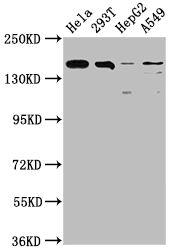
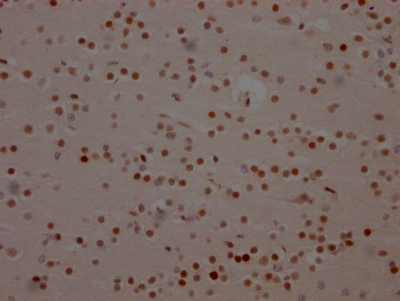
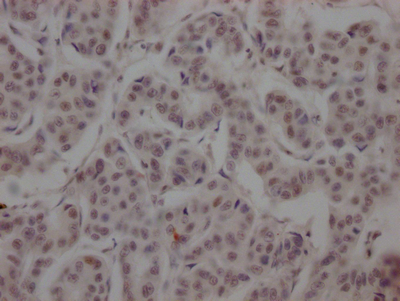
Validation testing demonstrates reliable detection of human BRD4 across multiple experimental platforms. In western blot applications, the antibody successfully identifies the 153 kDa band corresponding to the full-length protein in HeLa, 293T, HepG2, and A549 cell lysates at dilutions ranging from 1:500 to 1:5000. While BRD4 exists as multiple isoforms with predicted sizes of 153, 81, and 89 kDa, the observed detection of the 153 kDa species confirms recognition of the predominant full-length variant. For immunohistochemistry applications, the antibody has been validated in paraffin-embedded human brain tissue and human breast cancer specimens using citrate buffer antigen retrieval at dilutions of 1:50 to 1:200, providing flexibility for tissue-based expression studies.
Whether investigating BRD4's role in transcriptional regulation, exploring BET inhibitor mechanisms, or characterizing expression patterns in cancer specimens, this antibody supports diverse experimental approaches in epigenetics and oncology research.
There are currently no reviews for this product.





