
Call us
301-363-4651 (Available 9 a.m. to 5 p.m. CST from Monday to Friday)

| Code | CSB-EP335904AEJ |
| Abbreviation | Recombinant African swine fever virus Ba71V-93 protein |
| MSDS | |
| Size | $388 |
| Order now | |
| Image |
|
| Have Questions? | Leave a Message or Start an on-line Chat |
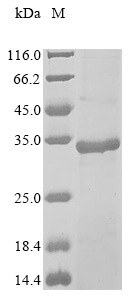
Recombinant African swine fever virus Phosphoprotein p30 (Ba71V-93) is produced in E. coli using a full-length expression that covers amino acids 1-204. The protein carries an N-terminal 6xHis tag, which makes purification and detection more straightforward. SDS-PAGE analysis confirms purity levels above 85%, indicating it should work well for various research applications. This product is designed strictly for research use and cannot be applied for diagnostic or therapeutic purposes.
Phosphoprotein p30 of the African swine fever virus appears to play a significant role in the viral replication cycle. Current research suggests it's involved in virus entry and assembly, which likely influences the virus's capacity to infect host cells. As a structural protein, p30 has become a target for investigating viral pathogenesis and immune response. This makes it potentially useful for studying African swine fever virus mechanisms and developing vaccines, though much work remains to be done.
Potential Applications
Note: The applications listed below are based on what we know about this protein's biological functions, published research, and experience from experts in the field. However, we haven't fully tested all of these applications ourselves yet. We'd recommend running some preliminary tests first to make sure they work for your specific research goals.
Based on the provided information, the recombinant African swine fever virus phosphoprotein p30 is expressed in E. coli, a prokaryotic system that is generally unsuitable for producing functional eukaryotic viral proteins. ASFV p30 is a complex phosphoprotein that requires specific post-translational modifications (particularly phosphorylation) and proper folding for its biological functions in viral replication and host interaction. While the protein is full-length (1-204aa) with an N-terminal 6xHis tag and >85% purity, E. coli lacks the eukaryotic kinase machinery necessary for proper phosphorylation and the chaperone systems for correct folding of viral proteins. Since activity is unverified, the protein cannot be assumed to be correctly folded, properly modified, or bioactive without experimental validation.
1. Antibody Development and Validation
The recombinant p30 can serve as an effective immunogen for generating antibodies that recognize linear epitopes, even if the protein is misfolded or unphosphorylated. The His-tag facilitates purification and screening. However, antibodies may not recognize phosphorylation-dependent or conformational epitopes of native, properly modified p30 from ASFV-infected cells. Validation against native p30 is essential.
2. Protein-Protein Interaction Studies
This application is high-risk without folding and modification validation. While the His-tag enables technical feasibility for pull-down assays, if p30 is misfolded and unphosphorylated (as expected in E. coli), it will not interact physiologically with true binding partners. Viral phosphoproteins require specific modifications and conformations for proper interactions with host and viral proteins. Identified interactions could be non-physiological artifacts. This application should not be pursued without confirmation of proper folding and phosphorylation.
3. ELISA-Based Binding Assays
This application is feasible for antibody detection but problematic for functional studies. The His-tag enables technical development of ELISA formats, but if p30 is misfolded and unphosphorylated, binding assays will not reflect biological reality. The assay may work for antibody detection, but requires validation against properly modified p30 for accurate biological binding studies.
Final Recommendation & Action Plan
Given the high probability of improper folding and lack of essential phosphorylation in E. coli for this viral phosphoprotein, recommend first performing comprehensive validation: 1) Biophysical characterization (circular dichroism for secondary structure, size-exclusion chromatography for oligomeric state); 2) Phosphorylation status analysis using phospho-specific antibodies or mass spectrometry; 3) Functional validation using known p30 interactions if possible. Antibody development can proceed as the safest application. Avoid all functional studies (interactions, binding assays) until proper folding and modification are confirmed. For reliable p30 research, obtain the protein from eukaryotic expression systems capable of proper phosphorylation, or use ASFV-infected cell extracts as a source of native protein. Always include appropriate controls, such as known phosphorylated p30 standards, when possible.
There are currently no reviews for this product.
KEGG: vg:22220322





