
Call us
301-363-4651 (Available 9 a.m. to 5 p.m. CST from Monday to Friday)

| Code | CSB-EP352689HU |
| Abbreviation | Recombinant Human ERVFRD-1 protein, partial |
| MSDS | |
| Size | $306 |
| Order now | |
| Image |
|
| Have Questions? | Leave a Message or Start an on-line Chat |
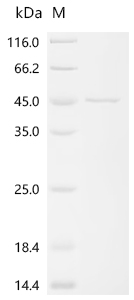
Recombinant Human Syncytin-2 (ERVFRD-1) is produced in E. coli and comprises amino acids 16-350 with a C-terminal 6xHis tag for simplified purification. This partially expressed protein shows purity exceeding 90%, as verified by SDS-PAGE analysis. It's designed for research use only and appears to deliver reliable performance in various experimental applications.
Syncytin-2, encoded by the ERVFRD-1 gene, is an envelope protein derived from endogenous retroviruses. The protein plays what seems to be a crucial role in human placental development. It's integral to syncytiotrophoblast formation, contributing to cell fusion processes. Syncytin-2 has drawn significant interest in studies related to reproductive biology and the evolutionary impact of viral elements in human genomes.
Potential Applications
Note: The applications listed below are based on what we know about this protein's biological functions, published research, and experience from experts in the field. However, we haven't fully tested all of these applications ourselves yet. We'd recommend running some preliminary tests first to make sure they work for your specific research goals.
Based on the provided information, the recombinant human Syncytin-2 is expressed in E. coli, a prokaryotic system that is fundamentally unsuitable for producing functional eukaryotic viral envelope proteins. Syncytin-2 is a complex fusogenic protein that requires precise folding, disulfide bond formation, glycosylation, and correct membrane integration for its biological activity. The protein is expressed as a partial fragment (16-350aa) with a C-terminal 6xHis tag and >90% purity. However, E. coli lacks the eukaryotic chaperones, disulfide isomerases, and glycosylation machinery necessary for proper folding of this retroviral envelope protein. The C-terminal His-tag may further interfere with the transmembrane domain and protein function. Since activity is unverified, the protein cannot be assumed to be correctly folded or bioactive without experimental validation of its fusogenic activity.
1. Protein-Protein Interaction Studies Using His-Tag Pull-Down Assays
The C-terminal 6xHis tag enables technical feasibility for pull-down assays. However, if Syncytin-2 is misfolded (as expected in E. coli), it will not interact physiologically with true binding partners (e.g., ASCT2 receptor). The fusogenic domain requires precise conformation for specific receptor interactions. Identified interactions could be non-physiological artifacts. This application should not be pursued without confirmation of proper folding and receptor-binding capability.
2. Antibody Development and Validation
The recombinant Syncytin-2 can serve as an effective immunogen for generating antibodies that recognize linear epitopes, even if misfolded. The high purity supports immunization protocols. However, antibodies may not recognize conformational or glycosylation-dependent epitopes of native, properly folded Syncytin-2 in human tissues. Validation against endogenous Syncytin-2 is essential.
3. Biochemical Characterization and Stability Studies
This application is well-suited for assessing the recombinant human Syncytin-2 itself. Techniques like circular dichroism spectroscopy, size-exclusion chromatography, and thermal shift assays can evaluate the protein's folding state and stability. These studies are valuable even if the protein is inactive, as they characterize the recombinant product and inform about its suitability for other applications.
4. Comparative Structural Analysis Using Biophysical Methods
This application can provide structural insights, but with significant limitations. Biophysical techniques can assess the E. coli-expressed Syncytin-2's properties, but results will not reflect the native Syncytin-2 structure due to a lack of glycosylation and potential misfolding. The partial sequence (16-350aa) lacks important functional domains, limiting the biological relevance of structural findings.
Final Recommendation & Action Plan
Given the high probability of misfolding in E. coli for this complex viral envelope protein, we recommend first performing comprehensive biophysical characterization (circular dichroism for secondary structure, size-exclusion chromatography for oligomeric state) to assess folding quality. Antibody development can proceed as the safest application. Avoid all functional studies (interactions, fusion assays) until proper folding is validated through receptor-binding or cell-cell fusion assays. For reliable Syncytin-2 research, obtain the protein from mammalian expression systems capable of proper glycosylation and folding. Always include appropriate controls, such as known fusogenic proteins, and validate findings with native Syncytin-2 from human tissues when possible.

Applications : Binding assay/Protein-protein interaction
Review: The recombinant human Syncytin-2 (ERVFRD-1, Lot DC06049b1g0) was evaluated as an antigen for multiplex immunoassays. The protein reconstituted efficiently, remained soluble during bead conjugation, and demonstrated stable antigenicity across repeated runs. It enabled the reliable detection of Syncytin-2–specific antibody responses with low background signals in control beads, confirming good specificity.
By Mehak





