
Call us
301-363-4651 (Available 9 a.m. to 5 p.m. CST from Monday to Friday)

| Code | CSB-EP025546HU(F2) |
| Abbreviation | Recombinant Human UCK1 protein |
| MSDS | |
| Size | $224 |
| Order now | |
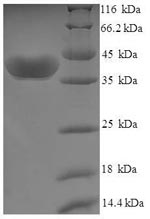
| Image |
|
| Have Questions? | Leave a Message or Start an on-line Chat |
Recombinant Human Uridine-cytidine kinase 1 (UCK1) is produced in an E. coli expression system and contains the complete sequence of isoform 2, covering amino acids 1-201. The protein includes an N-terminal 6xHis-SUMO tag, which makes purification and detection more straightforward. SDS-PAGE analysis confirms purity levels above 90%, and the product appears well-suited for research applications where consistent experimental performance is needed.
Uridine-cytidine kinase 1 (UCK1) is an enzyme with a key function in the pyrimidine salvage pathway. It catalyzes the phosphorylation of uridine and cytidine, converting them to their respective monophosphate forms. This process seems essential for nucleotide metabolism and may help maintain proper cellular nucleotide pools. UCK1 has drawn particular attention from researchers studying nucleotide synthesis and how cells regulate these pathways in different contexts.
Potential Applications
Note: The applications listed below are based on what we know about this protein's biological functions, published research, and experience from experts in the field. However, we haven't fully tested all of these applications ourselves yet. We'd recommend running some preliminary tests first to make sure they work for your specific research goals.
Human UCK1 is a nucleoside kinase that requires precise folding, proper ATP-binding site formation, and specific tertiary structure for its enzymatic activity in phosphorylating uridine and cytidine. The E. coli expression system can produce soluble proteins but may not support optimal eukaryotic folding or post-translational modifications. The large N-terminal 6xHis-SUMO tag (∼15 kDa) may sterically interfere with the protein's active site or substrate-binding domains. While UCK1 can sometimes be functionally expressed in E. coli, the probability of correct folding with full enzymatic activity requires experimental validation.
1. Enzyme Kinetics and Substrate Specificity Studies
This application carries a significant risk without functional validation. UCK1 enzymatic activity requires precise ATP-binding site formation and proper tertiary structure. If correctly folded and active (verified through kinase assays), the protein may be suitable for kinetic studies. If misfolded/inactive (unverified), kinetic measurements will yield biologically meaningless results. The SUMO tag may sterically interfere with substrate access.
2. Nucleotide Analog Drug Metabolism Research
This application requires rigorous functional validation. Drug metabolism studies depend on native enzyme conformation and catalytic activity. If correctly folded and active (verified), limited analog phosphorylation studies may be possible. If misfolded/inactive (unverified), results will be unreliable for drug development applications.
3. Protein-Protein Interaction Studies
This application carries substantial risk without proper folding validation. UCK1 interactions with regulatory proteins require precise tertiary structure. If correctly folded (verified), the protein may identify physiological interaction partners. If misfolded/unverified, there is a high risk of non-specific binding or failure to replicate genuine metabolic complex formation.
4. Antibody Development and Validation
This application is highly suitable as antibody development relies on antigenic sequence recognition rather than functional enzymatic activity. The full-length isoform provides comprehensive epitope coverage for generating UCK1-specific antibodies. The high purity (>90%) ensures minimal contamination-related issues.
5. Structural and Biophysical Characterization
These studies are essential for determining folding status. Techniques should include circular dichroism spectroscopy to assess secondary structure, size-exclusion chromatography to evaluate oligomeric state, and thermal shift assays to determine stability. However, the SUMO tag may interfere with high-resolution structural studies.
Final Recommendation & Action Plan
The E. coli-expressed UCK1 with a large SUMO tag may not be properly folded for functional applications without experimental validation. Begin with Application 5 (Structural Characterization) to assess folding quality through CD spectroscopy, SEC, and validate enzymatic activity using standard nucleoside kinase assays before considering functional applications. Applications 1, 2, and 3 require rigorous functional validation. Application 4 (antibody development) can proceed immediately. Consider SUMO tag removal for critical functional studies to minimize potential steric interference. Always include appropriate activity controls and validate key findings with mammalian-expressed UCK1 when possible for reliable kinase research.
There are currently no reviews for this product.





