
Call us
301-363-4651 (Available 9 a.m. to 5 p.m. CST from Monday to Friday)

| Code | CSB-YP524921HU |
| Abbreviation | Recombinant Human PDE5A protein, partial |
| MSDS | |
| Size | $306 |
| Order now | |
| Image |
|
| Have Questions? | Leave a Message or Start an on-line Chat |
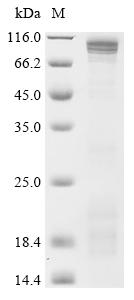
Recombinant Human cGMP-specific 3',5'-cyclic phosphodiesterase (PDE5A) is expressed in yeast, covering the amino acid region 534-875. This partial protein is tagged with a C-terminal 6xHis-tag for ease of purification and detection. The product demonstrates a purity greater than 85%, as verified by SDS-PAGE analysis, ensuring reliable performance in research applications.
PDE5A is an enzyme involved in the hydrolysis of cGMP, a critical second messenger in various signal transduction pathways. The enzyme appears to play a pivotal role in regulating vascular smooth muscle contraction and represents a significant target in cardiovascular research. By modulating cGMP levels, PDE5A impacts processes such as vasodilation and platelet aggregation. This makes it an important focus for understanding cardiovascular function and potential therapeutic interventions.
Potential Applications
Note: The applications listed below are based on what we know about this protein's biological functions, published research, and experience from experts in the field. However, we haven't fully tested all of these applications ourselves yet. We'd recommend running some preliminary tests first to make sure they work for your specific research goals.
Based on the provided information, the folding state and bioactivity of this recombinant PDE5A protein fragment are unknown and cannot be assumed. PDE5A is a phosphodiesterase enzyme whose catalytic activity depends on the correct folding of its catalytic domain and the proper binding of zinc and other cofactors. While the expressed region (534-875aa) likely contains the catalytic domain, expression in a yeast system with a C-terminal 6xHis tag introduces uncertainty about correct folding. The tag could potentially interfere with the protein's structure or function. The >85% purity indicates minimal contaminants but does not confirm proper folding or enzymatic activity. Therefore, applications relying on specific biological activity or native conformation are speculative without validation.
1. Protein-Protein Interaction Studies via His-Tag Pull-Down Assays
The His-tagged recombinant PDE5A fragment can be immobilized for pull-down experiments. However, the utility for identifying biological interaction partners is entirely contingent on the protein being correctly folded. If the catalytic domain is misfolded, it may not present native protein interaction surfaces, leading to the identification of non-specific binders.
2. Antibody Development and Epitope Mapping
This recombinant PDE5A fragment is suitable as an immunogen to generate antibodies specific to this region (534-875aa). However, antibodies generated will primarily recognize linear epitopes. Their ability to bind the natively folded, active PDE5A enzyme in cells or tissues is not guaranteed and requires validation.
3. Biochemical Characterization and Domain Function Analysis
This purified recombinant PDE5A protein is well-suited for biochemical characterization of its physical properties, including thermal stability and structural characteristics. The studies should be framed as characterizing the biophysical properties of this recombinant PDE5A fragment, not its function. True functional analysis (e.g., catalytic activity) requires prior validation of enzymatic activity.
4. ELISA-Based Binding Assays
The His-tagged recombinant PDE5A protein can be immobilized for ELISA development. However, its use for "screening potential small molecule ligands" or "quantitative assessment of binding affinities" is not valid without confirmed bioactivity. If the PDE5A protein is misfolded, any binding data will be irrelevant to native PDE5A function. This application should be limited to detecting antibodies against the immunogen until enzymatic activity is verified.
Final Recommendation & Action Plan
The immediate priority is to validate the phosphodiesterase activity of this recombinant PDE5A fragment using a standard enzymatic assay (e.g., measuring cGMP hydrolysis) before pursuing functional studies. If active, it becomes valuable for interaction studies (Application 1) and binding assays (Application 4). If inactive, its use should be restricted to antibody production (Application 2) and biophysical characterization (Application 3). The high purity is a good starting point, but functionality must be confirmed before investing in mechanistic studies. For all applications, appropriate controls should be included to account for potential tag-mediated effects or non-specific interactions.
There are currently no reviews for this product.





