
Call us
301-363-4651 (Available 9 a.m. to 5 p.m. CST from Monday to Friday)

| Code | CSB-EP886188MO |
| Abbreviation | Recombinant Mouse Acot2 protein |
| MSDS | |
| Size | $306 |
| Order now | |
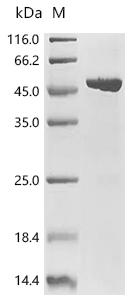
| Image |
|
| Have Questions? | Leave a Message or Start an on-line Chat |
Recombinant Mouse Acyl-coenzyme A thioesterase 2, mitochondrial (Acot2) is produced in E. coli and represents the full-length mature protein, spanning amino acids 43-453. A C-terminal 6xHis-tag is attached to help with purification and detection. The protein reaches over 90% purity, as determined by SDS-PAGE, which makes it workable for various research applications where high-quality recombinant proteins are required.
Acyl-coenzyme A thioesterase 2 (Acot2) appears to be a mitochondrial enzyme involved in lipid metabolism. It catalyzes the hydrolysis of acyl-CoA to free fatty acid and CoA, playing what seems to be a critical role in regulating intracellular levels of acyl-CoA and free fatty acids. This protein may be of particular interest in studies related to energy metabolism and metabolic disorders, potentially providing insights into mitochondrial function and lipid regulation mechanisms.
Potential Applications
Note: The applications listed below are based on what we know about this protein's biological functions, published research, and experience from experts in the field. However, we haven't fully tested all of these applications ourselves yet. We'd recommend running some preliminary tests first to make sure they work for your specific research goals.
Based on the provided information, the recombinant mouse Acot2 is expressed in E. coli, a prokaryotic system that is generally suitable for producing soluble enzymatic proteins like Acot2. As a mitochondrial acyl-CoA thioesterase, Acot2 is a relatively small soluble enzyme that does not require complex post-translational modifications for its catalytic activity. The protein is expressed as the full-length mature form (43-453aa) with a C-terminal 6xHis tag and >90% purity. The C-terminal tag placement minimizes interference with the catalytic domain. However, since activity is unverified and mitochondrial proteins may require specific folding environments, the protein cannot be assumed to be correctly folded or bioactive without experimental validation of its thioesterase activity using appropriate acyl-CoA substrates.
1. Protein-Protein Interaction Studies Using His-Tag Affinity Purification
The C-terminal 6xHis tag enables technical feasibility for pull-down assays. However, if Acot2 is misfolded, it may not interact physiologically with true binding partners. Mitochondrial enzymes often form complexes that require precise conformation. This application should only be pursued after confirming proper folding and enzymatic activity.
2. Antibody Development and Validation
The recombinant Acot2 can serve as an effective immunogen for generating antibodies that recognize linear epitopes. The full-length mature sequence ensures comprehensive epitope coverage. Validation against native Acot2 from mouse mitochondria is recommended.
3. Biochemical Characterization and Enzyme Kinetics Analysis
Basic biochemical characterization is feasible, but enzyme kinetics studies require activity validation first. If Acot2 is misfolded, kinetic parameters (Km, Vmax) will be invalid. These studies should only follow confirmation of thioesterase activity using known acyl-CoA substrates.
4. Structural and Biophysical Studies
This application is well-suited for initial characterization. Techniques like analytical ultracentrifugation, circular dichroism spectroscopy, and thermal shift assays can assess folding state and oligomeric structure. These studies are valuable even before activity validation.
Final Recommendation & Action Plan
Given that Acot2 is a soluble enzyme expressed in a prokaryotic system with a C-terminal tag, the probability of proper folding is relatively high. However, recommend first performing validation studies: 1) Functional validation using thioesterase activity assays with various acyl-CoA substrates; 2) Biophysical characterization (size-exclusion chromatography with multi-angle light scattering) to confirm proper oligomeric state; 3) If possible, comparison with Acot2 from eukaryotic expression systems. Antibody development can proceed immediately. Avoid interaction studies until proper folding and activity are confirmed. For reliable kinetic studies, use activity-verified protein and include appropriate controls such as known substrates and specific inhibitors.
There are currently no reviews for this product.





