
Call us
301-363-4651 (Available 9 a.m. to 5 p.m. CST from Monday to Friday)

| Code | CSB-YP319316MO |
| Abbreviation | Recombinant Mouse Mup2 protein |
| MSDS | |
| Size | $368 |
| Order now | |
| Image |
|
| Have Questions? | Leave a Message or Start an on-line Chat |
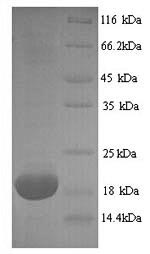
Recombinant Mouse Major urinary protein 2 (Mup2) is expressed in a yeast system, which appears to provide robust and consistent protein production. The protein contains the full length of the mature form, with an N-terminal 6xHis-tag that makes purification and detection more straightforward. The product shows a purity of over 90% as confirmed by SDS-PAGE analysis, suggesting it may be suitable for various research applications. Endotoxin levels are kept low, meeting research-grade standards.
Major urinary protein 2 (Mup2) belongs to the lipocalin family and is primarily involved in binding and transporting small hydrophobic molecules, such as pheromones. This protein likely plays a significant role in chemical communication and social behavior in mice. Researchers often study Mup2 to understand the molecular mechanisms of olfactory signaling and its impact on animal behavior. This makes it a potentially valuable target in research exploring communication and social interaction pathways.
Potential Applications
Note: The applications listed below are based on what we know about this protein's biological functions, published research, and experience from experts in the field. However, we haven't fully tested all of these applications ourselves yet. We'd recommend running some preliminary tests first to make sure they work for your specific research goals.
Based on the provided information, recombinant mouse Mup2 is produced in a yeast expression system as the full-length mature protein (19-180aa) with an N-terminal 6xHis-tag. Mup2 is a lipocalin family protein that typically requires precise folding of its β-barrel structure for proper ligand-binding activity. Yeast expression systems provide eukaryotic folding machinery capable of supporting disulfide bond formation and proper tertiary structure formation, which are important for Mup2's structural integrity. As a full-length protein expressed in a eukaryotic system, it has a high probability of correct folding. The small His-tag is unlikely to significantly interfere with the protein's structure or function. Purity >90% by SDS-PAGE indicates good production quality. However, no validation data (e.g., ligand binding assays, circular dichroism) are provided to confirm native folding or bioactivity. Therefore, while the protein is likely correctly folded, its functional activity cannot be confirmed without experimental validation.
1. Protein-Protein Interaction Studies
If correctly folded, the recombinant Mup2 can be used in pull-down assays to identify binding partners, as the His-tag facilitates immobilization. However, if misfolded, interaction domains may be altered, leading to non-specific binding or failure to recognize genuine biological partners. The high purity reduces background, but cannot compensate for structural defects.
2. Antibody Development and Validation
This application is highly suitable as antibody generation primarily relies on linear epitope recognition. The full-length protein provides comprehensive epitope coverage. The yeast expression system likely produces a properly folded protein that maintains native-like structure, enhancing antibody quality for recognizing conformational epitopes.
3. Structural and Biophysical Characterization
If properly folded, the protein is suitable for structural studies and biophysical analysis. The His-tag should be removed for high-resolution structural determination, but may not significantly interfere with techniques like circular dichroism or dynamic light scattering. If misfolded, structural data would misrepresent the native protein.
4. Biochemical Assay Development
If correctly folded and functional, the recombinant Mup2 can serve as a reliable standard for biochemical assays. However, if misfolded, it will not accurately represent native Mup2 behavior, potentially leading to invalid standard curves and assay conditions.
Final Recommendation & Action Plan
This yeast-expressed full-length Mup2 has a high probability of being properly folded due to the eukaryotic expression system and full-length construct. The recommended action plan includes: (1) Validate folding and function through ligand binding assays (if known ligands are available) and biophysical characterization (circular dichroism for secondary structure); (2) Proceed with antibody development immediately as this application is low-risk; (3) For structural studies, consider removing the His-tag proteolytically for highest resolution analysis; (4) For interaction studies and assay development, include appropriate controls to confirm biological relevance. The protein can be used with reasonable confidence for most applications, with functional studies requiring basic validation of activity.
There are currently no reviews for this product.
UniGene: Mm.335875





