
Call us
301-363-4651 (Available 9 a.m. to 5 p.m. CST from Monday to Friday)

| Code | CSB-EP886515EYA |
| Abbreviation | Recombinant Porphyromonas gingivalis Peptidylarginine deiminase protein |
| MSDS | |
| Size | US$388 |
| Order now | |
| Image |
|
| Have Questions? | Leave a Message or Start an on-line Chat |
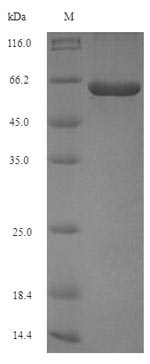
Recombinant Porphyromonas gingivalis Peptidylarginine deiminase (PG_1424) is expressed in an E. coli system, spanning the complete mature protein sequence from amino acids 44 to 556. The construct carries an N-terminal 6xHis tag that simplifies purification and detection procedures. SDS-PAGE analysis confirms the product achieves greater than 90% purity. This research-use-only protein is carefully manufactured to maintain low endotoxin levels, which appears to support more consistent experimental results.
Peptidylarginine deiminase from Porphyromonas gingivalis serves a key function in converting arginine residues to citrulline through a process called citrullination or deimination. This enzyme holds particular importance for researchers studying post-translational modifications, which may influence how proteins function and interact with one another. Its activity could help reveal mechanisms underlying various biological pathways and disease conditions. This makes it a potentially valuable tool for proteomics research.
Potential Applications
Note: The applications listed below are based on what we know about this protein's biological functions, published research, and experience from experts in the field. However, we haven't fully tested all of these applications ourselves yet. We'd recommend running some preliminary tests first to make sure they work for your specific research goals.
Based on the provided information, the recombinant Porphyromonas gingivalis Peptidylarginine deiminase is expressed in E. coli, which is generally suitable for expressing bacterial proteins since both are prokaryotic systems. The protein contains the full-length mature sequence (44-556aa), increasing the likelihood of containing all necessary domains for proper folding. However, as a bacterial enzyme that may require specific cofactors or precise conformational states for activity, correct folding cannot be guaranteed without experimental validation. The N-terminal 6xHis tag might potentially influence protein structure, but typically has minimal impact on folding. While the probability of correct folding is reasonably high given the homologous expression system, the lack of activity verification means the protein's functional state remains uncertain.
1. Protein-Protein Interaction Studies via His-Tag Pull-Down Assays
The N-terminal 6xHis-tag enables immobilization for pull-down experiments, but this application depends heavily on correct protein folding. If the enzyme is properly folded, it could identify genuine biological interactors. However, if misfolded, detected interactions may be non-physiological. The high purity reduces background noise, but researchers should validate folding through activity assays before interpreting interaction data. The description should note that results are conditional on proper folding.
2. Antibody Development and Validation
This application is well-suited for this recombinant protein. Even if misfolded, the protein can generate antibodies recognizing linear epitopes useful for techniques like Western blotting. The high purity and full-length sequence provide excellent antigenic coverage. However, antibodies against a misfolded protein might not recognize the native enzyme's conformational epitopes. The description is generally correct, but it should recommend validation against native protein when possible.
3. Biochemical Characterization and Enzyme Kinetics Analysis
This application is appropriate but requires careful interpretation. The protein can be used to develop activity assays, but kinetic studies are only valid if the enzyme is active. The initial experiments must confirm enzymatic activity using appropriate substrates before any kinetic parameters can be reliably determined. If inactive, the protein can still be used for method development but not for functional characterization.
4. Structural and Biophysical Studies
This application is highly appropriate and should be prioritized. Techniques like circular dichroism and dynamic light scattering can directly assess protein folding and stability. These studies are valuable regardless of enzymatic activity, as they provide essential characterization data. The high purity supports reliable results.
Final Recommendation & Action Plan
Given the uncertainty in enzymatic activity, the recommended approach is to first conduct biophysical characterization (Application #4) to assess the protein's folding state, followed by functional validation using enzymatic assays with appropriate substrates (Application #3). If the protein demonstrates the expected deiminase activity, it can be confidently used for interaction studies (Application #1) and as a positive control in functional experiments. For antibody development (Application #2), the protein can be used immediately, with the understanding that resulting antibodies may require validation against the active enzyme. The E. coli expression system is appropriate for this bacterial protein, but researchers should include proper controls and consider verifying key findings with the native protein when possible.
There are currently no reviews for this product.
KEGG: pgi:PG_1424
STRING: 242619.PG1424





