
Call us
301-363-4651 (Available 9 a.m. to 5 p.m. CST from Monday to Friday)

| Code | CSB-MP339158LQA |
| Abbreviation | Recombinant Saxiphilin protein, partial for Lithobates catesbeiana protein, partial |
| MSDS | |
| Size | $256 |
| Order now | |
| Image |
|
| Have Questions? | Leave a Message or Start an on-line Chat |
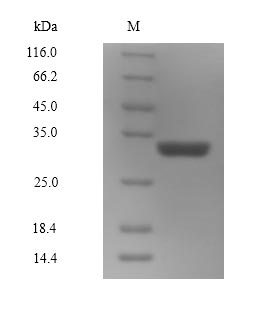
Recombinant Saxiphilin for Lithobates catesbeiana is produced in a mammalian cell expression system, which appears to ensure proper folding and post-translational modifications. This partial protein spans amino acids 484-844 and is tagged with an N-terminal 6xHis-Myc for ease of purification and detection. The product achieves a purity of over 90% as verified by SDS-PAGE, making it suitable for high-precision research applications.
Saxiphilin is a notable protein found in the American bullfrog, Lithobates catesbeiana, known for its role in binding saxitoxin, a potent neurotoxin. This protein plays an instrumental role in studies of toxin interactions and serves as a model for understanding binding mechanisms in toxin-related research. Its ability to bind saxitoxin makes it a key component in exploring toxin resistance and detoxification pathways.
Potential Applications
Note: The applications listed below are based on what we know about this protein's biological functions, published research, and experience from experts in the field. However, we haven't fully tested all of these applications ourselves yet. We'd recommend running some preliminary tests first to make sure they work for your specific research goals.
Saxiphilin is a complex eukaryotic protein that binds saxitoxin with high affinity and requires precise folding for its functional activity. The mammalian cell expression system provides the optimal environment for proper folding, post-translational modifications, and disulfide bond formation. However, this recombinant protein represents only a partial fragment (484-844aa) of the full-length protein, which may lack a complete structural context. While mammalian expression increases the probability of correct folding, the partial nature and presence of the N-terminal 6xHis-Myc tag require experimental validation to confirm functional activity.
1. Protein-Protein Interaction Studies Using Pull-Down Assays
Protein-protein interactions depend on a precise tertiary structure that must be confirmed experimentally.
If Correctly Folded (Verified): Highly suitable for identifying physiological binding partners involved in saxiphilin's biological functions. The mammalian expression ensures native-like interactions.
If Misfolded/Unverified: High risk of non-specific binding or failure to recognize genuine interaction partners. Results would be biologically misleading.
2. Antibody Development and Validation
Antibody development can proceed based on sequence, but conformation-specific antibodies require proper folding.
If Correctly Folded (Verified): Excellent for generating conformation-sensitive antibodies that recognize native saxiphilin epitopes.
If Misfolded/Unverified: Suitable for producing antibodies against linear epitopes, but these may not efficiently recognize the native protein structure.
3. Comparative Protein Structure and Function Analysis
Valid structural and functional comparisons require the protein to be in its native conformation.
If Correctly Folded (Verified): Ideal for meaningful comparative studies with saxiphilin orthologs, providing insights into evolutionary adaptations.
If Misfolded/Unverified: Comparative analyses would yield misleading results, as structural differences would reflect misfolding rather than genuine evolutionary variations.
4. Tag-Based Immunoassay Development
Immunoassays primarily rely on sequence-specific antibody recognition rather than functional conformation.
If Correctly Folded (Verified): Highly suitable as a quantitative standard for detecting native saxiphilin in biological samples.
If Misfolded/Unverified: Can serve as an immunoassay standard for detecting immunoreactive material, but may not accurately measure functional saxiphilin levels.
Final Recommendation & Action Plan
The mammalian expression system provides a high probability of correct folding for this saxiphilin fragment, but the partial nature of the protein requires experimental validation before reliable use in functional studies. The immediate priority is to conduct biochemical and functional characterization to assess folding quality through techniques like size-exclusion chromatography with multi-angle light scattering (SEC-MALS) and functional saxitoxin-binding assays. If correct folding and binding activity are verified, proceed confidently with Applications 1, 2 (conformational antibodies), and 3 for interaction studies, antibody development, and comparative analyses. If misfolding is detected, limit applications to linear epitope antibody production (Application 2) and use as an immunoassay standard (Application 4). For all applications involving functional studies, include appropriate controls and validation steps to ensure data reliability. This systematic approach ensures appropriate use based on experimental validation of protein folding and functional competence.
There are currently no reviews for this product.





