Recombinant Escherichia coli ECF RNA polymerase sigma-E factor (rpoE)

In Stock
Code CSB-EP314854ENV
Abbreviation Recombinant E.coli rpoE protein
MSDS
Size $256
Order now
Image
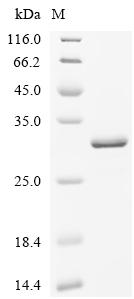
  • (Tris-Glycine gel) Discontinuous SDS-PAGE (reduced) with 5% enrichment gel and 15% separation gel.
Have Questions? Leave a Message or Start an on-line Chat

Product Details

Purity
≥95% as determined by SDS-PAGE.
Activity
Not Test
Target Names
rpoE
Uniprot No.
Research Area
Others
Alternative Names
RNA polymerase sigma-E factor;Sigma-24
Species
Escherichia coli (strain K12)
Source
E.coli
Expression Region
1-191aa
Target Protein Sequence
MSEQLTDQVLVERVQKGDQKAFNLLVVRYQHKVASLVSRYVPSGDVPDVVQEAFIKAYRALDSFRGDSAFYTWLYRIAVNTAKNYLVAQGRRPPSSDVDAIEAENFESGGALKEISNPENLMLSEELRQIVFRTIESLPEDLRMAITLRELDGLSYEEIAAIMDCPVGTVRSRIFRAREAIDNKVQPLIRR
Note: The complete sequence may include tag sequence, target protein sequence, linker sequence and extra sequence that is translated with the protein sequence for the purpose(s) of secretion, stability, solubility, etc.
If the exact amino acid sequence of this recombinant protein is critical to your application, please explicitly request the full and complete sequence of this protein before ordering.
Mol. Weight
28.6 kDa
Protein Length
Full Length
Tag Info
C-terminal 6xHis-tagged
Form
Liquid or Lyophilized powder
Note: We will preferentially ship the format that we have in stock, however, if you have any special requirement for the format, please remark your requirement when placing the order, we will prepare according to your demand.
Buffer
If the delivery form is liquid, the default storage buffer is Tris/PBS-based buffer, 5%-50% glycerol. If the delivery form is lyophilized powder, the buffer before lyophilization is Tris/PBS-based buffer, 6% Trehalose, pH 8.0.
Reconstitution
We recommend that this vial be briefly centrifuged prior to opening to bring the contents to the bottom. Please reconstitute protein in deionized sterile water to a concentration of 0.1-1.0 mg/mL.We recommend to add 5-50% of glycerol (final concentration) and aliquot for long-term storage at -20℃/-80℃. Our default final concentration of glycerol is 50%. Customers could use it as reference.
Troubleshooting and FAQs
Storage Condition
Store at -20°C/-80°C upon receipt, aliquoting is necessary for mutiple use. Avoid repeated freeze-thaw cycles.
Shelf Life
The shelf life is related to many factors, storage state, buffer ingredients, storage temperature and the stability of the protein itself.
Generally, the shelf life of liquid form is 6 months at -20°C/-80°C. The shelf life of lyophilized form is 12 months at -20°C/-80°C.
Lead Time
3-7 business days
Notes
Repeated freezing and thawing is not recommended. Store working aliquots at 4℃ for up to one week.
Datasheet & COA
Please contact us to get it.
Customer Reviews and Q&A

 Customer Reviews

There are currently no reviews for this product.

Submit a Review here

Target Background

Function
Sigma factors are initiation factors that promote the attachment of RNA polymerase (RNAP) to specific initiation sites and are then released. Extracytoplasmic function (ECF) sigma-E controls the envelope stress response, responding to periplasmic protein stress, increased levels of periplasmic lipopolysaccharide (LPS) as well as heat shock and oxidative stress; it controls protein processing in the extracytoplasmic compartment. The 90 member regulon consists of the genes necessary for the synthesis and maintenance of both proteins and LPS of the outer membrane. Indirectly activates transcription of csrB and csrC, 2 sRNAs that antagonize translational regulator CsrA, linking envelope stress, the stringent response and the catabolite repression systems.
Gene References into Functions
  1. Mapping of 5' ends of rpoE mRNA identified five new transcriptional initiation sites (P1 to P5) located distal to Esigma(E)-regulated promoter. PMID: 27629414
  2. These results demonstrate that appropriate regulation of sigma(E) activity, ensuring that it is neither too high nor too low, is critical for envelope integrity and cell viability. PMID: 28373273
  3. This paper describes a unique mutation that enhances kinetics of the rpoE envelope stress response pathway rather than preinducing the response. PMID: 27325680
  4. In particular, Esigma(S) appears to contribute significantly to transcription of genes encoding proteins involved in LPS biosynthesis and in cell surface composition. Finally, our results highlight a direct role of Esigma(S) in the regulation of non coding RNAs PMID: 26020590
  5. RpoE regulates transcription of the defective prophage DLP12 lysis genes through interaction with QDLP12. PMID: 25998262
  6. However, membrane protein damage induced by gentamicin can be eliminated or repaired by RpoE- and Cpx-dependent mechanisms pre-emptively induced in P-starved cells. PMID: 25039943
  7. TraR increases the concentrations of periplasmic chaperones and proteases by directly activating the transcription of sigma(E)-dependent promoters. PMID: 25535270
  8. The sigma(E) response was activated in Deltahfq mutants of all strains tested, resulting from the misregulation ofouter membrane proteins, whereas the Cpx response was activated by loss of hfq in enteropathogenic strains, but not in E. coli K-12. PMID: 24628810
  9. Through employing a labile mutant periplasmic protein, AcrA(L222Q), it was determined that the rpoE3 mutation overcomes the DeltadegP phenotypes, in part, by activating a sigma(E)-dependent proteolytic pathway. PMID: 22439016
  10. Taken together, the results suggest that the cell lysis proceeds in the cascade of sigma(E) --> expression of micA and rybB --> reduction in Omp proteins --> disintegration of the outer membrane. PMID: 22251246
  11. Recognition of beta-strand motifs of sigma(E) by RseB is required for sigma(E) activity. PMID: 21908666
  12. RpoE is required for stress-induced lac amplification. The role of the sigma(E) stress response in mutagenesis is independent of SOS and DinB upregulation, cytoplasmic heat-shock- and RpoS-stress responses. PMID: 20497332
  13. Role in resistance to zinc, cadmium, and copper toxicity. PMID: 15774872
  14. hypotheses:(1)negatively charged N-terminal domain of sigma(70) is bound in polymerase;(2)rate-determining isomerization involves ejecting this domain, unmasking active site; (3)conversion to RP(o) involves coupled folding of downstream clamp of pol. PMID: 16475805
  15. Hfq modulates the sigmaE-mediated envelope stress response and the sigma32-mediated cytoplasmic stress response in Escherichia coli. PMID: 17158661
  16. the PDZ domain and loop L3 of DegS define a novel molecular switch allowing strict regulation of the sigmaE stress response system PMID: 17938245
  17. when sigma(E) is inhibited, cell envelope stress increases and envelope integrity is lost PMID: 18253509

Show More

Hide All

Subcellular Location
Cytoplasm.
Protein Families
Sigma-70 factor family, ECF subfamily
Database Links
icon of phone
Call us
301-363-4651 (Available 9 a.m. to 5 p.m. CST from Monday to Friday)
icon of address
Address
No. 269, Shendun 5th Road, Donghu Hi-Tech Development Area, Hubei Province, 430206, P.R.China
icon of social media
Join us with

Subscribe newsletter

Leave a message

* To protect against spam, please pass the CAPTCHA test below.
CAPTCHA verification
© 2007-2026 CUSABIO TECHNOLOGY LLC All rights reserved. 鄂ICP备15011166号-1
Place an order now

I. Product details

*
*
*
*

II. Contact details

*
*

III. Ship To

*
*
*
*
*
*
*

IV. Bill To

*
*
*
*
*
*
*
*



