Recombinant Escherichia coli Elongation factor G (fusA)

Code CSB-EP009373ENV
Abbreviation Recombinant E.coli fusA protein
MSDS
Size $224
Order now
Image
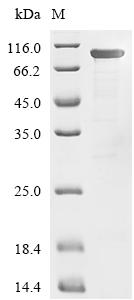
  • (Tris-Glycine gel) Discontinuous SDS-PAGE (reduced) with 5% enrichment gel and 15% separation gel.
Have Questions? Leave a Message or Start an on-line Chat

Product Details

Purity
Greater than 85% as determined by SDS-PAGE.
Target Names
fusA
Uniprot No.
Research Area
Others
Species
Escherichia coli (strain K12)
Source
E.coli
Expression Region
2-704aa
Target Protein Sequence
ARTTPIARYRNIGISAHIDAGKTTTTERILFYTGVNHKIGEVHDGAATMDWMEQEQERGITITSAATTAFWSGMAKQYEPHRINIIDTPGHVDFTIEVERSMRVLDGAVMVYCAVGGVQPQSETVWRQANKYKVPRIAFVNKMDRMGANFLKVVNQIKTRLGANPVPLQLAIGAEEHFTGVVDLVKMKAINWNDADQGVTFEYEDIPADMVELANEWHQNLIESAAEASEELMEKYLGGEELTEAEIKGALRQRVLNNEIILVTCGSAFKNKGVQAMLDAVIDYLPSPVDVPAINGILDDGKDTPAERHASDDEPFSALAFKIATDPFVGNLTFFRVYSGVVNSGDTVLNSVKAARERFGRIVQMHANKREEIKEVRAGDIAAAIGLKDVTTGDTLCDPDAPIILERMEFPEPVISIAVEPKTKADQEKMGLALGRLAKEDPSFRVWTDEESNQTIIAGMGELHLDIIVDRMKREFNVEANVGKPQVAYRETIRQKVTDVEGKHAKQSGGRGQYGHVVIDMYPLEPGSNPKGYEFINDIKGGVIPGEYIPAVDKGIQEQLKAGPLAGYPVVDMGIRLHFGSYHDVDSSELAFKLAASIAFKEGFKKAKPVLLEPIMKVEVETPEENTGDVIGDLSRRRGMLKGQESEVTGVKIHAEVPLSEMFGYATQLRSLTKGRASYTMEFLKYDEAPSNVAQAVIEARGK
Note: The complete sequence may include tag sequence, target protein sequence, linker sequence and extra sequence that is translated with the protein sequence for the purpose(s) of secretion, stability, solubility, etc.
If the exact amino acid sequence of this recombinant protein is critical to your application, please explicitly request the full and complete sequence of this protein before ordering.
Mol. Weight
84.4 kDa
Protein Length
Full Length of Mature Protein
Tag Info
C-terminal 6xHis-tagged
Form
Liquid or Lyophilized powder
Note: We will preferentially ship the format that we have in stock, however, if you have any special requirement for the format, please remark your requirement when placing the order, we will prepare according to your demand.
Buffer
If the delivery form is liquid, the default storage buffer is Tris/PBS-based buffer, 5%-50% glycerol. If the delivery form is lyophilized powder, the buffer before lyophilization is Tris/PBS-based buffer, 6% Trehalose, pH 8.132.
Reconstitution
We recommend that this vial be briefly centrifuged prior to opening to bring the contents to the bottom. Please reconstitute protein in deionized sterile water to a concentration of 0.1-1.0 mg/mL.We recommend to add 5-50% of glycerol (final concentration) and aliquot for long-term storage at -20℃/-80℃. Our default final concentration of glycerol is 50%. Customers could use it as reference.
Troubleshooting and FAQs
Storage Condition
Store at -20°C/-80°C upon receipt, aliquoting is necessary for mutiple use. Avoid repeated freeze-thaw cycles.
Shelf Life
The shelf life is related to many factors, storage state, buffer ingredients, storage temperature and the stability of the protein itself.
Generally, the shelf life of liquid form is 6 months at -20°C/-80°C. The shelf life of lyophilized form is 12 months at -20°C/-80°C.
Lead Time
Basically, we can dispatch the products out in 3-7 working days after receiving your orders. Delivery time may differ from different purchasing way or location, please kindly consult your local distributors for specific delivery time.
Datasheet & COA
Please contact us to get it.
Customer Reviews and Q&A

 Customer Reviews

There are currently no reviews for this product.

Submit a Review here

Target Background

Function
Catalyzes the GTP-dependent ribosomal translocation step during translation elongation. During this step, the ribosome changes from the pre-translocational (PRE) to the post-translocational (POST) state as the newly formed A-site-bound peptidyl-tRNA and P-site-bound deacylated tRNA move to the P and E sites, respectively. Catalyzes the coordinated movement of the two tRNA molecules, the mRNA and conformational changes in the ribosome.
Gene References into Functions
  1. Kinetics of spontaneous and EF-G-accelerated rotation of ribosomal subunits has been presented. PMID: 27524615
  2. These results show that EF-G bound to GTP (EF-G-GTP) continuously samples both rotational states of the ribosome, binding with higher affinity to the rotated state. PMID: 23624862
  3. These structures suggest that EF-G controls the translocation reaction by cycles of conformational rigidity and relaxation before and after GTP hydrolysis. PMID: 23812721
  4. A central interdomain protein joint in elongation factor G regulates antibiotic sensitivity, GTP hydrolysis, and ribosome translocation PMID: 21531717
  5. the structure of the rRNA stabilized by the C-terminal domain of L11 is necessary to stabilize EF-G binding in the post-translocation state, and thiostrepton may modulate this structure in a manner that interferes with the ribosome-EF-G interaction PMID: 15492007
  6. control of Pi release by interactions between EF-G and L7/12 appears to be important for maintaining the conformational coupling between EF-G and the ribosome for translocation and for timing the dissociation of the factor from the ribosome PMID: 16292341
  7. These results imply that during the GTP hydrolytic cycle EF-G must detach from S12 within the central cavity of the ribosome, while EF-G can remain associated with L7/L12 located on one of the peripheral stalks of the ribosome. PMID: 17395204
  8. Binding of elongation factor EF-G in the presence of nonhydrolyzable GTP analog GDPNP stabilizes the 70S ribosome intermediate hybrid state; complete translocation is supported only by EF-G.GTP or EF-G.GDPNP. PMID: 17630323
  9. Single-molecule studies for ribosomes engaged in poly(Phe) synthesis, fluor. res. energy transfer (FRET) between the G' domain of EF-G and the N-terminal domain of protein L11 occurs within two rapidly interconverting states. PMID: 17727272
  10. Collectively, the results support a central role of sw1 in driving the EF-G cycle during protein synthesis. PMID: 19536129

Show More

Hide All

Subcellular Location
Cytoplasm.
Protein Families
TRAFAC class translation factor GTPase superfamily, Classic translation factor GTPase family, EF-G/EF-2 subfamily
Database Links
icon of phone
Call us
301-363-4651 (Available 9 a.m. to 5 p.m. CST from Monday to Friday)
icon of address
Address
7505 Fannin St., Ste 610, Room 7 (CUBIO Innovation Center), Houston, TX 77054, USA
icon of social media
Join us with

Subscribe newsletter

Leave a message

* To protect against spam, please pass the CAPTCHA test below.
CAPTCHA verification
© 2007-2026 CUSABIO TECHNOLOGY LLC All rights reserved. 鄂ICP备15011166号-1
Place an order now

I. Product details

*
*
*
*

II. Contact details

*
*

III. Ship To

*
*
*
*
*
*
*

IV. Bill To

*
*
*
*
*
*
*
*



