Recombinant Human Angiopoietin-related protein 6 (ANGPTL6)

In Stock
Code CSB-EP822824HUc7
Abbreviation Recombinant Human ANGPTL6 protein
MSDS
Size $306
Order now
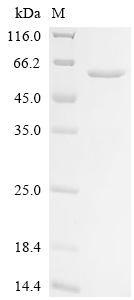
Image
  • (Tris-Glycine gel) Discontinuous SDS-PAGE (reduced) with 5% enrichment gel and 15% separation gel.
Have Questions? Leave a Message or Start an on-line Chat

Product Details

Purity
Greater than 90% as determined by SDS-PAGE.
Activity
Not Test
Target Names
ANGPTL6
Uniprot No.
Research Area
Cardiovascular
Alternative Names
Angiopoietin-like protein 6;Angiopoietin-related growth factor;Angiopoietin-related protein 5
Species
Homo sapiens (Human)
Source
E.coli
Expression Region
21-470aa
Target Protein Sequence
RAGAPRCTYTFVLPPQKFTGAVCWSGPASTRATPEAANASELAALRMRVGRHEELLRELQRLAAADGAVAGEVRALRKESRGLSARLGQLRAQLQHEAGPGAGPGADLGAEPAAALALLGERVLNASAEAQRAAARFHQLDVKFRELAQLVTQQSSLIARLERLCPGGAGGQQQVLPPPPLVPVVPVRLVGSTSDTSRMLDPAPEPQRDQTQRQQEPMASPMPAGHPAVPTKPVGPWQDCAEARQAGHEQSGVYELRVGRHVVSVWCEQQLEGGGWTVIQRRQDGSVNFFTTWQHYKAGFGRPDGEYWLGLEPVYQLTSRGDHELLVLLEDWGGRGARAHYDGFSLEPESDHYRLRLGQYHGDAGDSLSWHNDKPFSTVDRDRDSYSGNCALYQRGGWWYHACAHSNLNGVWHHGGHYRSRYQDGVYWAEFRGGAYSLRKAAMLIRPLKL
Note: The complete sequence may include tag sequence, target protein sequence, linker sequence and extra sequence that is translated with the protein sequence for the purpose(s) of secretion, stability, solubility, etc.
If the exact amino acid sequence of this recombinant protein is critical to your application, please explicitly request the full and complete sequence of this protein before ordering.
Mol. Weight
56.4 kDa
Protein Length
Full Length of Mature Protein
Tag Info
C-terminal 6xHis-tagged
Form
Liquid or Lyophilized powder
Note: We will preferentially ship the format that we have in stock, however, if you have any special requirement for the format, please remark your requirement when placing the order, we will prepare according to your demand.
Buffer
If the delivery form is liquid, the default storage buffer is Tris/PBS-based buffer, 5%-50% glycerol. If the delivery form is lyophilized powder, the buffer before lyophilization is Tris/PBS-based buffer, 6% Trehalose.
Reconstitution
We recommend that this vial be briefly centrifuged prior to opening to bring the contents to the bottom. Please reconstitute protein in deionized sterile water to a concentration of 0.1-1.0 mg/mL.We recommend to add 5-50% of glycerol (final concentration) and aliquot for long-term storage at -20°C/-80°C. Our default final concentration of glycerol is 50%. Customers could use it as reference.
Troubleshooting and FAQs
Storage Condition
Store at -20°C/-80°C upon receipt, aliquoting is necessary for mutiple use. Avoid repeated freeze-thaw cycles.
Shelf Life
The shelf life is related to many factors, storage state, buffer ingredients, storage temperature and the stability of the protein itself.
Generally, the shelf life of liquid form is 6 months at -20°C/-80°C. The shelf life of lyophilized form is 12 months at -20°C/-80°C.
Lead Time
3-7 business days
Notes
Repeated freezing and thawing is not recommended. Store working aliquots at 4°C for up to one week.
Datasheet & COA
Please contact us to get it.
Description

Recombinant Human Angiopoietin-related protein 6 (ANGPTL6) is produced in E. coli and includes the complete sequence of the mature protein spanning amino acids 21 to 470. This recombinant protein carries a C-terminal 6xHis-tag, which makes purification and detection more straightforward. The product shows purity greater than 90%, confirmed through SDS-PAGE analysis. This level of purity appears suitable for demanding research applications.

Angiopoietin-related protein 6 (ANGPTL6) belongs to the angiopoietin-like family, which seems to influence various physiological processes. Research suggests ANGPTL6 may be involved in regulating metabolism and angiogenesis. Scientists studying metabolic pathways and angiogenesis-related processes are likely to find this protein particularly useful for their investigations.

Potential Applications

Note: The applications listed below are based on what we know about this protein's biological functions, published research, and experience from experts in the field. However, we haven't fully tested all of these applications ourselves yet. We'd recommend running some preliminary tests first to make sure they work for your specific research goals.

Based on the provided information, the folding state and bioactivity of this recombinant ANGPTL6 protein are unknown and must be considered highly uncertain. ANGPTL6 is a secreted glycoprotein that typically undergoes complex folding, including the formation of oligomers and specific disulfide bonds essential for its activity. Expression in the reducing cytoplasm of E. coli makes correct disulfide bond formation unlikely, and the absence of eukaryotic glycosylation further diverges from its native post-translational modification pattern. While the protein represents the mature sequence (21-470aa), the C-terminal His-tag could potentially interfere with the structure of the C-terminal fibrinogen-like domain, which is critical for function. Therefore, it is highly improbable that this protein is correctly folded and bioactive. Applications relying on specific biological interactions or activities are speculative without validation.

1. Antibody Development and Validation

This recombinant ANGPTL6 protein is suitable for use as an immunogen to generate antibodies. Antibodies generated will be against the linear epitopes of this non-glycosylated, misfolded protein. Their ability to recognize the correctly folded, glycosylated, and oligomeric native ANGPTL6 in human serum or tissues is very low and must be rigorously tested. The protein is reliable as a positive control for Western blotting (denaturing conditions) but not for detecting the native protein.

2. Biochemical Characterization and Stability Studies

This purified recombinant protein is well-suited for basic biochemical and biophysical characterization. Researchers can determine its oligomerization state, thermal stability, and aggregation behavior under various buffer conditions. This application is valid because it focuses on the intrinsic physical properties of the purified polypeptide, which are independent of its native bioactivity.

3. ELISA-Based Quantitative Assays

The His-tagged ANGPTL6 can be used to develop an ELISA. An ELISA built with this recombinant human ANGPTL6 protein would only detect itself or antibodies raised against it. It would not accurately quantify native ANGPTL6, leading to erroneous results. Its use in ELISA should be restricted to testing antibodies specific to the immunogen.

Final Recommendation & Action Plan

The recommended course of action is to restrict the use of this protein lot to applications that do not depend on native conformation. It can be used for antibody production (Application 1, with the explicit caveat that the antibodies may not recognize the native protein) and for biophysical characterization of the recombinant material itself (Application 2). Protein-protein interaction studies rely on the protein having native-like structure and function, which are not feasible and should be abandoned. The essential first step to enable functional studies is to obtain a version of the protein produced in a mammalian expression system, which can facilitate proper folding, oligomerization, and glycosylation. Before any quantitative or interaction studies are attempted, the activity of any new protein preparation must be validated in a functional assay, such as one measuring its effect on endothelial cell migration or proliferation.

Customer Reviews and Q&A

 Customer Reviews

There are currently no reviews for this product.

Submit a Review here

Target Background

Function
May play a role in the wound healing process. May promote epidermal proliferation, remodeling and regeneration. May promote the chemotactic activity of endothelial cells and induce neovascularization. May counteract high-fat diet-induced obesity and related insulin resistance through increased energy expenditure.
Gene References into Functions
  1. rare coding variants in ANGPTL6 are causally related to familial forms of Intracranial aneurysms. PMID: 29304371
  2. Poor glycemic control in diabetes mellitus as reflected by higher serum HbA1c levels is associated with raised serum ANGPTL6 levels PMID: 29033485
  3. ANGPTL6, S100A8 and S100A9 are overexpressed in skin of psoriasis patients versus zero expression in controls. PMID: 27698489
  4. Data suggest that serum AGF levels are up-regulated in type 2 diabetic patients with lower extremity peripheral arterial disease according to disease severity; patients with highest serum AGF levels exhibit increased cardiovascular mortality and all-cause mortality. PMID: 27866700
  5. Serum ANGPTL6 levels increased in patients with a hypothyroid status, and both TSH and free T4 levels are associated with ANGPLT6 levels, suggesting a possible association between thyroid function and ANGPTL6 levels. PMID: 26189599
  6. AGF concentrations is significantly higher in patients with type 2 diabetes as compared to controls. PMID: 25011017
  7. In the second trimester, Angptl6 levels are higher in women with subsequent pregnancy-induced hypertension. PMID: 23905605
  8. There are no significant differences in maternal Angptl6/ARP5 serum level between pre-eclamptic women and normally pregnant control women PMID: 23718665
  9. Serum AGF levels are significantly higher in subjects with polycystic ovary syndrome than those in the healthy control group. PMID: 22406517
  10. Interaction between alpha6 integrin and E-cadherin drives liver metastasis of colorectal cancer cells through hepatic angiopoietin-like 6. PMID: 23070965
  11. ANGPTL6 affects resting metabolic rate (RMR), significantly improves lipid profile and slightly improves insulin levels and insulin sensitivity, as well. PMID: 21460784
  12. serum AGF levels were paradoxically increased in metabolic syndrome, in comparison with data from animal experiments and data on sex, age, and waist circumference PMID: 20673930
  13. findings suggest that AGF affects epidermal proliferation and thereby plays a role in the wound healing process PMID: 12871997
  14. showed that AGF is a secreted protein, AGF directly promotes chemotactic activity of vascular endothelial cells, and AGF directly induces a permeability change in the local vasculature. PMID: 14764539
  15. Our results strongly suggest that AGF is an integrin ligand as well as a mitogenic growth factor and theoretically participates in cutaneous wound healing in a more complex mechanism. PMID: 16806062
  16. study of associations between ANGPTL6 polymorphisms and metabolic syndrome or related phenotypes in a French population PMID: 19447061

Show More

Hide All

Subcellular Location
Secreted.
Database Links

HGNC: 23140

OMIM: 609336

KEGG: hsa:83854

STRING: 9606.ENSP00000253109

UniGene: Hs.712850

icon of phone
Call us
301-363-4651 (Available 9 a.m. to 5 p.m. CST from Monday to Friday)

icon of address
Address
7505 Fannin St., Ste 610, Room 7 (CUBIO Innovation Center), Houston, TX 77054, USA
icon of social media
Join us with

Subscribe newsletter

Leave a message

* To protect against spam, please pass the CAPTCHA test below.
CAPTCHA verification
© 2007-2025 CUSABIO TECHNOLOGY LLC All rights reserved. 鄂ICP备15011166号-1
×
Place an order now

I. Product details

*
*
*
*

II. Contact details

*
*

III. Ship To

*
*
*
*
*
*
*

IV. Bill To

*
*
*
*
*
*
*
*


