
Call us
301-363-4651 (Available 9 a.m. to 5 p.m. CST from Monday to Friday)

| Code | CSB-EP351212HU |
| Abbreviation | Recombinant Human HERVK_113 protein |
| MSDS | |
| Size | $306 |
| Order now | |
| Image |
|
| Have Questions? | Leave a Message or Start an on-line Chat |
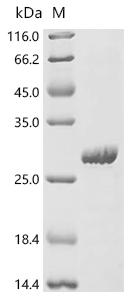
Recombinant Human Endogenous retrovirus group K member 113 Pro protein (HERVK_113) is produced in an E. coli expression system, covering the protein's complete 1-156 amino acid sequence. The protein carries a C-terminal 6xHis tag, which makes purification and detection more straightforward. SDS-PAGE analysis confirms that purity levels exceed 95%. This protein is strictly for research purposes.
HERVK_113 appears to be linked with human endogenous retrovirus group K. These retroviral elements likely represent traces of ancient infections that became integrated into our genome over evolutionary time. Studying HERVK_113 may be important for understanding how retroviruses evolved and what roles they might play in human biology and disease. Scientists often examine these proteins to see how they might influence gene expression or affect human health, though the connections aren't always clear.
Potential Applications
Note: The applications listed below are based on what we know about this protein's biological functions, published research, and experience from experts in the field. However, we haven't fully tested all of these applications ourselves yet. We'd recommend running some preliminary tests first to make sure they work for your specific research goals.
Based on the provided information, the recombinant human Endogenous Retrovirus Group K Member 113 Pro protein is expressed in E. coli, a prokaryotic system that is generally unsuitable for producing functional eukaryotic viral proteins. This retroviral protein likely requires specific folding, post-translational modifications, and potentially protease activity for its biological function. While the protein is full-length (1-156aa) with a C-terminal 6xHis tag and high purity (>95%), E. coli lacks the eukaryotic chaperones and modification machinery necessary for proper folding of complex viral proteins. The C-terminal His-tag may interfere with the native protein structure. Since activity is unverified, the protein cannot be assumed to be correctly folded or bioactive without experimental validation.
1. Antibody Development and Validation Studies
The recombinant protein can serve as an effective immunogen for generating antibodies that recognize linear epitopes, even if the protein is misfolded. The high purity and C-terminal His-tag facilitate purification and screening. However, antibodies may not recognize conformational or modification-dependent epitopes of native, properly folded retroviral protein in human cells.
2. Protein-Protein Interaction Studies
This application is high-risk without folding validation. While the His-tag enables technical feasibility for pull-down assays, if the protein is misfolded (as likely in E. coli), it will not interact physiologically with true cellular binding partners. Identified interactions could be non-physiological artifacts. This application should not be pursued without confirmation of proper folding.
3. Biochemical Characterization and Stability Studies
This application is well-suited for assessing the recombinant human Endogenous Retrovirus Group K Member 113 Pro protein itself. Techniques like circular dichroism spectroscopy, size-exclusion chromatography, and thermal shift assays can evaluate the protein's folding state and stability. These studies are valuable even if the protein is inactive, as they characterize the recombinant product.
4. His-Tag-Based Affinity Purification Method Development
This application is appropriate for technical optimization. The protein can be used to develop and refine purification protocols for His-tagged proteins. However, methods developed using this potentially misfolded protein may not directly apply to properly folded viral proteins.
Final Recommendation & Action Plan
Given the high probability of misfolding in E. coli for this complex retroviral protein, recommend first performing comprehensive biophysical characterization to assess folding quality. This should include circular dichroism spectroscopy for secondary structure analysis and size-exclusion chromatography with multi-angle light scattering for oligomeric state assessment. Antibody development can proceed immediately as the safest application. Avoid all functional studies (interactions) until proper folding is validated. For reliable retroviral protein studies, obtain the protein from mammalian expression systems capable of proper folding and post-translational modifications. Always include appropriate controls and validate findings with native protein when possible.

Applications : Binding assay/Protein-protein interaction
Review: The recombinant human ERVK-113 pro protein (Lot DA06295k1g0) was tested as an antigen for antibody detection. The protein reconstituted cleanly, showed good solubility, and coupled efficiently to Luminex beads. It enabled consistent recognition by human sera, with strong reproducibility across technical replicates and minimal nonspecific activity.
By Mehak





