Recombinant Mouse Leucine zipper putative tumor suppressor 1 (Lzts1)

In Stock
Code CSB-EP013291MO
Abbreviation Recombinant Mouse Lzts1 protein
MSDS
Size $306
Order now
Image
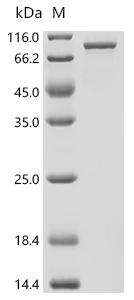
  • (Tris-Glycine gel) Discontinuous SDS-PAGE (reduced) with 5% enrichment gel and 15% separation gel.
Have Questions? Leave a Message or Start an on-line Chat

Product Details

Purity
Greater than 85% as determined by SDS-PAGE.
Activity
Not Test
Target Names
Lzts1
Uniprot No.
Research Area
Cancer
Species
Mus musculus (Mouse)
Source
E.coli
Expression Region
2-599aa
Target Protein Sequence
GSVSSLISGHSFHSKHCRASQYKLRKSSHLKKLNRYSDGLLRFGFSQDSGRGKSSSKMGKSEDFFYIKVSQKARGSHRPDYTALSSGDIGGQTGVDFDPATPPKLMPFSNQLEMSSDKGAVRPTAFKPVLPRSGAILHSSPESTSHQLHPMPPDKPKEQELKPGLCSGALSDSGRNSMSSLPTHSTTSSYQLDPLVTPVGPTSRFGGSAHNITQGIILQDSNMMSLKALSFSDGGSKLAHPGKADKGASCVRSPLSTDECTIQELEQKLLQRETALQKLQRSFDEKEFASGQTFEERPRRTRDELECLEPKSKLKPPSQKSQRTQQVLQLQVLQLQQEKRQLRQELESLMKEQDLLETKLRSYEREKTNFAPALEETQWEVCQKSGEISLLKQQLKESQLEVNTKASEILSLKAQLKDTRGKLDGMELKTQDLESALRTKGLELEVCENELQRKKNEAELLREKVNLLEQELMELRAQAALHPAPLGPPGVGLTFSEDIPALQRELDRLRAELKEERQGHDQMSSGFQHERLVWKEEKEKVIQYQRQLQQSYLAMYQRNQRLEKALQQLARGDGPGEPFEIDLEGADIPYEDIIATEI
Note: The complete sequence may include tag sequence, target protein sequence, linker sequence and extra sequence that is translated with the protein sequence for the purpose(s) of secretion, stability, solubility, etc.
If the exact amino acid sequence of this recombinant protein is critical to your application, please explicitly request the full and complete sequence of this protein before ordering.
Mol. Weight
74.1 kDa
Protein Length
Full Length of Mature Protein
Tag Info
C-terminal 6xHis-tagged
Form
Liquid or Lyophilized powder
Note: We will preferentially ship the format that we have in stock, however, if you have any special requirement for the format, please remark your requirement when placing the order, we will prepare according to your demand.
Buffer
If the delivery form is liquid, the default storage buffer is Tris/PBS-based buffer, 5%-50% glycerol. If the delivery form is lyophilized powder, the buffer before lyophilization is Tris/PBS-based buffer, 6% Trehalose, pH 8.0.
Reconstitution
We recommend that this vial be briefly centrifuged prior to opening to bring the contents to the bottom. Please reconstitute protein in deionized sterile water to a concentration of 0.1-1.0 mg/mL.We recommend to add 5-50% of glycerol (final concentration) and aliquot for long-term storage at -20°C/-80°C. Our default final concentration of glycerol is 50%. Customers could use it as reference.
Troubleshooting and FAQs
Storage Condition
Store at -20°C/-80°C upon receipt, aliquoting is necessary for mutiple use. Avoid repeated freeze-thaw cycles.
Shelf Life
The shelf life is related to many factors, storage state, buffer ingredients, storage temperature and the stability of the protein itself.
Generally, the shelf life of liquid form is 6 months at -20°C/-80°C. The shelf life of lyophilized form is 12 months at -20°C/-80°C.
Lead Time
3-7 business days
Notes
Repeated freezing and thawing is not recommended. Store working aliquots at 4°C for up to one week.
Datasheet & COA
Please contact us to get it.
Description

This recombinant Mouse Leucine zipper putative tumor suppressor 1 (Lzts1) protein is produced using an E. coli expression system and includes the full mature protein from amino acids 2 to 599. The protein comes tagged with a C-terminal 6xHis, which makes purification and detection more straightforward. It is provided with a purity level exceeding 85%, confirmed by SDS-PAGE analysis, which should give reliable results for research use.

Leucine zipper putative tumor suppressor 1 (Lzts1) appears to be a protein involved in cell cycle regulation and is considered a potential tumor suppressor. It seems to play a crucial role in maintaining genomic stability and has become a subject of interest in cancer research due to its implications in cell proliferation and apoptosis pathways. Understanding what Lzts1 actually does may be essential for gaining insights into tumorigenesis and developing therapeutic strategies.

Potential Applications

Note: The applications listed below are based on what we know about this protein's biological functions, published research, and experience from experts in the field. However, we haven't fully tested all of these applications ourselves yet. We'd recommend running some preliminary tests first to make sure they work for your specific research goals.

Based on the provided information, the recombinant mouse Lzts1 is expressed in E. coli, a prokaryotic system that may not support proper folding of this eukaryotic tumor suppressor protein. Lzts1 contains functional domains, including leucine zipper motifs that require specific folding and potentially post-translational modifications for activity. While the protein is full-length mature (2-599aa) with a  C-terminal 6xHis tag and >85% purity, the E. coli expression system lacks eukaryotic chaperones and modification machinery. Since activity is unverified, the protein cannot be assumed to be correctly folded or bioactive without experimental validation.

1. Protein-Protein Interaction Studies Using His-Tag Pull-Down Assays

The C-terminal 6xHis tag enables technical feasibility for pull-down assays, but if Lzts1 is misfolded, the leucine zipper domain may not interact properly with biological partners. Identified interactions could be non-physiological. This application requires prior validation of proper folding and leucine zipper functionality to ensure biologically relevant results.

2. Antibody Development and Validation

This application is appropriate. The recombinant Lzts1 can serve as an effective immunogen for antibody generation. The full-length sequence provides comprehensive epitope coverage, and the His-tag facilitates purification and detection. Even if misfolded, antibodies may recognize linear epitopes useful for detection assays.

3. Biochemical Characterization and Stability Studies

This application is well-suited and should be prioritized. Techniques like circular dichroism spectroscopy and size-exclusion chromatography can directly assess protein folding and oligomerization state. These studies are valuable for characterizing the recombinant Lzts1 protein regardless of bioactivity status.

4. In Vitro Functional Assays for Leucine Zipper Domain Analysis

This application is high-risk without activity verification. If Lzts1 is misfolded, dimerization assays and functional studies will yield misleading results. The leucine zipper domain requires precise conformation for proper function. This application should only be pursued after confirming native folding.

Final Recommendation & Action Plan

Given the uncertainty in folding and bioactivity, recommend first performing biophysical characterization (circular dichroism for secondary structure, analytical ultracentrifugation for oligomeric state) to assess protein folding. Antibody development can proceed immediately, while interaction and functional studies should await folding validation. Always include proper controls and validate key findings with native Lzts1 when possible.

Customer Reviews and Q&A

 Customer Reviews

There are currently no reviews for this product.

Submit a Review here

Target Background

Function
Involved in the regulation of cell growth. May stabilize the active CDC2-cyclin B1 complex and thereby contribute to the regulation of the cell cycle and the prevention of uncontrolled cell proliferation. May act as tumor suppressor.
Gene References into Functions
  1. The results of this study provide a novel Rap2-specific regulatory mechanism in synaptic maturation involving PSD-Zip70. PMID: 26490870
  2. Taken together, the spatial and temporal distribution of Lzts1 is consistent with a potential function(s) in cell cycle regulation, axon growth or guidance, and/or migration of neurons. PMID: 22419569
  3. Lzts1 deficiency was associated with an increased incidence of both spontaneous and carcinogen-induced cancers in mice. PMID: 17349584
  4. Partial or complete loss of Lzts1 downregulates Cdc25C and inhibits Cdk1 activity during mitosis, leading to premature transition from metaphase to anaphase. PMID: 17419986
  5. Loss of one or both LZTS1 alleles hampers the normal defenses of urothelial cells against carcinogens, favoring bladder cancer development, which may make FEZ1 a target for gene therapy. PMID: 18192690

Show More

Hide All

Subcellular Location
Cytoplasm. Cell membrane. Cell projection, dendritic spine. Cell junction, synapse, postsynaptic density. Cell junction, synapse.
Protein Families
LZTS family
Database Links
icon of phone
Call us
301-363-4651 (Available 9 a.m. to 5 p.m. CST from Monday to Friday)

icon of address
Address
7505 Fannin St., Ste 610, Room 7 (CUBIO Innovation Center), Houston, TX 77054, USA
icon of social media
Join us with

Subscribe newsletter

Leave a message

* To protect against spam, please pass the CAPTCHA test below.
CAPTCHA verification
© 2007-2026 CUSABIO TECHNOLOGY LLC All rights reserved. 鄂ICP备15011166号-1
Place an order now

I. Product details

*
*
*
*

II. Contact details

*
*

III. Ship To

*
*
*
*
*
*
*

IV. Bill To

*
*
*
*
*
*
*
*


