Recombinant Mouse Sprouty-related, EVH1 domain-containing protein 1 (Spred1)

In Stock
Code CSB-EP835669MO
Abbreviation Recombinant Mouse Spred1 protein
MSDS
Size $224
Order now
Image
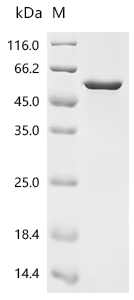
  • (Tris-Glycine gel) Discontinuous SDS-PAGE (reduced) with 5% enrichment gel and 15% separation gel.
Have Questions? Leave a Message or Start an on-line Chat

Product Details

Purity
Greater than 85% as determined by SDS-PAGE.
Activity
Not Test
Target Names
Spred1
Uniprot No.
Research Area
Signal Transduction
Alternative Names
Spred-1
Species
Mus musculus (Mouse)
Source
E.coli
Expression Region
2-444aa
Target Protein Sequence
SEETATSDNDNSYARVRAVVMTRDDSSGGWLPLGGSGLSSVTVFRVPHQEENGCADFFIRGERLRDKMVVLECMLKKDLIYNKVTPTFHHWKIDDKKFGLTFQSPADARAFDRGIRRAIEDISLGCPASKTEAEGGDDDLQTTEEDTSRSLVKDHFFQQETVVTSEPYRSSDIRPLPFEDLNARRVYLQSQVSQIPFSQQGLDIQSRSMEYVQRQISKECGSLKSQTRVPLKSIRHVSFQDEDEIVRINPRDILIRRYADYRHPDMWKNDLERDDTDSSVPFSKQDSKKSDYLYHCGDETKLSSLKDSVVFKTQPPSLKFKSKRRKEDGERSRCVYCQERFNHEENARGKCQDAPDPVKRCIYQVSCMLCAESMLYHCMSDSEGDFSDPCSCDTSDDKFCLRWLALVALSFIVPCMCCYVPLRMCHRCGEACGCCGGKHKAAG
Note: The complete sequence may include tag sequence, target protein sequence, linker sequence and extra sequence that is translated with the protein sequence for the purpose(s) of secretion, stability, solubility, etc.
If the exact amino acid sequence of this recombinant protein is critical to your application, please explicitly request the full and complete sequence of this protein before ordering.
Mol. Weight
55.6 kDa
Protein Length
Full Length of Mature Protein
Tag Info
N-terminal 10xHis-tagged and C-terminal Myc-tagged
Form
Liquid or Lyophilized powder
Note: We will preferentially ship the format that we have in stock, however, if you have any special requirement for the format, please remark your requirement when placing the order, we will prepare according to your demand.
Buffer
If the delivery form is liquid, the default storage buffer is Tris/PBS-based buffer, 5%-50% glycerol. If the delivery form is lyophilized powder, the buffer before lyophilization is Tris/PBS-based buffer, 6% Trehalose, pH 8.0.
Reconstitution
We recommend that this vial be briefly centrifuged prior to opening to bring the contents to the bottom. Please reconstitute protein in deionized sterile water to a concentration of 0.1-1.0 mg/mL.We recommend to add 5-50% of glycerol (final concentration) and aliquot for long-term storage at -20°C/-80°C. Our default final concentration of glycerol is 50%. Customers could use it as reference.
Troubleshooting and FAQs
Storage Condition
Store at -20°C/-80°C upon receipt, aliquoting is necessary for mutiple use. Avoid repeated freeze-thaw cycles.
Shelf Life
The shelf life is related to many factors, storage state, buffer ingredients, storage temperature and the stability of the protein itself.
Generally, the shelf life of liquid form is 6 months at -20°C/-80°C. The shelf life of lyophilized form is 12 months at -20°C/-80°C.
Lead Time
3-7 business days
Notes
Repeated freezing and thawing is not recommended. Store working aliquots at 4°C for up to one week.
Datasheet & COA
Please contact us to get it.
Customer Reviews and Q&A

 Customer Reviews

There are currently no reviews for this product.

Submit a Review here

Target Background

Function
Tyrosine kinase substrate that inhibits growth-factor-mediated activation of MAP kinase. Negatively regulates hematopoiesis of bone marrow. Inhibits fibroblast growth factor (FGF)-induced retinal lens fiber differentiation, probably by inhibiting FGF-mediated phosphorylation of ERK1/2. Attenuates actin stress fiber formation via inhibition of TESK1-mediated phosphorylation of cofilin. Inhibits TGFB-induced epithelial-to-mesenchymal transition in lens epithelial cells.
Gene References into Functions
  1. Cosuppression of Sprouty and Sprouty-related negative regulators of FGF signalling in prostate cancer PMID: 26075267
  2. SPREDs promote self-renewal and inhibit mesodermal differentiation of murine ES cells by selective suppression of the ERK/MAPK signaling pathway in pluripotent cells PMID: 25690936
  3. The data suggest that Spred1 negatively regulates group 2 innate lymphoid cell development and functions through the suppression of the Ras-ERK pathway. PMID: 26116510
  4. Microrna-126 was transported into recipient human coronary artery endothelial cells by endothelial microparticles and functionally regulated the target protein sprouty-related, EVH1 domain-containing protein 1 (SPRED1). PMID: 24014835
  5. show that neurofibromin, the NF1 gene product, is a Spred1-interacting protein that is necessary for Spred1's inhibitory function PMID: 22751498
  6. The results suggest that Spred1 negatively regulates mast cell activation, which is modulated by miR126. PMID: 21668589
  7. SPRED1 is a likely substrate of SHP2, whose tyrosine dephosphorylation is required to attenuate the inhibitory action of SPRED1 in the Ras/ERK pathway. PMID: 21531714
  8. Data show that both SPRED1 and SPRED2 inhibit the ability of DYRK1A to phosphorylate its substrates. PMID: 20736167
  9. These data suggest that Spreds are key regulators of RhoA-mediated cell motility and signal transduction. Furthermore, our study suggests that the induction of Spreds could be a novel strategy for preventing cancer cell metastasis. PMID: 15184877
  10. role in hematopoiesis PMID: 15465815
  11. Spred-1 and Spred-2 were found to be expressed predominantly in brain PMID: 15580519
  12. Spred-1 negatively regulates allergen-induced airway eosinophilia and hyperresponsiveness by modulating IL-5 signaling in allergic asthma, without affecting helper T cell differentiation PMID: 15630138
  13. We show here that Spred-1 and Spred-2 appear to have distinct mechanisms whereby they induce their effects, as the Sprouty domain of Spred-1 is not required to block MAPK (mitogen-activated protein kinase) activation, while that of Spred-2 is required. PMID: 15683364
  14. These data suggest that Spred-1 inhibits ERK activation in collaboration with Cav-1 PMID: 16115197
  15. Spred1 is essential for embryonic lymphangiogenesis by regulating VEGFR3 signaling. PMID: 17438136
  16. Spred1 is required for synaptic plasticity and hippocampus-dependent learning. PMID: 19118178
  17. TGF-beta mediates an inhibitory mechanism on CD8+ TILs involving TCR-signaling blockade and the upregulation of Spred-1. PMID: 19319531
  18. Spred1 is critical for normal cortical development, as it modulates progenitor self-renewal/proliferation and helps maintain the integrity and organization of germinal zones PMID: 20047999

Show More

Hide All

Subcellular Location
Cell membrane; Peripheral membrane protein. Membrane, caveola; Peripheral membrane protein. Nucleus.
Tissue Specificity
Expressed in brain. Weakly expressed in lung, heart, liver, kidney, intestine, spleen, testis, thymus, colon and ovary. Also expressed in embryonic tissues such as heart, lung, liver and brain. Highly expressed in IL3-dependent hematopoietic cell lines (B
Database Links
icon of phone
Call us
301-363-4651 (Available 9 a.m. to 5 p.m. CST from Monday to Friday)
icon of address
Address
7505 Fannin St., Ste 610, Room 7 (CUBIO Innovation Center), Houston, TX 77054, USA
icon of social media
Join us with

Subscribe newsletter

Leave a message

* To protect against spam, please pass the CAPTCHA test below.
CAPTCHA verification
© 2007-2026 CUSABIO TECHNOLOGY LLC All rights reserved. 鄂ICP备15011166号-1
Place an order now

I. Product details

*
*
*
*

II. Contact details

*
*

III. Ship To

*
*
*
*
*
*
*

IV. Bill To

*
*
*
*
*
*
*
*



