
Call us
301-363-4651 (Available 9 a.m. to 5 p.m. CST from Monday to Friday)

| Code | CSB-EP025648PI |
| Abbreviation | Recombinant Pig UOX protein |
| MSDS | |
| Size | US$388 |
| Order now | |
| Image |
|
| Have Questions? | Leave a Message or Start an on-line Chat |
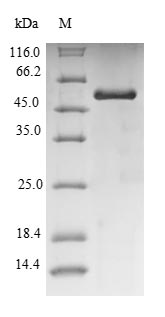
Recombinant Pig Uricase (UOX) is expressed in E. coli and consists of the full-length protein spanning amino acids 1 to 304. The protein features an N-terminal 6xHis-SUMO tag, which appears to improve both solubility and purification efficiency. SDS-PAGE analysis confirms a purity level greater than 90%. This protein is designed strictly for research use, maintaining what seems to be solid quality standards for experimental work.
Uricase, or urate oxidase as it's sometimes called, plays a critical role in oxidizing uric acid to allantoin—a key step in purine metabolism. Researchers often find this enzyme valuable when studying uric acid metabolism and related disorders. The conversion of uric acid to a more soluble form may be essential for understanding degradation pathways and potential therapeutic approaches.
Potential Applications
Note: The applications listed below are based on what we know about this protein's biological functions, published research, and experience from experts in the field. However, we haven't fully tested all of these applications ourselves yet. We'd recommend running some preliminary tests first to make sure they work for your specific research goals.
Based on the provided information, the recombinant pig uricase is expressed in E. coli, a prokaryotic system that is generally suitable for producing soluble enzymatic proteins like uricase. Uricase is a relatively well-behaved enzyme that typically forms a homotetramer and does not require complex post-translational modifications for activity. The presence of an N-terminal 6xHis-SUMO tag may enhance solubility and proper folding, with the SUMO tag particularly known to improve folding efficiency. The protein is full-length (1-304aa) with high purity (>90%), which are positive indicators. However, since enzymatic activity is unverified, the protein cannot be assumed to be correctly folded or bioactive without experimental validation of its uricase activity. The tetramerization capability, which is essential for function, also requires confirmation.
1. Protein-Protein Interaction Studies Using His-Tag Affinity Purification
The N-terminal 6xHis-SUMO tag enables technical feasibility for pull-down assays. However, if the uricase is improperly folded or fails to tetramerize correctly, identified interactions may not be physiologically relevant. This application should be pursued only after confirming proper folding and tetramerization through biochemical characterization.
2. Comparative Biochemical Analysis Across Species
This application is appropriate for structural and biophysical comparisons. The full-length uricase allows for meaningful comparison of stability, thermal denaturation, and other physical properties across species. However, functional comparisons (e.g., specific activity) require prior validation of this uricase's enzymatic activity.
3. Antibody Development and Validation
This application is well-suited as the primary use case. The high purity and full-length sequence make it an excellent immunogen for antibody production. Even if misfolded, antibodies may recognize linear epitopes. Validation against native pig uricase is still recommended.
4. Protein Expression and Purification Protocol Optimization
This application is appropriate. The recombinant uricase can serve as a model for optimizing expression and purification conditions for uricase proteins. The high-purity baseline provides a good starting point for method development.
Final Recommendation & Action Plan
Given the relatively high likelihood of proper folding for this soluble enzyme in E. coli, recommend first conducting functional validation through a uricase activity assay using uric acid as substrate. Simultaneously, perform biophysical characterization (size-exclusion chromatography with multi-angle light scattering) to confirm proper tetramer formation. If activity and quaternary structure are validated, the protein becomes suitable for all described applications. If not, focus on antibody development and biochemical characterization studies. For interaction studies, always include appropriate controls to distinguish specific from non-specific binding.
There are currently no reviews for this product.
Does any of the components contain the following three? If yes, provide concentration.
1. Sodium azide
2. Thimerosal
3. 2-mercaptoethanol
If it is lyophilized, provide the concentration after the lyophilization.
For CSB-EP025648PI, we do not use the following components during our manufacturing process.
1. Sodium azide
2. Thimerosal
3. 2-mercaptoethanol
It concentration before freeze-drying is 1mg/ml, and customers can reconstitute it with sterile water to the required concentration.