Recombinant Rat Sodium channel protein type 11 subunit alpha (Scn11a), partial

Code CSB-EP020833RA
Abbreviation Recombinant Rat Scn11a protein, partial
MSDS
Size $306
Order now
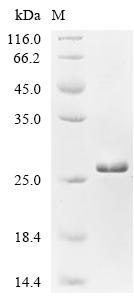
Image
  • (Tris-Glycine gel) Discontinuous SDS-PAGE (reduced) with 5% enrichment gel and 15% separation gel.
Have Questions? Leave a Message or Start an on-line Chat

Product Details

Purity
Greater than 85% as determined by SDS-PAGE.
Activity
Not Test
Target Names
Uniprot No.
Research Area
Neuroscience
Alternative Names
NaN;Sensory neuron sodium channel 2;Sodium channel protein type XI subunit alpha;Voltage-gated sodium channel subunit alpha Nav1.9
Species
Rattus norvegicus (Rat)
Source
E.coli
Expression Region
1-126aa
Target Protein Sequence
MEERYYPVIFPDERNFRPFTSDSLAAIEKRIAIQKERKKSKDKAAAEPQPRPQLDLKASRKLPKLYGDIPPELVAKPLEDLDPFYKDHKTFMVLNKKRTIYRFSAKRALFILGPFNPLRSLMIRIS
Note: The complete sequence may include tag sequence, target protein sequence, linker sequence and extra sequence that is translated with the protein sequence for the purpose(s) of secretion, stability, solubility, etc.
If the exact amino acid sequence of this recombinant protein is critical to your application, please explicitly request the full and complete sequence of this protein before ordering.
Mol. Weight
21.7 kDa
Protein Length
Partial
Tag Info
C-terminal 6xHis-tagged
Form
Liquid or Lyophilized powder
Note: We will preferentially ship the format that we have in stock, however, if you have any special requirement for the format, please remark your requirement when placing the order, we will prepare according to your demand.
Buffer
If the delivery form is liquid, the default storage buffer is Tris/PBS-based buffer, 5%-50% glycerol. If the delivery form is lyophilized powder, the buffer before lyophilization is Tris/PBS-based buffer, 6% Trehalose, pH 8.0.
Reconstitution
We recommend that this vial be briefly centrifuged prior to opening to bring the contents to the bottom. Please reconstitute protein in deionized sterile water to a concentration of 0.1-1.0 mg/mL.We recommend to add 5-50% of glycerol (final concentration) and aliquot for long-term storage at -20°C/-80°C. Our default final concentration of glycerol is 50%. Customers could use it as reference.
Troubleshooting and FAQs
Storage Condition
Store at -20°C/-80°C upon receipt, aliquoting is necessary for mutiple use. Avoid repeated freeze-thaw cycles.
Shelf Life
The shelf life is related to many factors, storage state, buffer ingredients, storage temperature and the stability of the protein itself.
Generally, the shelf life of liquid form is 6 months at -20°C/-80°C. The shelf life of lyophilized form is 12 months at -20°C/-80°C.
Lead Time
Basically, we can dispatch the products out in 3-7 working days after receiving your orders. Delivery time may differ from different purchasing way or location, please kindly consult your local distributors for specific delivery time.
Datasheet & COA
Please contact us to get it.
Customer Reviews and Q&A

 Customer Reviews

There are currently no reviews for this product.

Submit a Review here

Target Background

Function
This protein mediates the voltage-dependent sodium ion permeability of excitable membranes. Assuming opened or closed conformations in response to the voltage difference across the membrane, the protein forms a sodium-selective channel through which sodium ions may pass in accordance with their electrochemical gradient. It is a tetrodotoxin-resistant sodium channel isoform. Also involved, with the contribution of the receptor tyrosine kinase NTRK2, in rapid BDNF-evoked neuronal depolarization.
Gene References into Functions
  1. The mRNA expression of the SCN11a gene (which encodes the Nav1.9 channel) in mPFC tissue was significantly higher in young rats than in late adolescent and adult rats. PMID: 28913981
  2. We conclude that Nav1.9 acts as a subthreshold amplifier in cold-sensitive nociceptive neurons and is required for the perception of cold pain under normal and pathological conditions. PMID: 25959819
  3. verapamil and lidocaine significantly reduce the degree of ischemia-reperfusion injury due to effects to TRPM and Nav1.9 genes PMID: 24507022
  4. The effects of insecticides and pyridostimine bromide on the exprssion of Nav1.9 in muscle and vascular nociceptors is reported. PMID: 24732443
  5. These results suggest that Nav1.9 may contribute to the firing pattern of MSC of the SON, and that careful assessment of hypothalamic function be performed as NaV1.9 blocking agents are studied as potential pain therapies. PMID: 24424281
  6. Upregulation of NaV1.9 in small-sized dorsal root ganglion neurons contributes to melittin-induced heat hypersensitivity. PMID: 23264124
  7. The up-regulation of mRNA and protein levels of Nav1.9 suggested it's potential involvement in the development and maintenance of bone cancer pain. PMID: 22342308
  8. The pattern of expression of the voltage-gated sodium channels Na(v)1.8 and Na(v)1.9 does not change in uninjured primary sensory neurons in experimental neuropathic pain models. PMID: 11972999
  9. Examination of lamotrigine block of mutant sodium channel alpha subunits, in which alanine had been substituted for each individual amino acid in IVS6, identified mutations I1760A, F1764A and Y1771A as causing the largest reductions in affinity. PMID: 12604088
  10. strongly IB4+ DRG neurons are exclusively C-nociceptor type and that high Nav1.9 expression may contribute to their distinct membrane properties PMID: 16822986
  11. potential role of Nav1.9 in the transmission of trigeminal pain and the regulation of intestinal reflexes PMID: 17363266
  12. Na(V)1.9 plays a role in the maintenance of chronic inflammatory pain several weeks after the initial insult PMID: 17950013

Show More

Hide All

Subcellular Location
Cell membrane; Multi-pass membrane protein.
Protein Families
Sodium channel (TC 1.A.1.10) family, Nav1.9/SCN11A subfamily
Tissue Specificity
Expressed (at protein level) in myenteric sensory neurons. Expressed in small sensory neurons of the dorsal root ganglia (C-fiber neurons) and trigeminal ganglia.
Database Links
icon of phone
Call us
301-363-4651 (Available 9 a.m. to 5 p.m. CST from Monday to Friday)
icon of address
Address
7505 Fannin St., Ste 610, Room 7 (CUBIO Innovation Center), Houston, TX 77054, USA
icon of social media
Join us with

Subscribe newsletter

Leave a message

* To protect against spam, please pass the CAPTCHA test below.
CAPTCHA verification
© 2007-2026 CUSABIO TECHNOLOGY LLC All rights reserved. 鄂ICP备15011166号-1
Place an order now

I. Product details

*
*
*
*

II. Contact details

*
*

III. Ship To

*
*
*
*
*
*
*

IV. Bill To

*
*
*
*
*
*
*
*



