Recombinant Rat Sodium channel protein type 9 subunit alpha (Scn9a), partial

In Stock
Code CSB-EP020846RA
Abbreviation Recombinant Rat Scn9a protein, partial
MSDS
Size $256
Order now
Image
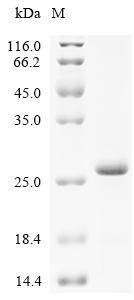
  • (Tris-Glycine gel) Discontinuous SDS-PAGE (reduced) with 5% enrichment gel and 15% separation gel.
Have Questions? Leave a Message or Start an on-line Chat

Product Details

Purity
Greater than 85% as determined by SDS-PAGE.
Activity
Not Test
Target Names
Uniprot No.
Research Area
Neuroscience
Alternative Names
Peripheral sodium channel 1;Sodium channel protein type IX subunit alpha;Voltage-gated sodium channel subunit alpha Nav1.7
Species
Rattus norvegicus (Rat)
Source
E.coli
Expression Region
1-125aa
Target Protein Sequence
MAMLPPPGPQSFVHFTKQSLALIEQRISEEKAKEHKDEKKDDEEEGPKPSSDLEAGKQLPFIYGDIPPGMVSEPLEDLDPYYADKKTFIVLNKGKAIFRFNATPALYMLSPFSPLRRISIKILVH
Note: The complete sequence may include tag sequence, target protein sequence, linker sequence and extra sequence that is translated with the protein sequence for the purpose(s) of secretion, stability, solubility, etc.
If the exact amino acid sequence of this recombinant protein is critical to your application, please explicitly request the full and complete sequence of this protein before ordering.
Mol. Weight
21.1 kDa
Protein Length
Partial
Tag Info
C-terminal 6xHis-tagged
Form
Liquid or Lyophilized powder
Note: We will preferentially ship the format that we have in stock, however, if you have any special requirement for the format, please remark your requirement when placing the order, we will prepare according to your demand.
Buffer
If the delivery form is liquid, the default storage buffer is Tris/PBS-based buffer, 5%-50% glycerol. If the delivery form is lyophilized powder, the buffer before lyophilization is Tris/PBS-based buffer, 6% Trehalose, pH 8.0.
Reconstitution
We recommend that this vial be briefly centrifuged prior to opening to bring the contents to the bottom. Please reconstitute protein in deionized sterile water to a concentration of 0.1-1.0 mg/mL.We recommend to add 5-50% of glycerol (final concentration) and aliquot for long-term storage at -20°C/-80°C. Our default final concentration of glycerol is 50%. Customers could use it as reference.
Troubleshooting and FAQs
Storage Condition
Store at -20°C/-80°C upon receipt, aliquoting is necessary for mutiple use. Avoid repeated freeze-thaw cycles.
Shelf Life
The shelf life is related to many factors, storage state, buffer ingredients, storage temperature and the stability of the protein itself.
Generally, the shelf life of liquid form is 6 months at -20°C/-80°C. The shelf life of lyophilized form is 12 months at -20°C/-80°C.
Lead Time
3-7 business days
Datasheet & COA
Please contact us to get it.
Customer Reviews and Q&A

 Customer Reviews

There are currently no reviews for this product.

Submit a Review here

Target Background

Function
Mediates the voltage-dependent sodium ion permeability of excitable membranes. Assuming opened or closed conformations in response to the voltage difference across the membrane, the protein forms a sodium-selective channel through which Na(+) ions may pass in accordance with their electrochemical gradient. It is a tetrodotoxin-sensitive Na(+) channel isoform. Plays a role in pain mechanisms, especially in the development of inflammatory pain.
Gene References into Functions
  1. Nav1.7 of L4-L6 dorsal root ganglion plays an important role in the development of pain hypersensitivity after plantar incision. PMID: 29790813
  2. the presence of Nav1.7 mRNA and protein in dorsal root ganglia but not in embryonic hippocampal neurons. PMID: 29166836
  3. The expression of Nav1.7 is up-regulated in dorsal root ganglion up to 20 days after surgery compared to control groups. PMID: 29115943
  4. SCN9A gene modification can promote the expression of Nav1.8 and Nav1.9 channels, in addition to NGF which may provide a novel therapeutic basis for treating of diarrheapredominant irritable bowel syndrome. PMID: 29138838
  5. PGE2 was an important regulator of Nav1.7 in TMJ inflammatory pain PMID: 28349234
  6. This study demonstrated that the expression of miR-30b and Nav1.7 was down-regulated and up-regulated, respectively, in the dorsal root ganglion of spared nerve injury rats PMID: 27765894
  7. Estradiol could upregulate trigeminal ganglionic Nav1.7 expression to contribute to hyperalgesia of inflamed temporomandibular joint. PMID: 28582470
  8. This study demonstrated that Positive immunoreactivity was found for NaV1.1, predominantly in sensory terminals together with NaV1.6 and for NaV1.7. PMID: 28123009
  9. Nav1.7 plays a vital role in lowering heat pain threshold after burn injury; shRNA mediated knockdown of Nav1.7 attenuates burn induced pain in rats as well as decreased the activation of c-fos protein. PMID: 27514860
  10. The role of NaV1.7 channels in the transmission of muscle afferent input evoking the exercise pressor reflex is reported in decerebrated, unanesthetized rats. PMID: 26310938
  11. De novo expression of Nav1.7 mRNA in putative proprioceptive neurons and increase in Nav1.7-ir fibers in the ipsilateral gracile nucleus following spinal nerve ligation may suggest functional changes in touch sense pathways after peripheral nerve injury PMID: 25453779
  12. Studied pain-related behavior and expression of NaV1.7 in dorsal root ganglia (DRG) after combined sciatic nerve compression and nucleus pulposus (NP) application in rats. PMID: 24253930
  13. disc injury increases NaV1.7 expression in dorsal root ganglia neurons innervating injured discs PMID: 24480965
  14. TNF-alpha up-regulates NaV1.7 mRNA in both adrenal chromaffin cells and dorsal root ganglia (DRG) neurons, highlighting the peripheral nociceptive mechanism of TNF-alpha PMID: 24445633
  15. Nav 1.7 has an important function in the hyperalgesia of the inflamed temporomandibular joint, which is dependent on the communication with the satellite glials PMID: 23242737
  16. NaV1.7 is present within neurosecretory neurons of rat supraoptic nucleus, where the level of immunoreactivity is dynamic, increasing in response to osmotic stress PMID: 23924059
  17. The expression of Nav1.7 in DRG neurons extends from peripheral terminals in the skin to preterminal central branches and terminals in the dorsal horn. PMID: 23134641
  18. the involvement of functional voltage-gated sodium channels expression as a potentiating factor in metastatic prostate cancer has been confirmed in vivo for the first time PMID: 22484465
  19. Na(V)1.7 expression in the rat, highest mRNA expression levels are found in peripheral ganglia, and the protein is expressed within these ganglion cells and on the projections of these neurons in the central nervous system. PMID: 17722032
  20. Nerve growth factor did not affect the Nav1.7 mRNA level, but the total voltage-gated Na+ channel alpha-subunit protein level was upregulated. PMID: 17149708
  21. Nav1.7 is the dominant sodium channel in rat and mouse olfactory sensory neurons. PMID: 21569247
  22. We demonstrate increased levels of Na(V)1.7 in experimental rat sciatic nerve neuromas, 2weeks after nerve ligation and transaction. PMID: 21601570
  23. Na(V)1.7 plays a role in the maintenance of chronic inflammatory pain several weeks after the initial insult. PMID: 17950013
  24. The results of these studies suggest that activation of the presynaptic delta-opioid receptor by enkephalin prevents the increase in neuronal Na(V)1.7 in DRG through inhibition of PKC and p38. PMID: 18579738
  25. Na(v)1.7 plays a major role in pain and is inhibited by the sodium channel blocker BZP PMID: 19690272

Show More

Hide All

Subcellular Location
Cell membrane; Multi-pass membrane protein. Cell projection, neuron projection.
Protein Families
Sodium channel (TC 1.A.1.10) family, Nav1.7/SCN9A subfamily
Tissue Specificity
Expressed at high level in the dorsal root ganglion and at much lower levels in the brain, sciatic nerve, nodose ganglia, heart, thyroid and adrenal glands and Schwann cells, but not in the cardiac and skeletal muscles, brain and liver.
Database Links
icon of phone
Call us
301-363-4651 (Available 9 a.m. to 5 p.m. CST from Monday to Friday)
icon of address
Address
7505 Fannin St., Ste 610, Room 7 (CUBIO Innovation Center), Houston, TX 77054, USA
icon of social media
Join us with

Subscribe newsletter

Leave a message

* To protect against spam, please pass the CAPTCHA test below.
CAPTCHA verification
© 2007-2026 CUSABIO TECHNOLOGY LLC All rights reserved. 鄂ICP备15011166号-1
Place an order now

I. Product details

*
*
*
*

II. Contact details

*
*

III. Ship To

*
*
*
*
*
*
*

IV. Bill To

*
*
*
*
*
*
*
*



