
Call us
301-363-4651 (Available 9 a.m. to 5 p.m. CST from Monday to Friday)

| Code | CSB-EP324966FKZ |
| Abbreviation | Recombinant Staphylococcus aureus entD protein |
| MSDS | |
| Size | $388 |
| Order now | |
| Image |
|
| Have Questions? | Leave a Message or Start an on-line Chat |
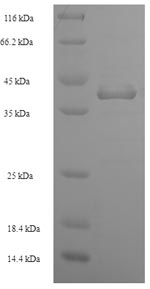
The construction of a plasmid coding for the Staphylococcus aureus entD protein (26-258aa) is the initial step for the preparation of the recombiant Staphylococcus aureus entD protein. The next is to transform the constructed plasmid into e.coli cells. e.coli cells containing the plasmid are screened and then cultured under conditions that promote the expression of the gene of interest. The protein is equipped with a N-terminal 6xHis-SUMO tag. After that, affinity purification is used to isolate and purify the recombinant entD protein from the cell lysate. Finally, the resulting recombinant entD protein undergoes SDS-PAGE analysis, demonstrating a purity greater than 90%.

Applications : Binding assay/Protein-protein interaction
Review: I recently utilized the Recombinant Staphylococcus aureus Enterotoxin D (entD) from CusaBio for Luminex-based immunoassays aimed at profiling specific antibody responses. Overall, our experience with this reagent has been highly positive. The protein arrived well-packaged with clear labeling, and the accompanying datasheet provided thorough information regarding its concentration, purity, and buffer conditions. In the Luminex assay, entD post- PBS buffer exchange, coupled efficiently to the beads, and the conjugation yield was consistent across batches. Importantly, the antigen maintained excellent immunoreactivity, as indicated by robust and specific signal detection in both pilot and larger-scale assays. The background noise was minimal, and no nonspecific bead aggregation was observed, which greatly enhanced assay reproducibility and sensitivity.
By Anonymous





