
Call us
301-363-4651 (Available 9 a.m. to 5 p.m. CST from Monday to Friday)

| Code | CSB-EP314893SLD |
| Abbreviation | Recombinant Staphylococcus epidermidis ecpA protein |
| MSDS | |
| Size | $388 |
| Order now | |
| Image |
|
| Have Questions? | Leave a Message or Start an on-line Chat |
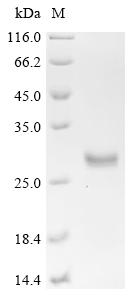
Recombinant Staphylococcus epidermidis Extracellular cysteine protease (ecpA) is expressed in E. coli with a C-terminal 6xHis tag for easier purification and detection. The product represents the full length of the mature protein, spanning amino acids 222 to 395. SDS-PAGE analysis indicates a purity level greater than 90%, which should provide reliable results for most experimental applications.
The extracellular cysteine protease (ecpA) from Staphylococcus epidermidis appears to play an important role in protein degradation. This may contribute to how the bacteria acquire nutrients and interact with their hosts. The enzyme seems to be involved in various proteolytic pathways, which makes it an interesting research target for those studying bacterial physiology and pathogenicity. Understanding how ecpA functions could help researchers explore bacterial survival mechanisms and the complex dynamics between hosts and pathogens.
Potential Applications
Note: The applications listed below are based on what we know about this protein's biological functions, published research, and experience from experts in the field. However, we haven't fully tested all of these applications ourselves yet. We'd recommend running some preliminary tests first to make sure they work for your specific research goals.
Based on the provided information, the recombinant Staphylococcus epidermidis extracellular cysteine protease is expressed in E. coli, a prokaryotic system that may be suitable for expressing bacterial proteins, as it shares a similar cellular environment. However, proteases like this often require precise folding, disulfide bond formation, or post-translational modifications for activity, which E. coli may not always achieve reliably. Since the protein's activity is explicitly unknown and unvalidated, it cannot be assumed to be correctly folded or bioactive. The expression of the full-length mature protein (222-395aa) increases the likelihood of proper folding, but without functional assays (e.g., protease activity tests), the folding and bioactivity remain uncertain. Thus, experimental validation is essential.
1. Biochemical Characterization and Enzyme Kinetics Studies
This application is appropriate but highly dependent on correct folding and activity. The recombinant protease can be used for biochemical studies, but since activity is unconfirmed, initial experiments must focus on verifying proteolytic function using fluorogenic or chromogenic substrates. The C-terminal 6xHis tag facilitates purification, and >90% purity is suitable for assays. If the protein is misfolded or inactive, kinetic measurements and inhibitor screening will be invalid. Therefore, activity confirmation is a prerequisite for reliable results.
2. Antibody Development and Immunological Studies
This application is generally suitable. The recombinant protein can serve as an immunogen for antibody generation, even if misfolded, as antibodies may recognize linear epitopes useful for techniques like Western blotting. The 6xHis tag simplifies purification and quantification. However, antibodies produced against a potentially misfolded protein might not bind the native protease in physiological contexts, so validation against natural S. epidermidis samples is recommended.
3. Protein-Protein Interaction Studies
This application requires correct protein folding to ensure authentic interactions. The 6xHis tag allows immobilization for pull-down assays, but if the protease is misfolded, it may not bind true substrates or partners (e.g., from bacterial or host lysates), leading to false results. The high purity reduces background, but folding must be validated first. If inactive, this application should be avoided or results interpreted with caution.
4. Inhibitor Screening and Drug Discovery Research
This application critically depends on bioactivity. The recombinant protease could be used for inhibitor screening, but only if it is correctly folded and active. The 6xHis tag enables immobilization for high-throughput assays, and >90% purity supports reliability. However, without activity confirmation, screening may identify non-specific inhibitors or yield misleading data. Preliminary activity tests are essential before proceeding.
Final Recommendation & Action Plan
Given the uncertainty in folding and bioactivity, the priority should be to validate the protein's conformation and function before any application. Recommend performing initial protease activity assays (e.g., using synthetic substrates) and biophysical characterization (e.g., circular dichroism for secondary structure, size-exclusion chromatography for oligomeric state) to confirm folding. If active, the protein can be used for all described applications; if inactive, focus on non-functional uses like antibody development or as a negative control. Always include appropriate controls and consider alternative expression systems if folding issues persist. For interaction or inhibitor studies, correlate findings with native protein data when possible.
There are currently no reviews for this product.
KEGG: sep:SE0184





