
Call us
301-363-4651 (Available 9 a.m. to 5 p.m. CST from Monday to Friday)

| Code | CSB-RA166610A0HU |
| Size | US$210 |
| Order now | |
| Image |
|
| Have Questions? | Leave a Message or Start an on-line Chat |
| Application | Recommended Dilution |
|---|---|
| IF | 1:50-1:200 |
| FC | 1:50-1:200 |
AKT1 and AKT2 are central serine/threonine kinases within the PI3K/AKT signaling pathway, governing critical cellular processes including survival, proliferation, metabolism, and growth. As key downstream effectors of growth factor signaling, these kinases are frequently dysregulated in cancer and metabolic disorders, making them essential targets for researchers investigating oncogenic transformation, insulin signaling, and therapeutic intervention strategies.
This recombinant monoclonal antibody, clone 15H1, recognizes both AKT1 and AKT2 isoforms, providing researchers with a versatile tool for studying this kinase family. Developed using recombinant technology with a defined sequence, this antibody delivers the lot-to-lot consistency essential for longitudinal studies and reproducible experimental outcomes. The rabbit IgG format, combined with affinity chromatography purification, ensures high specificity and minimal background interference across validated applications.
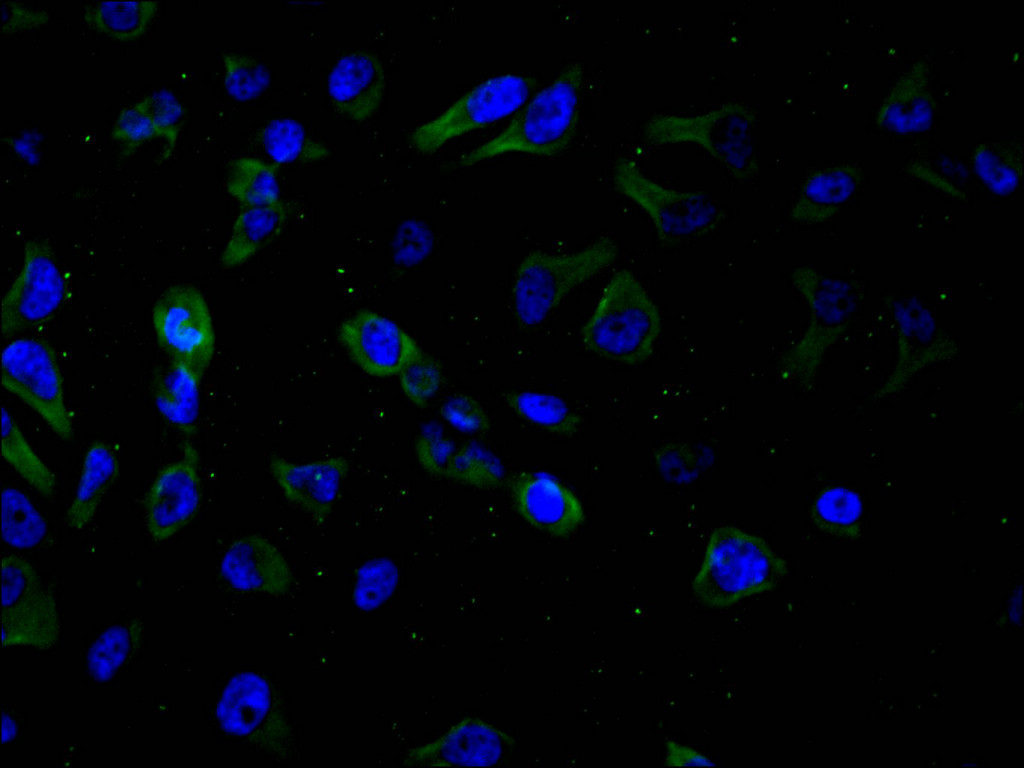
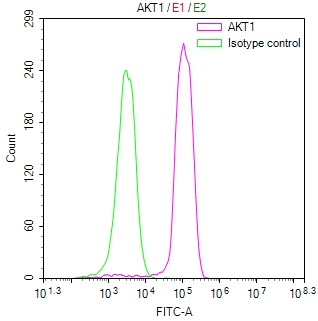
Validation studies demonstrate reliable performance in immunofluorescence and flow cytometry applications using human MCF-7 breast cancer cells, a widely used model for studying AKT pathway activation. Immunofluorescence analysis at 1:50 dilution reveals clear cellular staining patterns when counter-stained with DAPI, while flow cytometry experiments at 1:100 dilution show distinct positive signal separation from isotype control, confirming specific detection of endogenous AKT1/AKT2 in fixed and permeabilized cells. The antibody is also validated for ELISA applications.
This dual-target antibody serves researchers investigating PI3K/AKT pathway dynamics, cancer biology, metabolic signaling, and drug resistance mechanisms. Its validated performance in cell-based assays makes it particularly suitable for studies examining AKT localization, expression levels, and pathway activation status in human cell models.
There are currently no reviews for this product.





