AP2S1 Recombinant Monoclonal Antibody

Code CSB-RA590809A0HU
Size US$210
Order now
Image
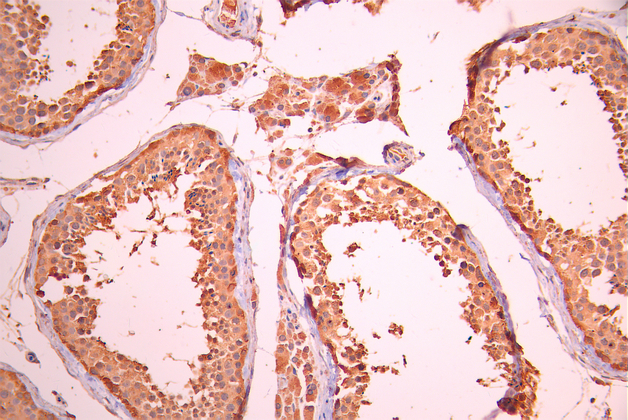
  • IHC image of CSB-RA590809A0HU diluted at 1:100 and staining in paraffin-embedded human testis tissue performed on a Leica BondTM system. After dewaxing and hydration, antigen retrieval was mediated by high pressure in a citrate buffer (pH 6.0). Section was blocked with 10% normal goat serum 30min at RT. Then primary antibody (1% BSA) was incubated at 4°C overnight. The primary is detected by a Goat anti-rabbit polymer IgG labeled by HRP and visualized using 0.05% DAB.
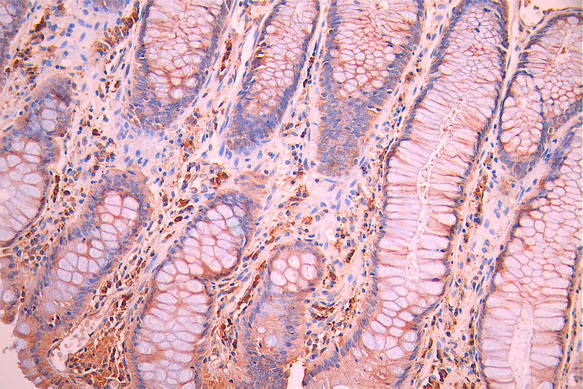
  • IHC image of CSB-RA590809A0HU diluted at 1:100 and staining in paraffin-embedded human colorectal cancer performed on a Leica BondTM system. After dewaxing and hydration, antigen retrieval was mediated by high pressure in a citrate buffer (pH 6.0). Section was blocked with 10% normal goat serum 30min at RT. Then primary antibody (1% BSA) was incubated at 4°C overnight. The primary is detected by a Goat anti-rabbit polymer IgG labeled by HRP and visualized using 0.05% DAB.
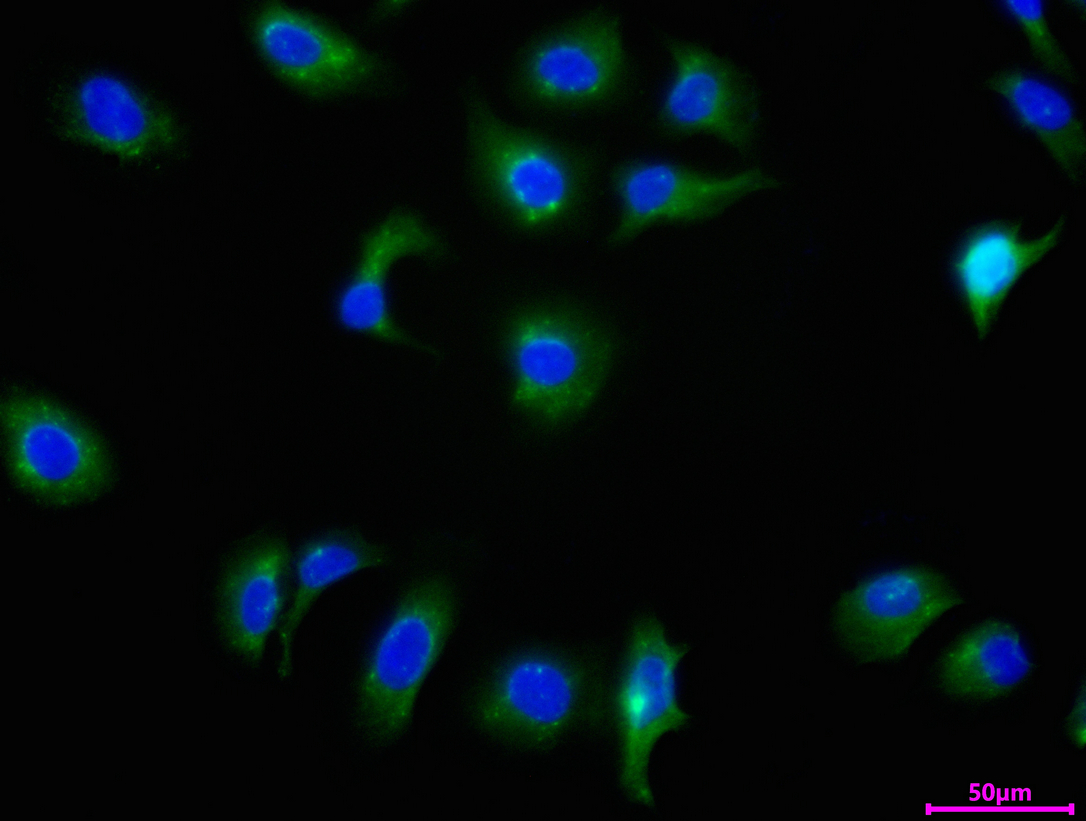
  • Immunofluorescence staining of hela cell with CSB-RA590809A0HU at 1:50 ,counter-stained with DAPI. The cells were fixed in 4% formaldehyde and blocked in 10% normal Goat Serum. The cells were then incubated with the antibody overnight at 4°C. The secondary antibody was Fluorescein Alexa Fluor 488-congugated AffiniPure Goat Anti-Rabbit IgG(H+L).
Have Questions? Leave a Message or Start an on-line Chat

Product Details

Uniprot No.
Target Names
Alternative Names
AP-2 complex subunit sigma (Adaptor protein complex AP-2 subunit sigma) (Adaptor-related protein complex 2 subunit sigma) (Clathrin assembly protein 2 sigma small chain) (Clathrin coat assembly protein AP17) (Clathrin coat-associated protein AP17) (HA2 17 kDa subunit) (Plasma membrane adaptor AP-2 17 kDa protein) (Sigma2-adaptin), AP2S1, AP17 CLAPS2
Species Reactivity
Human
Immunogen
A synthesized peptide derived from Human AP2S1 protein
Immunogen Species
Homo sapiens (Human)
Conjugate
Non-conjugated
Clonality
Monoclonal
Isotype
Rabbit IgG
Clone No.
10A6
Purification Method
Affinity-chromatography
Concentration
It differs from different batches. Please contact us to confirm it.
Buffer
Rabbit IgG in 10mM phosphate buffered saline , pH 7.4, 150mM sodium chloride, 0.05% BSA, 0.02% sodium azide and 50% glycerol.
Form
Liquid
Tested Applications
ELISA, IHC, IF
Recommended Dilution
Application Recommended Dilution
IHC 1:50-1:200
IF 1:20-1:200
Troubleshooting and FAQs
Storage
Upon receipt, store at -20°C or -80°C. Avoid repeated freeze.
Lead Time
Basically, we can dispatch the products out in 1-3 working days after receiving your orders. Delivery time maybe differs from different purchasing way or location, please kindly consult your local distributors for specific delivery time.
Usage
For Research Use Only. Not for use in diagnostic or therapeutic procedures.
Customer Reviews and Q&A

 Customer Reviews

There are currently no reviews for this product.

Submit a Review here

Target Background

Function
Component of the adaptor protein complex 2 (AP-2). Adaptor protein complexes function in protein Transport via Transport vesicles in different membrane traffic pathways. Adaptor protein complexes are vesicle coat components and appear to be involved in cargo selection and vesicle formation. AP-2 is involved in clathrin-dependent endocytosis in which cargo proteins are incorporated into vesicles surrounded by clathrin (clathrin-coated vesicles, CCVs) which are destined for fusion with the early endosome. The clathrin lattice serves as a mechanical scaffold but is itself unable to bind directly to membrane components. Clathrin-associated adaptor protein (AP) complexes which can bind directly to both the clathrin lattice and to the lipid and protein components of membranes are considered to be the major clathrin adaptors contributing the CCV formation. AP-2 also serves as a cargo receptor to selectively sort the membrane proteins involved in receptor-mediated endocytosis. AP-2 seems to play a role in the recycling of synaptic vesicle membranes from the presynaptic surface. AP-2 recognizes Y-X-X-[FILMV] (Y-X-X-Phi) and [ED]-X-X-X-L-[LI] endocytosis signal motifs within the cytosolic tails of transmembrane cargo molecules. AP-2 may also play a role in maintaining normal post-endocytic trafficking through the ARF6-regulated, non-clathrin pathway. The AP-2 alpha and AP-2 sigma subunits are thought to contribute to the recognition of the [ED]-X-X-X-L-[LI] motif. May also play a role in extracellular calcium homeostasis.
Gene References into Functions
  1. In 33 CASR-negative patients with suspected FHH, Data found two (~6%) with a mutation in AP2S1 (p.Arg15Leu and p.Arg15His). Family screening confirmed the genotype-phenotype correlations. Data did not identify any pathogenic mutations in GNA11. PMID: 27913609
  2. our studies demonstrate AP2sigma2 mutations to result in a more severe FHH phenotype with genotype-phenotype correlations, and a dominant-negative mechanism of action with mutational bias at the Arg15 residue. PMID: 26082470
  3. The results affirm that a significant number of patients suspected of having Familial hypocalciuric hypercalcemia but proven negative for CASR mutation have AP2S1 p.R15 mutations. PMID: 24731014
  4. The absence of AP2S1 abnormalities in hypocalcemic patients, suggests that autosomal dominant hypocalcemia 3 (ADH3) may not occur or otherwise represents a rare hypocalcemic disorder. PMID: 24708097
  5. None of the 60 patients presented with nucleotidic changes or copy number variation in the AP2S1 gene, thereby excluding AP2S1 defects as a frequent cause of isolated hypoparathyroidism. PMID: 24423332
  6. Mutations in AP2S1 cause familial hypocalciuric hypercalcemia type 3. PMID: 23222959

Show More

Hide All

Involvement in disease
Hypocalciuric hypercalcemia, familial 3 (HHC3)
Subcellular Location
Cell membrane. Membrane, coated pit; Peripheral membrane protein; Cytoplasmic side.
Protein Families
Adaptor complexes small subunit family
Database Links

HGNC: 565

OMIM: 600740

KEGG: hsa:1175

STRING: 9606.ENSP00000263270

UniGene: Hs.119591

icon of phone
Call us
301-363-4651 (Available 9 a.m. to 5 p.m. CST from Monday to Friday)
icon of address
Address
7505 Fannin St., Ste 610, Room 7 (CUBIO Innovation Center), Houston, TX 77054, USA
icon of social media
Join us with

Subscribe newsletter

Leave a message

* To protect against spam, please pass the CAPTCHA test below.
CAPTCHA verification
© 2007-2026 CUSABIO TECHNOLOGY LLC All rights reserved. 鄂ICP备15011166号-1
Place an order now

I. Product details

*
*
*
*

II. Contact details

*
*

III. Ship To

*
*
*
*
*
*
*

IV. Bill To

*
*
*
*
*
*
*
*