
Call us
301-363-4651 (Available 9 a.m. to 5 p.m. CST from Monday to Friday)

| Code | CSB-RA034568A0HU |
| Size | US$210 |
| Order now | |
| Image |
|
| Have Questions? | Leave a Message or Start an on-line Chat |
| Application | Recommended Dilution |
|---|---|
| FC | 1:50-1:200 |
CHAF1A, also known as Chromatin Assembly Factor 1 subunit A or p150, serves as the largest subunit of the CAF-1 complex, which plays an essential role in depositing histones onto newly synthesized DNA during replication and repair. This process is fundamental to maintaining chromatin structure and epigenetic information across cell divisions, making CHAF1A a compelling target for researchers investigating DNA replication, chromatin dynamics, and cell cycle regulation. Dysregulation of CHAF1A has been implicated in various proliferative disorders, positioning it as a relevant marker in cancer biology and developmental studies.
This recombinant monoclonal antibody, clone 7C3, offers the reproducibility and consistency that demanding experimental workflows require. Generated against a synthetic peptide derived from human CHAF1A and produced using recombinant technology in rabbit host, this antibody provides sequence-defined specificity that eliminates the lot-to-lot variability often encountered with traditional hybridoma-derived reagents. The result is reliable performance across extended research programs where experimental continuity matters.
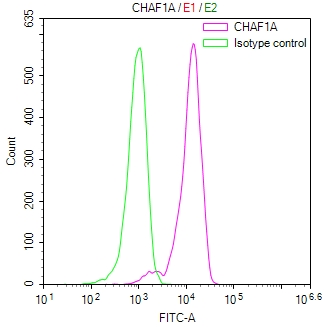
Validated for flow cytometry applications, this antibody has demonstrated effective detection of CHAF1A in human SH-SY5Y neuroblastoma cells at dilutions ranging from 1:50 to 1:200. The validation protocol employed fixation with formaldehyde followed by Triton X-100 permeabilization, confirming suitability for intracellular staining workflows. Clear separation from isotype control signals was achieved when acquiring greater than 10,000 events, indicating robust specificity under standard flow cytometry conditions.
Researchers studying chromatin biology, DNA damage responses, or cell proliferation will find this antibody well-suited for characterizing CHAF1A expression patterns in human cell models, particularly in neuronal or cancer cell contexts where chromatin remodeling plays a critical role.
There are currently no reviews for this product.





