
Call us
301-363-4651 (Available 9 a.m. to 5 p.m. CST from Monday to Friday)

| Code | CSB-RA945280A0HU |
| Size | US$210 |
| Order now | |
| Image |
|
| Have Questions? | Leave a Message or Start an on-line Chat |
| Application | Recommended Dilution |
|---|---|
| FC | 1:50-1:200 |
EIF2B5 encodes the epsilon subunit of eukaryotic translation initiation factor 2B, a guanine nucleotide exchange factor essential for protein synthesis initiation. This catalytic subunit plays a central role in regulating global translation rates in response to cellular stress, making it a critical target for researchers investigating translational control mechanisms. Mutations in EIF2B5 are associated with vanishing white matter disease, also known as childhood ataxia with central nervous system hypomyelination, positioning this protein as an important focus in neurological disorder research.
This recombinant monoclonal antibody, clone 1G9, offers the reproducibility and consistency that demanding experimental workflows require. Produced using recombinant technology in rabbit host, the antibody provides sequence-defined specificity against human EIF2B5, ensuring reliable performance across experiments and eliminating the lot-to-lot variability that can compromise longitudinal studies. The monoclonal nature guarantees recognition of a single epitope, generated against a synthesized peptide from the human EIF2B5 protein.
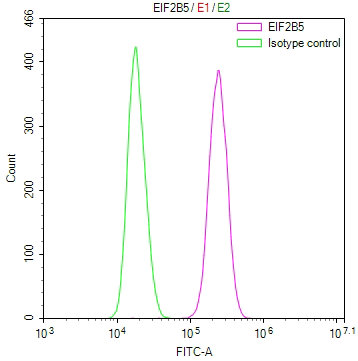
Validation through flow cytometry demonstrates clear detection of EIF2B5 in HeLa cells, with recommended dilutions ranging from 1:50 to 1:200. The flow cytometry data shows distinct separation between antibody-stained and control populations, confirming specific intracellular detection following fixation and permeabilization. The antibody is also validated for ELISA applications, providing flexibility for researchers employing multiple detection platforms.
Supplied in a glycerol-containing buffer optimized for long-term stability at -20°C or -80°C, this unconjugated antibody is compatible with standard secondary detection systems. Researchers studying translational regulation, integrated stress response pathways, or leukodystrophy mechanisms will find this antibody a dependable tool for characterizing EIF2B5 expression and function.
There are currently no reviews for this product.





