
Call us
301-363-4651 (Available 9 a.m. to 5 p.m. CST from Monday to Friday)

| Code | CSB-RA103196A0HU |
| Size | US$210 |
| Order now | |
| Image |
|
| Have Questions? | Leave a Message or Start an on-line Chat |
| Application | Recommended Dilution |
|---|---|
| FC | 1:50-1:200 |
HIRA plays a central role in chromatin dynamics as a histone chaperone responsible for replication-independent deposition of histone variant H3.3. This function is essential for transcriptional regulation, cellular senescence, and the maintenance of chromatin integrity at actively transcribed genes and regulatory elements. Originally identified within the DiGeorge syndrome critical region, HIRA has become an important focus for researchers investigating epigenetic mechanisms, developmental biology, and age-related chromatin changes.
This recombinant monoclonal antibody, clone 16E9, offers the consistency and reliability that demanding epigenetic studies require. Developed using recombinant technology with a defined sequence, it eliminates the lot-to-lot variability that can compromise longitudinal experiments or multi-site collaborations. The rabbit host and monoclonal nature ensure high specificity for human HIRA, while affinity chromatography purification delivers a clean reagent suitable for sensitive detection methods.
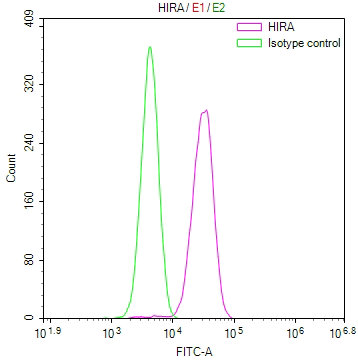
Validation by flow cytometry demonstrates clear performance in intracellular staining applications. Testing in Jurkat cells, a human T lymphocyte line commonly used in immunological and signaling research, shows distinct positive signal separation from isotype control when used at dilutions between 1:50 and 1:200. The protocol employed standard fixation with formaldehyde and permeabilization with Triton X-100, providing a reliable starting point for researchers establishing their own workflows.
The unconjugated format allows flexibility in secondary antibody selection, accommodating various detection systems and multiplexing strategies. For investigators exploring histone variant dynamics, senescence pathways, or chromatin remodeling mechanisms, this antibody provides a dependable tool for characterizing HIRA expression and localization in human cell systems.
There are currently no reviews for this product.





