
Call us
301-363-4651 (Available 9 a.m. to 5 p.m. CST from Monday to Friday)

| Code | CSB-RA051003A0HU |
| Size | US$210 |
| Order now | |
| Image |
|
| Have Questions? | Leave a Message or Start an on-line Chat |
| Application | Recommended Dilution |
|---|---|
| IF | 1:50-1:200 |
| FC | 1:50-1:200 |
KSR1 functions as a critical scaffolding protein within the MAPK/ERK signaling cascade, orchestrating the spatial organization of RAF, MEK, and ERK kinases to enable efficient signal transduction downstream of Ras activation. Despite its name suggesting kinase suppressor activity, KSR1 actually facilitates Ras-mediated signaling by bringing pathway components into close proximity, making it an essential regulator of cell proliferation, differentiation, and survival responses. Researchers investigating oncogenic Ras signaling, metabolic regulation, or T cell activation will find KSR1 a compelling target given its emerging role in cancer biology and immune cell function.
This recombinant monoclonal antibody, generated against a synthetic peptide derived from human KSR1, offers the reproducibility and consistency that demanding experimental workflows require. Because the antibody sequence is defined and production occurs in controlled recombinant systems, researchers can expect minimal lot-to-lot variation—a meaningful advantage when building datasets across extended studies or when standardizing protocols across laboratory teams.
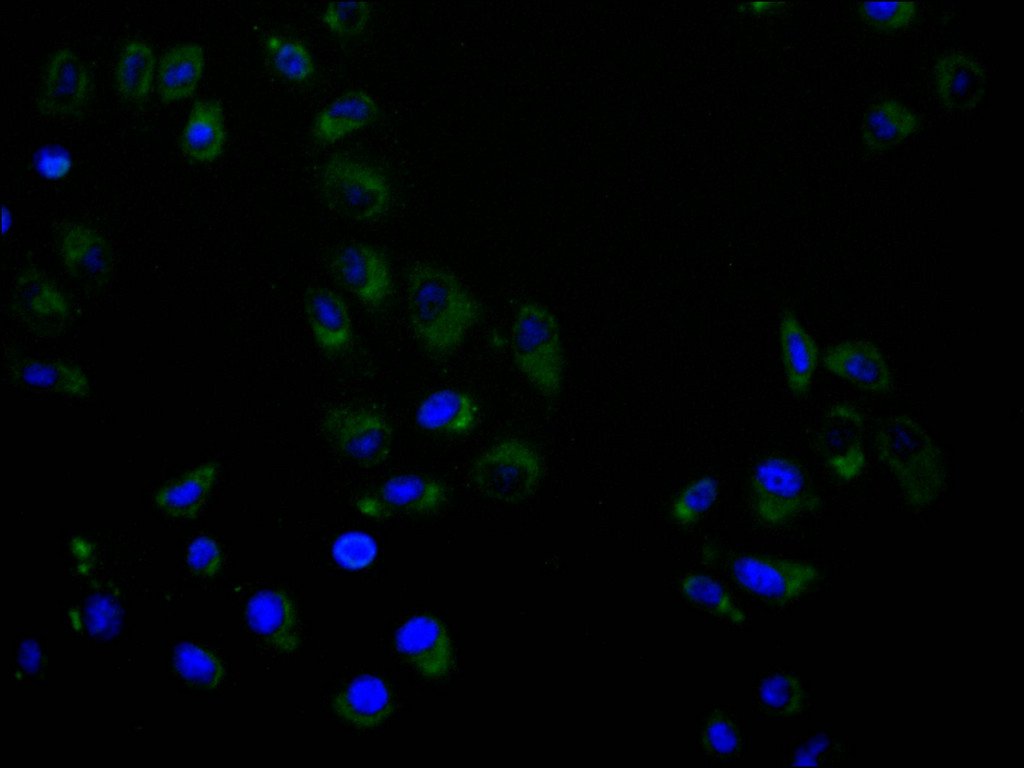
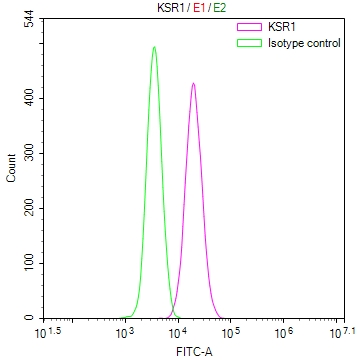
Validation testing confirms reliable performance in immunofluorescence and flow cytometry applications. Immunofluorescence staining of HeLa cells demonstrates clear cytoplasmic localization patterns at dilutions between 1:50 and 1:200, while flow cytometric analysis of Jurkat cells shows distinct positive population shifts compared to isotype controls, indicating specific detection in both adherent and suspension human cell models. These validated applications provide flexibility for researchers examining KSR1 expression at the single-cell level or conducting high-throughput screening approaches.
This antibody serves investigators exploring MAPK pathway dynamics, Ras-driven tumorigenesis, or the scaffolding mechanisms that govern signal transduction fidelity in human cellular systems.
There are currently no reviews for this product.





