
Call us
301-363-4651 (Available 9 a.m. to 5 p.m. CST from Monday to Friday)

| Code | CSB-RA013003A0HU |
| Size | US$210 |
| Order now | |
| Image |
|
| Have Questions? | Leave a Message or Start an on-line Chat |
| Application | Recommended Dilution |
|---|---|
| IHC | 1:50-1:200 |
| IF | 1:20-1:200 |
| IP | 1:200-1:1000 |
Lamin A/C, encoded by the LMNA gene, serves as a fundamental structural component of the nuclear lamina, where it maintains nuclear integrity, regulates chromatin organization, and participates in essential processes including DNA replication and gene expression. Mutations in LMNA are associated with a diverse group of disorders collectively known as laminopathies, encompassing conditions such as Emery-Dreifuss muscular dystrophy, dilated cardiomyopathy, and Hutchinson-Gilford progeria syndrome. This positions LMNA as a critical target for researchers investigating nuclear architecture, aging mechanisms, and disease pathogenesis.
This recombinant monoclonal antibody, clone 4H7, offers the reproducibility and consistency that demanding experimental workflows require. Generated against a synthetic peptide derived from human LMNA and produced using recombinant technology, this antibody provides sequence-defined specificity that eliminates the lot-to-lot variability often encountered with traditional hybridoma-derived reagents. Affinity chromatography purification ensures high purity for reliable performance across applications.
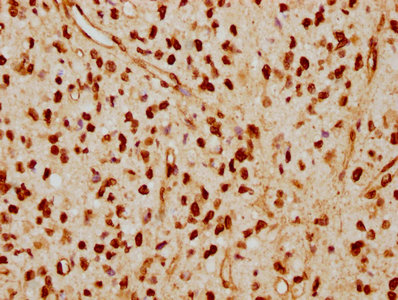
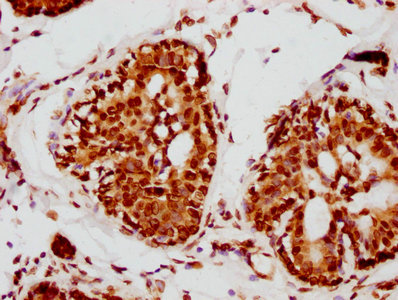
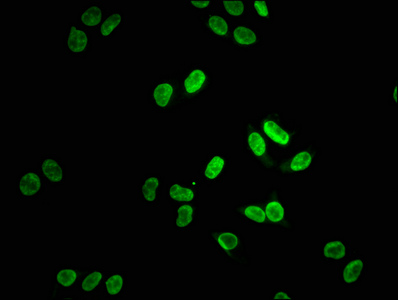
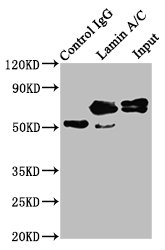
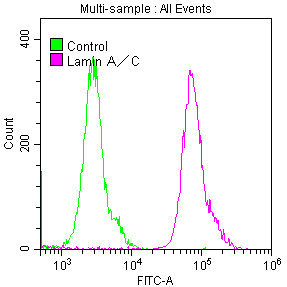
Validation studies demonstrate robust performance in multiple experimental contexts. Immunohistochemistry staining has been successfully performed on paraffin-embedded human glioma and breast cancer tissues using citrate buffer antigen retrieval, confirming utility for pathological investigations. Immunofluorescence analysis in HeLa cells reveals characteristic nuclear envelope localization when counter-stained with DAPI, providing clear visualization of Lamin A/C distribution. The antibody has also been validated for immunoprecipitation from HeLa whole cell lysates, enabling protein interaction studies, while flow cytometry applications allow quantitative analysis of Lamin A/C expression at the single-cell level.
This versatile reagent supports cell biology research programs focused on nuclear structure, mechanotransduction, and disease modeling where consistent, high-quality Lamin A/C detection is essential.
There are currently no reviews for this product.





