
Call us
301-363-4651 (Available 9 a.m. to 5 p.m. CST from Monday to Friday)

| Code | CSB-RA903890I1m |
| Size | US$329 |
| Order now | |
| Image |
|
| Have Questions? | Leave a Message or Start an on-line Chat |
| Application | Recommended Dilution |
|---|---|
| ELISA | 1:5000-1:50000 |
Monomethyl auristatin E and monomethyl auristatin F represent critical cytotoxic payloads in the rapidly expanding field of antibody-drug conjugate therapeutics. These potent antimitotic agents disrupt tubulin polymerization, making them highly effective warheads for targeted cancer therapy. As ADC development accelerates across oncology research, the ability to accurately detect and quantify these payloads becomes essential for pharmacokinetic studies, bioanalytical method development, and quality control applications.
This recombinant monoclonal antibody, clone 25G12B5, offers researchers a reliable tool for detecting both MMAE and MMAF payloads with the consistency that recombinant production provides. Because the antibody sequence is defined and expressed from a stable cell line, you can expect uniform performance across lots, eliminating the variability that can complicate longitudinal studies or assay transfer between laboratories.
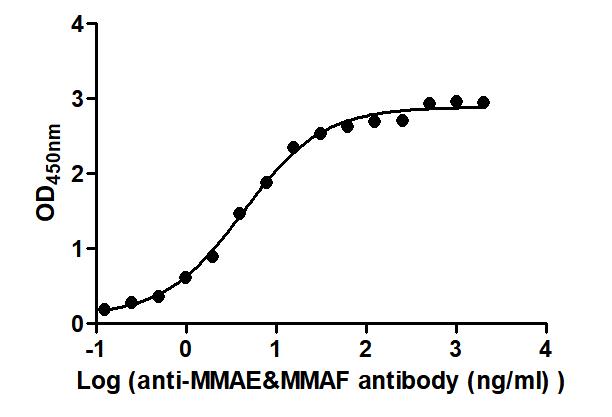
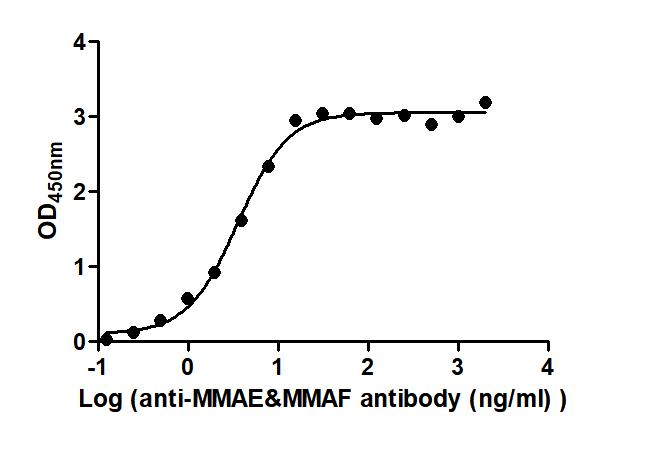
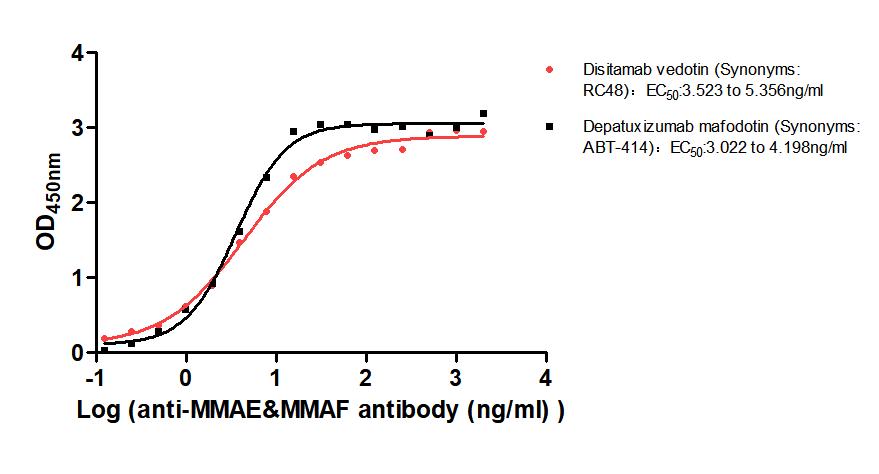
Functional ELISA validation demonstrates the antibody's robust binding characteristics against clinically relevant ADCs. Testing with Disitamab vedotin (RC48), an HER2-targeted ADC, yielded EC50 values in the low nanogram per milliliter range. Similarly, binding to Depatuxizumab mafodotin (ABT-414), an EGFR-directed conjugate, showed comparable sensitivity. These results confirm the antibody's utility for detecting auristatin payloads regardless of the targeting antibody component, providing flexibility across different ADC platforms in your research.
The recommended ELISA dilution range of 1:5000 to 1:50000 reflects the antibody's high affinity, allowing economical use across multiple experiments. Supplied in a glycerol-containing buffer for stability, this reagent supports researchers working in ADC development, bioanalytical assay validation, and pharmacokinetic profiling where precise payload detection is fundamental to advancing therapeutic candidates.
There are currently no reviews for this product.





