
Call us
301-363-4651 (Available 9 a.m. to 5 p.m. CST from Monday to Friday)

| Code | CSB-RA102164A0HU |
| Size | US$210 |
| Order now | |
| Image |
|
| Have Questions? | Leave a Message or Start an on-line Chat |
| Application | Recommended Dilution |
|---|---|
| IHC | 1:50-1:200 |
| FC | 1:50-1:200 |
Nuclear transcription factor Y subunit alpha (NFYA) serves as an essential component of the heterotrimeric NF-Y complex, a master regulator of CCAAT box-containing promoters found in approximately 30% of eukaryotic genes. This transcription factor plays a central role in cell cycle regulation, endoplasmic reticulum stress responses, and the coordinated expression of genes involved in lipid and cholesterol metabolism. Given its involvement in fundamental cellular processes and its emerging connections to cancer biology, NFYA represents a compelling target for researchers investigating transcriptional regulation and epigenetic mechanisms.
This recombinant monoclonal antibody, clone 16F10, offers the reproducibility and consistency that demanding experimental workflows require. Produced using recombinant technology in rabbit host, this antibody provides sequence-defined specificity against human NFYA, ensuring reliable performance across experiments and eliminating the lot-to-lot variability that can complicate long-term studies. The affinity-chromatography purification yields a preparation suitable for multiple detection platforms.
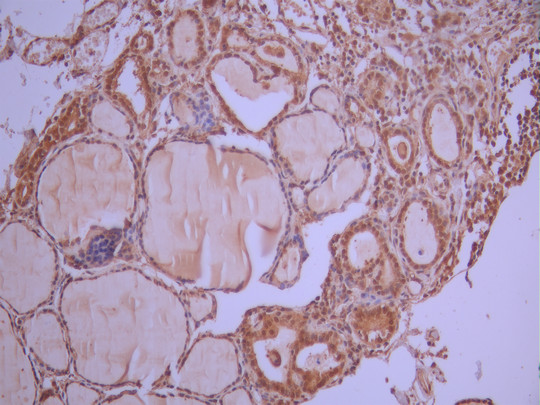
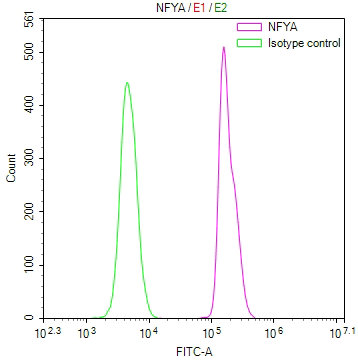
Validation studies demonstrate robust performance in both immunohistochemistry and flow cytometry applications. IHC analysis of paraffin-embedded human thyroid tissue using a Leica Bond system with citrate buffer antigen retrieval shows clear nuclear staining at 1:100 dilution, consistent with NFYA's function as a transcription factor. Flow cytometric analysis of SH-SY5Y neuroblastoma cells confirms intracellular detection capability, with distinct signal separation from isotype control, making this antibody well-suited for studying NFYA expression in neural cell models.
Researchers investigating epigenetics, nuclear signaling, and transcriptional regulation will find this antibody a dependable tool for characterizing NFYA expression patterns across experimental systems.
There are currently no reviews for this product.





