
Call us
301-363-4651 (Available 9 a.m. to 5 p.m. CST from Monday to Friday)

| Code | CSB-RA157160A0HU |
| Size | US$210 |
| Order now | |
| Image |
|
| Have Questions? | Leave a Message or Start an on-line Chat |
| Application | Recommended Dilution |
|---|---|
| WB | 1:500-1:5000 |
| IHC | 1:50-1:200 |
| FC | 1:50-1:200 |
PRPF8 stands as one of the largest and most highly conserved proteins in the spliceosome, serving as a central scaffold within the U5 small nuclear ribonucleoprotein complex. This 274 kDa splicing factor plays an essential role in pre-mRNA processing, positioning catalytic elements during both transesterification reactions of splicing. Mutations in PRPF8 have been linked to retinitis pigmentosa, making it a significant target for researchers investigating splicing disorders, retinal degeneration, and fundamental mechanisms of gene expression.
This recombinant rabbit monoclonal antibody, clone 9B2, offers the reproducibility and sequence-defined consistency that demanding splicing research requires. Generated against a synthetic peptide derived from human PRPF8, the antibody undergoes affinity chromatography purification to ensure high specificity for your target.
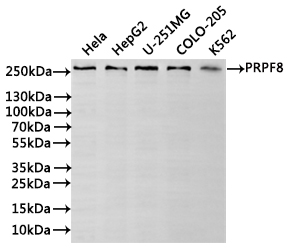
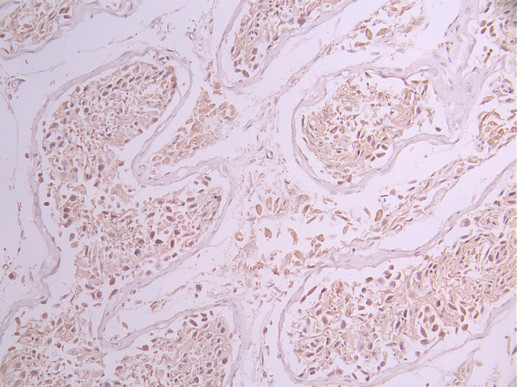
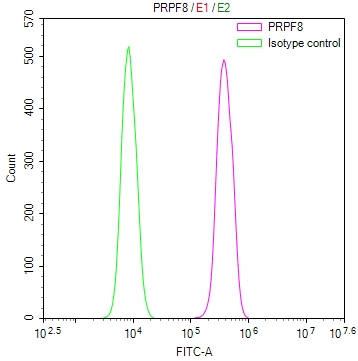
Validation studies demonstrate robust performance across multiple experimental platforms. Western blot analysis confirms detection of PRPF8 at the expected 274 kDa molecular weight across diverse human cell lines including HeLa, HepG2, U-251MG, COLO-205, and K562, indicating reliable detection in cells of epithelial, hepatic, glial, and hematopoietic origin. Immunohistochemistry testing in paraffin-embedded human testis tissue shows clear nuclear staining patterns consistent with PRPF8's role in pre-mRNA processing. Flow cytometry validation in HeLa cells further demonstrates the antibody's utility for quantitative single-cell analysis of this essential splicing factor.
Whether you are investigating spliceosome assembly, characterizing splicing factor dynamics, or exploring connections between RNA processing defects and disease, this antibody provides a dependable tool for immunohistochemistry and flow cytometry applications with recommended dilutions of 1:50–1:200 for both techniques.
There are currently no reviews for this product.





