
Call us
301-363-4651 (Available 9 a.m. to 5 p.m. CST from Monday to Friday)

| Code | CSB-RA613684A13phHU |
| Size | US$210 |
| Order now | |
| Image |
|
| Have Questions? | Leave a Message or Start an on-line Chat |
| Application | Recommended Dilution |
|---|---|
| WB | 1:500-1:5000 |
CDC37 serves as an essential co-chaperone that partners with Hsp90 to facilitate the maturation and stabilization of protein kinases, making it a central player in cellular signaling networks. Phosphorylation at serine 13 represents a critical regulatory modification that modulates CDC37's ability to recruit client kinases to the Hsp90 chaperone machinery. This phosphorylation event has garnered significant research attention due to its implications in cancer biology, where dysregulated kinase signaling drives tumor progression, and in understanding the broader mechanisms of protein quality control.
This recombinant monoclonal antibody, clone 3B3, offers researchers the reproducibility and consistency that comes with sequence-defined production. Unlike traditional hybridoma-derived antibodies, recombinant technology ensures that every lot performs identically, eliminating the variability that can compromise longitudinal studies or multi-site collaborations. The rabbit IgG format provides excellent sensitivity while the affinity-chromatography purification delivers a clean reagent suitable for demanding applications.
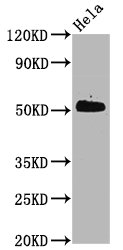
Validation in western blotting demonstrates reliable detection of phosphorylated CDC37 at the expected 50 kDa molecular weight in HeLa whole cell lysates, confirming specificity for the human target. The recommended working dilution range of 1:500 to 1:5000 provides flexibility to optimize signal-to-noise ratios across different experimental conditions and sample types. Additional compatibility with ELISA expands the utility of this antibody for quantitative phosphorylation studies.
For researchers investigating Hsp90 chaperone biology, kinase regulation, or the phospho-signaling events that govern protein homeostasis, this antibody provides a dependable tool for tracking this functionally important post-translational modification in human cell models.
There are currently no reviews for this product.





