
Call us
301-363-4651 (Available 9 a.m. to 5 p.m. CST from Monday to Friday)

| Code | CSB-RA116588A0HU |
| Size | US$210 |
| Order now | |
| Image |
|
| Have Questions? | Leave a Message or Start an on-line Chat |
| Application | Recommended Dilution |
|---|---|
| IHC | 1:50-1:200 |
| FC | 1:50-1:200 |
ST13, also known as Hsc70-interacting protein (Hip), functions as a co-chaperone that stabilizes the ADP-bound form of Hsc70, playing a critical role in protein folding and cellular stress responses. Originally identified as a putative tumor suppressor, ST13 has garnered significant research interest due to its involvement in cancer biology, with altered expression patterns observed across multiple malignancies. Its alternative designations as a progesterone receptor-associated protein and renal carcinoma antigen further underscore its relevance to hormone signaling and oncology research.
This recombinant monoclonal antibody, clone 7F12, offers the reproducibility essential for longitudinal studies and multi-site collaborations. Generated against a synthetic peptide derived from human ST13, the antibody is produced using recombinant technology that ensures sequence-defined consistency between lots, eliminating the variability that can compromise experimental reproducibility when working with traditional hybridoma-derived reagents.
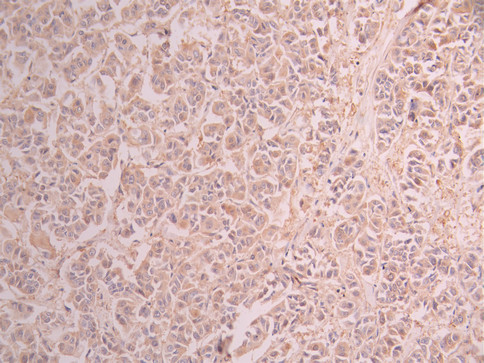
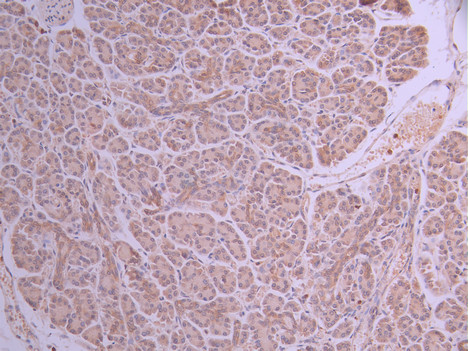
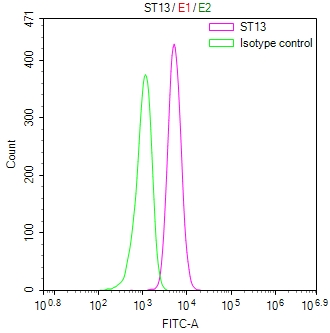
Validation studies demonstrate reliable performance across multiple applications. Immunohistochemistry testing in paraffin-embedded human tissues reveals clear cytoplasmic staining in both breast cancer and pancreatic tissue sections at 1:100 dilution using citrate buffer antigen retrieval, providing researchers with optimized starting conditions for their own tissue studies. Flow cytometry analysis using A431 epidermoid carcinoma cells shows a distinct positive shift compared to isotype controls, confirming the antibody's utility for intracellular protein detection in fixed and permeabilized cells.
The unconjugated format and affinity-purified preparation provide flexibility for researchers to pair this antibody with their preferred detection systems. Whether investigating ST13's role in chaperone-mediated protein quality control, exploring its tumor suppressor functions, or examining its expression patterns in clinical specimens, this antibody delivers the consistency and validated performance that rigorous research demands.
There are currently no reviews for this product.





