
Call us
301-363-4651 (Available 9 a.m. to 5 p.m. CST from Monday to Friday)

| Code | CSB-RA022948A0HU |
| Size | US$210 |
| Order now | |
| Image |
|
| Have Questions? | Leave a Message or Start an on-line Chat |
| Application | Recommended Dilution |
|---|---|
| IHC | 1:50-1:200 |
| IP | 1:200-1:1000 |
SUMO1 (Small ubiquitin-related modifier 1) plays a central role in post-translational modification pathways that regulate protein stability, nuclear transport, and transcriptional activity. SUMOylation—the covalent attachment of SUMO proteins to target substrates—influences diverse cellular processes including DNA repair, cell cycle progression, and stress responses, making SUMO1 a critical target for researchers investigating protein modification networks and their implications in disease states.
This recombinant monoclonal antibody, clone 5G3, offers the reproducibility and consistency that demanding experimental workflows require. Produced using recombinant technology with a sequence-defined rabbit IgG framework, it eliminates the lot-to-lot variability inherent in traditional hybridoma-derived antibodies, ensuring that your results remain comparable across extended studies and collaborative projects.
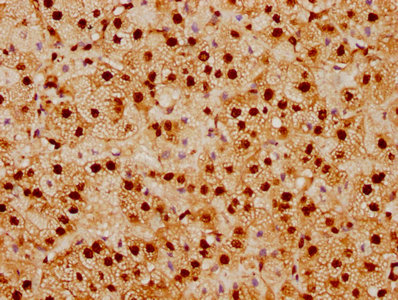
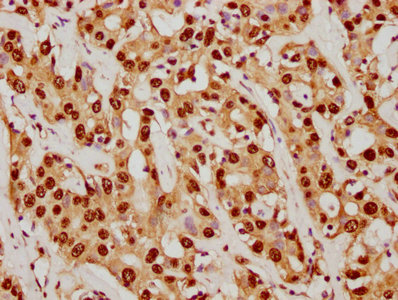
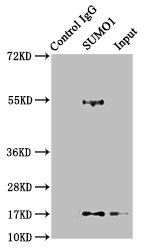
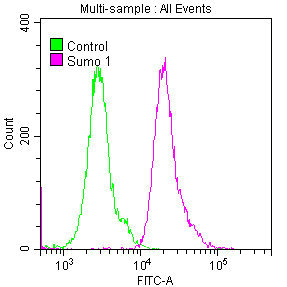
Validation data demonstrates robust performance across multiple applications. Immunohistochemistry staining in paraffin-embedded human tissues, including adrenal gland and liver cancer specimens, shows reliable detection using citrate buffer antigen retrieval on automated Leica Bond systems at dilutions around 1:92.5. For protein interaction studies, immunoprecipitation experiments successfully enriched SUMO1 from 293T whole cell lysates, confirming the antibody's utility for pulldown workflows. Flow cytometry analysis in HeLa cells, performed with ethanol fixation and Triton X-100 permeabilization, produced clear positive signal separation from control, supporting intracellular detection applications.
The antibody's affinity-purified format and compatibility with ELISA further extend its versatility for quantitative and screening approaches. Whether you are mapping SUMOylation dynamics in cancer biology, characterizing stress response pathways, or investigating nuclear protein trafficking, this antibody provides a dependable tool for advancing your cell biology research.
There are currently no reviews for this product.





