
Call us
301-363-4651 (Available 9 a.m. to 5 p.m. CST from Monday to Friday)

| Code | CSB-RA975045A0HU |
| Size | US$210 |
| Order now | |
| Image |
|
| Have Questions? | Leave a Message or Start an on-line Chat |
| Application | Recommended Dilution |
|---|---|
| IF | 1:50-1:200 |
| FC | 1:50-1:200 |
SUMO2 and SUMO3 are small ubiquitin-like modifier proteins that play essential roles in post-translational modification, regulating diverse cellular processes including transcription, DNA repair, nuclear transport, and stress responses. These two proteins share approximately 97% sequence identity and are often studied together due to their functional redundancy and the difficulty in distinguishing them with conventional reagents. Understanding SUMOylation dynamics has become increasingly important in cancer biology, neurodegenerative disease research, and studies of cellular stress responses.
This recombinant monoclonal antibody, clone 14A3, offers researchers the consistency and reliability that comes with sequence-defined production. Unlike traditional hybridoma-derived antibodies, recombinant technology ensures lot-to-lot reproducibility, allowing you to maintain experimental continuity across long-term studies without the variability that can complicate data interpretation. The rabbit IgG format provides excellent signal-to-noise characteristics for cellular imaging applications.
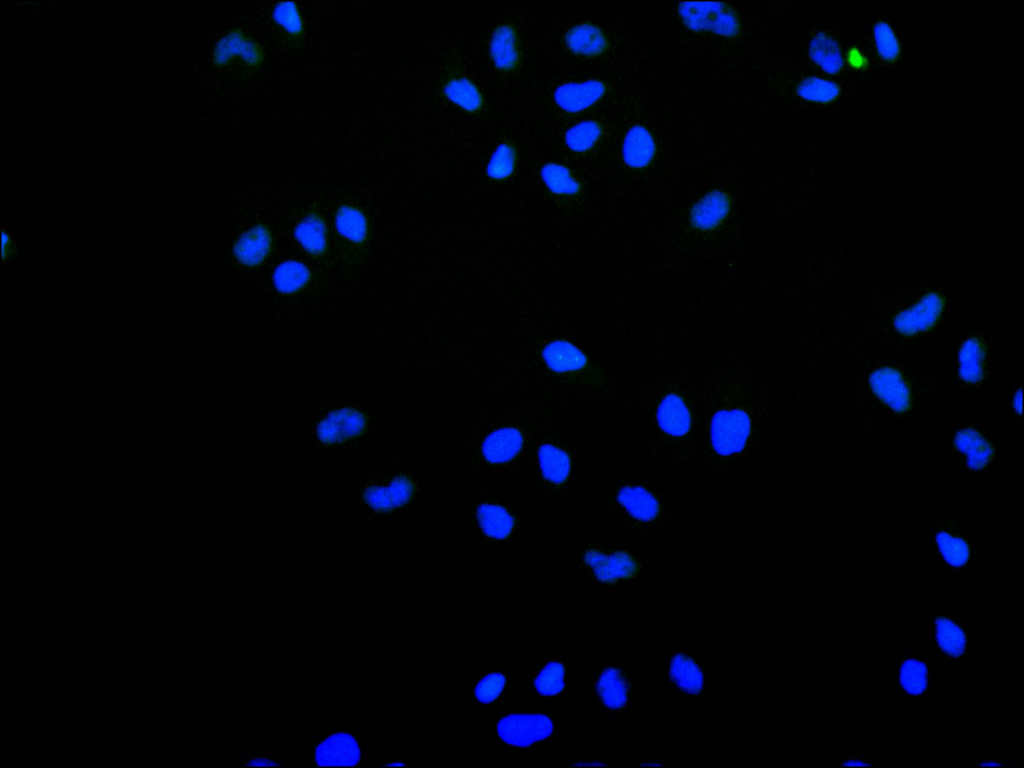
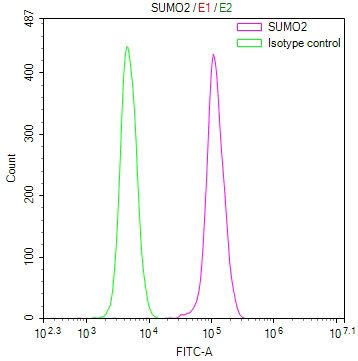
Validation studies confirm robust performance in immunofluorescence and flow cytometry applications. In HeLa cells, the antibody produces clear nuclear and cytoplasmic staining patterns consistent with known SUMO2/3 localization, with recommended dilutions of 1:50 to 1:200 for immunofluorescence work. Flow cytometry analysis using SH-SY5Y neuroblastoma cells demonstrates distinct positive population shifts compared to isotype controls, supporting applications in quantitative single-cell analysis at dilutions of 1:50 to 1:200.
This antibody serves researchers investigating SUMOylation in contexts ranging from proteotoxic stress responses to cell cycle regulation. The validated performance in both adherent epithelial and neuronal cell models makes it particularly suitable for studies examining SUMO2/3 dynamics across different cellular contexts and stress conditions.
There are currently no reviews for this product.





