
Call us
301-363-4651 (Available 9 a.m. to 5 p.m. CST from Monday to Friday)

| Code | CSB-CF3511GNY |
| Abbreviation | Recombinant Tetranychus urticae Uncharacterized protein |
| MSDS | |
| Size | $1620 |
| Order now | |
| Image |
|
| Have Questions? | Leave a Message or Start an on-line Chat |
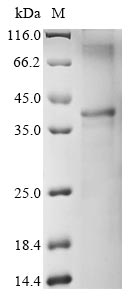
This recombinant protein from Tetranychus urticae gets produced using an in vitro E.coli expression system. It covers the complete sequence from amino acids 1 to 376 and comes with an N-terminal 10xHis-tag that makes purification and detection much easier. SDS-PAGE analysis shows the protein maintains a purity level above 85%. Important to note: this is strictly for research purposes - not for diagnostic or therapeutic use.
The uncharacterized protein from the two-spotted spider mite, Tetranychus urticae, continues to puzzle scientists. Proteins from this species often get studied for their roles in arthropod physiology and how they might interact with plant hosts. Since these mites are serious agricultural pests, understanding their proteins may suggest new pest control strategies and could contribute valuable insights to agricultural research.
Potential Applications
Note: The applications listed below are based on what we know about this protein's biological functions, published research, and experience from experts in the field. However, we haven't fully tested all of these applications ourselves yet. We'd recommend running some preliminary tests first to make sure they work for your specific research goals.
Based on the provided information, the recombinant Tetranychus urticae uncharacterized protein may not be correctly folded or bioactive without experimental validation. The cell-free E. coli expression system lacks the cellular environment (e.g., chaperones, post-translational modifications) that might be necessary for proper folding of a eukaryotic protein from a spider mite. The N-terminal 10xHis tag is relatively small but could still cause steric hindrance, especially if the N-terminus is critical for folding. The full-length expression (1-376aa) is advantageous, but the cell-free system may produce misfolded aggregates or incomplete folding due to rapid synthesis. The purity >85% indicates some impurities that could include misfolded proteins. Without validation (e.g., circular dichroism for secondary structure, size-exclusion chromatography for oligomeric state), the protein's folding status and bioactivity remain uncertain. Therefore, while the protein might fold correctly, it cannot be assumed without evidence.
1. Protein-Protein Interaction Studies via His-Tag Pull-Down Assays
This recombinant protein can be used for pull-down assays only if correct folding is verified. If misfolded, interactions may be non-specific or artifactual, leading to false positives. The His-tag allows immobilization, but the cell-free expression system may not produce a natively folded protein. Validate folding through biophysical methods (e.g., circular dichroism) before interaction studies, and include controls (e.g., tag-only protein) to ensure specificity.
2. Antibody Development and Immunological Studies
This recombinant protein can serve as an immunogen for antibody generation, but if misfolded, antibodies may recognize linear epitopes or the His-tag rather than conformational epitopes of the native protein. The high purity (>85%) reduces contamination risks but does not guarantee proper folding. Validate resulting antibodies against native protein from Tetranychus urticae tissues to confirm specificity for immunological applications.
3. Structural and Biophysical Characterization
This protein is unsuitable for high-resolution structural studies (e.g., crystallography or NMR) without folding validation and tag removal. The cell-free system may yield heterogeneous or misfolded proteins, and the His-tag could interfere with structural analysis. Biophysical techniques (e.g., circular dichroism, dynamic light scattering) can assess general folding but may not confirm native structure. For meaningful insights, remove the His-tag and verify folding before structural studies.
4. Comparative Evolutionary and Phylogenetic Analysis
This recombinant protein can be used for sequence-based comparative studies, but for functional or biochemical comparisons, correct folding must be verified. If misfolded, assays measuring activity or binding may not accurately reflect evolutionary conservation. Use with caution and validate folding before concluding functional homology across species.
Final Recommendation & Action Plan
To ensure reliable results, first validate the folding and bioactivity of the recombinant protein using techniques such as circular dichroism to assess secondary structure, size-exclusion chromatography to monitor oligomeric state and purity, and functional assays if possible (e.g., based on predicted function). For protein-protein interaction experiments, use only after folding confirmation and include appropriate controls. For antibody development, characterize antibodies against native protein sources. For structural studies, consider tag removal and use eukaryotic expression systems if folding is inadequate. Always prioritize folding validation before any application to avoid misleading data.
There are currently no reviews for this product.





