
Call us
301-363-4651 (Available 9 a.m. to 5 p.m. CST from Monday to Friday)

| Code | CSB-CF025578HU |
| Abbreviation | Recombinant Human UGT1A5 protein |
| MSDS | |
| Size | $878 |
| Order now | |
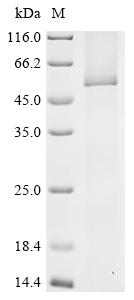
| Image |
|
| Have Questions? | Leave a Message or Start an on-line Chat |
Recombinant Human UDP-glucuronosyltransferase 1A5 (UGT1A5) is produced through an E.coli-based cell-free expression system. The protein spans amino acids 29 to 534, which represents the full length of the mature protein. An N-terminal 10xHis-tag has been included to simplify purification and detection processes. SDS-PAGE analysis confirms that the protein achieves a purity level above 85%, which appears sufficient for most research applications.
UDP-glucuronosyltransferase 1A5 (UGT1A5) belongs to the broader UGT superfamily - a group of enzymes that may play essential roles in phase II biotransformation of both endogenous and exogenous compounds. UGT1A5 specifically contributes to glucuronidation, a process that likely increases the solubility and excretion of lipophilic substances. This makes it particularly relevant for drug metabolism studies and research into human detoxification pathways.
Potential Applications
Note: The applications listed below are based on what we know about this protein's biological functions, published research, and experience from experts in the field. However, we haven't fully tested all of these applications ourselves yet. We'd recommend running some preliminary tests first to make sure they work for your specific research goals.
Based on the provided information, the recombinant Human UGT1A5 is expressed using an in vitro E. coli expression system (cell-free system), which generally provides better folding conditions than traditional cellular expression by reducing aggregation and cellular stress. The protein is expressed as the full-length mature protein (29-534aa) with an N-terminal 10xHis tag, and purity is >85% by SDS-PAGE. However, UGT1A5 is an endoplasmic reticulum membrane-associated enzyme that requires proper folding, membrane integration, and dimerization for its glucuronidation activity. Since activity is unverified, the protein cannot be assumed to be correctly folded or bioactive. While the cell-free system improves folding probability, the absence of ER membranes and specific chaperones may affect proper folding and membrane association. Experimental validation is essential to confirm both proper folding and enzymatic activity.
1. Antibody Development and Validation Studies
This application is well-supported. The recombinant UGT1A5 can serve as an effective immunogen for generating antibodies, as antibodies may recognize linear epitopes even if the protein is misfolded. The high purity (>85%) and His-tag facilitate purification and screening in ELISA, Western blot, and immunoprecipitation. However, if UGT1A5 is misfolded, antibodies may not recognize conformational epitopes of the native, membrane-associated enzyme. Validation against endogenous UGT1A5 from human tissues or cell lines is recommended.
2. Protein-Protein Interaction Studies
The His-tag enables pull-down assays to identify binding partners, but this application is highly dependent on correct folding. If UGT1A5 is misfolded or improperly membrane-integrated, interactions may be non-physiological. UGTs often form homo- and heterodimers and interact with ER proteins; misfolding could disrupt these specific associations. This application should only be pursued after confirming proper folding and activity. It should be noted that results require validation with orthogonal methods.
3. Biochemical Characterization and Enzyme Kinetics Research
This application is appropriate for basic biochemical analysis (e.g., thermal stability, pH sensitivity) but is problematic for enzyme kinetics without activity verification. If UGT1A5 is inactive, kinetic parameters (Km, Vmax) will be invalid. The protein can be used to optimize assay conditions, but functional validation (e.g., glucuronidation activity with probe substrates) is essential before quantitative kinetics. It should separate condition optimization from functional kinetics studies.
4. Structural Biology and Biophysical Analysis
This application is suitable and should be prioritized to assess folding. Techniques like circular dichroism, dynamic light scattering, and analytical ultracentrifugation can directly evaluate protein conformation, oligomeric state, and stability without requiring activity. These studies are valuable even if the protein is inactive. However, surface plasmon resonance studies for binding kinetics require correct folding to be meaningful. It should emphasize folding assessment before binding studies.
Final Recommendation & Action Plan
Given the uncertainty in folding and bioactivity, the recommended approach is to first perform biophysical characterization (Application #4) to assess the protein's secondary structure, oligomeric state, and stability. If the protein shows proper folding, proceed with functional validation using enzymatic assays (e.g., glucuronidation of known substrates like 4-methylumbelliferone). Once activity is confirmed, the protein can be used for interaction studies and detailed enzyme kinetics. For antibody development (Application #1), the protein can be used immediately, but antibodies should be validated against active UGT1A5. Always include appropriate controls such as known UGT substrates/inhibitors and compare results with literature values where possible. The cell-free expression system is advantageous but does not guarantee membrane protein functionality without validation.
There are currently no reviews for this product.





