
Call us
301-363-4651 (Available 9 a.m. to 5 p.m. CST from Monday to Friday)

| Code | CSB-MA000031M0m |
| Size | US$120 |
| Order now | |
| Image |
|
| Have Questions? | Leave a Message or Start an on-line Chat |
| Application | Recommended Dilution |
|---|---|
| WB | 1:500-1:80000 |
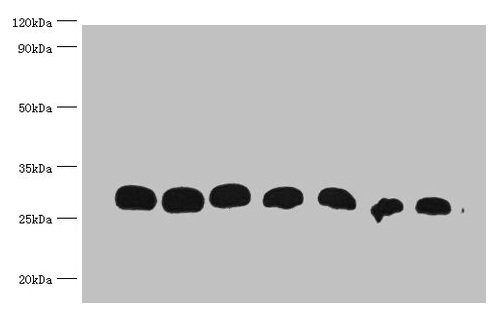
The glutathione S-transferase (GST) tag is a widely used fusion peptide tag to facilitate recombinant protein purification, expression detection, and quantitative analysis in prokaryotic protein engineering research. CSB-MA000031M0m is a mouse monoclonal IgG2b antibody raised against recombinant GST protein, purified by Protein G affinity chromatography with purity exceeding 95%. Its stable performance has been validated by 5 independent peer-reviewed publications to guarantee consistent batch-to-batch reproducibility and negligible non-specific binding. Functioning as a sensitive tag detection antibody, it specifically recognizes GST-fusion constructs across all species. Western blot on pure recombinant GST protein generates a single sharp 28 kDa band without visible non-specific bands, maintaining clear detectable signals at serial dilutions ranging from 1:1000 up to 1:80000, showing robust linear signal attenuation as dilution rises. Validated for ELISA and Western blot, this antibody provides a flexible working dilution window to support routine recombinant GST protein screening, quantification, and qualitative identification in prokaryotic expression and molecular interaction experiments.

Applications : WB
Sample dilution: 1: 3000
Review: The in vitro translated emerin deletion mutants were subjected to GST pull-down assays with purified GST and GST-NICD. Bound proteins were analyzed by western blotting with anti-HA antibody. The purified proteins were subjected to western blot analysis with anti-GST antibody.
By Anonymous
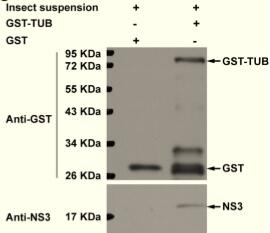
Applications : GST pull-down assay
Review: GST pull-down assays. LsTUB was fused to GST and incubated with viruliferous SBPH extracts or GST (control). Blots were probed with anti-NS3 or anti-GST antibodies.
By Anonymous
Applications : GST Pull-Down Assay
Review: Proteins were then separated by SDS–PAGE and detected using anti-GST and anti-LstrE3 antibodies.
By Anonymous





