SSC1 Antibody

Rare Species
Code CSB-PA206965XA01SVG
Size US$299
Image
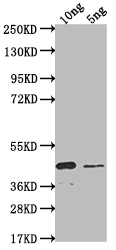
  • Western Blot
    Positive WB detected in Recombinant protein
    All lanes: SSC1 antibody at 1:2000
    Secondary
    Goat polyclonal to rabbit IgG at 1/50000 dilution
    Predicted band size: 35.4 kDa
    Observed band size: 40 kDa
Promotion Free Antibody trial simple
Have Questions? Leave a Message or Start an on-line Chat

Product Details

Uniprot No.
Target Names
SSC1
Alternative Names
Heat shock protein SSC1, mitochondrial (Endonuclease SceI 75 kDa subunit) (Endo.SceI 75 kDa subunit) (mtHSP70) SSC1 ENS1 YJR045C J1639
Species Reactivity
Saccharomyces cerevisiae (strain ATCC 204508 / S288c) (Baker's yeast)
Immunogen
Recombinant Saccharomyces cerevisiae (strain ATCC 204508 / S288c) (Baker's yeast) SSC1 protein (363-654aa)
Immunogen Species
Saccharomyces cerevisiae (strain ATCC 204508 / S288c) (Baker's yeast)
Conjugate
Non-conjugated
Clonality
Polyclonal
Isotype
IgG
Purification Method
Protein G
Concentration
It differs from different batches. Please contact us to confirm it.
Buffer
Preservative: 0.03% Proclin 300
Constituents: 50% Glycerol, 0.01M PBS, pH 7.4
Form
Liquid
Tested Applications
ELISA, WB
Troubleshooting and FAQs
Storage
Upon receipt, store at -20°C or -80°C. Avoid repeated freeze.
Lead Time
Basically, we can dispatch the products out in 1-3 working days after receiving your orders. Delivery time maybe differs from different purchasing way or location, please kindly consult your local distributors for specific delivery time.
Description

The SSC1 polyclonal antibody is produced by immunizing a rabbit with a recombinant Saccharomyces cerevisiae (strain ATCC 204508 / S288c) (Baker's yeast) SSC1 protein (363-654aa) to elicit an antibody response. The serum is collected from the rabbit to obtain polyclonal antibodies, which subsequently undergo protein G affinity chromatography purification. The efficacy of the SSC1 antibody in detecting Saccharomyces cerevisiae (strain ATCC 204508 / S288c) (Baker's yeast) SSC1 protein is validated through ELISA and WB assays.

The Saccharomyces cerevisiae SSC1 protein acts as a molecular chaperone that assists in protein folding, assembly, and transport within the cell. The SSC1 protein helps prevent protein misfolding and aggregation, ensuring proper protein function and maintaining cellular homeostasis. Additionally, it plays a role in the response to stress conditions, such as heat shock, by aiding in the refolding of denatured proteins.

Usage
For Research Use Only. Not for use in diagnostic or therapeutic procedures.

Customer Reviews and Q&A

 Customer Reviews

There are currently no reviews for this product.

Submit a Review here

Target Background

Function
Essential component of the PAM complex, a complex required for the translocation of transit peptide-containing proteins from the inner membrane into the mitochondrial matrix in an ATP-dependent manner. Constitutes the ATP-driven core of the motor and binds the precursor preprotein. Required for the import of the processed frataxin homolog YFH1 into the mitochondrion.
Gene References into Functions
  1. Amino acid substitution within SSC1 reveals structural elements within mtHsp70s that are required for allosteric modulation of the chaperone cycle. PMID: 24829379
  2. Results show that mtHsp70-Cox4 complex likely serves as a novel delivery system to channel Cox4 into the assembly line when needed. PMID: 23864706
  3. The intrinsic dynamics of the substrate-binding domain of Ssc1 was observed to be uncoupled from the dynamic interactions between substrate- and nucleotide-binding domains. PMID: 23624933
  4. the critical amino acid sequence of Ssc1 and Ssc3 that can "make or break" mtHsp70 chaperone function. PMID: 21474445
  5. interactions between Tim44 and mtHsp70, controlled by polypeptide binding, are required for efficient translocation across the mitochondrial inner membrane PMID: 15489862
  6. The N-terminal 167-amino-acid segment of mature Tim44 is sufficient for both interaction with mtHsp70 and destabilization of a Tim44-mtHsp70 complex caused by client protein binding. PMID: 18426906

Show More

Hide All

Subcellular Location
Mitochondrion matrix.
Protein Families
Heat shock protein 70 family
Database Links

KEGG: sce:YJR045C

STRING: 4932.YJR045C

icon of phone
Call us
301-363-4651 (Available 9 a.m. to 5 p.m. CST from Monday to Friday)

icon of address
Address
7505 Fannin St., Ste 610, Room 7 (CUBIO Innovation Center), Houston, TX 77054, USA
icon of social media
Join us with

Subscribe newsletter

Leave a message

* To protect against spam, please pass the CAPTCHA test below.
CAPTCHA verification
© 2007-2026 CUSABIO TECHNOLOGY LLC All rights reserved. 鄂ICP备15011166号-1



