SIGF Antibody

Rare Species
Code CSB-PA787263XA01DOA
Size US$299
Image
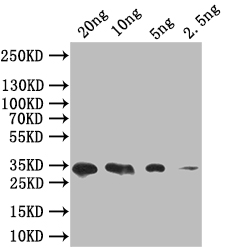
  • Western Blot
    Positive WB detected in: recombinant protein
    All lanes: SIGF Antibody at 1:1000
    Secondary
    Goat polyclonal to rabbit IgG at 1/50000 dilution
    Predicted band size: 34 kDa
    Observed band size: 34 kDa
Promotion Free Antibody trial simple
Have Questions? Leave a Message or Start an on-line Chat

Product Details

Uniprot No.
Target Names
SIGF
Alternative Names
RNA polymerase sigma factor sigF, chloroplastic (Sigma factor F) (Sigma-F) (Protein SINGLET OXYGEN-LINKED DEATH ACTIVATOR 8) (RNA polymerase sigma factor sig6) (Atsig6) (Sigma factor 6) SIGF SIG6 SOLDAT8 At2g36990 T1J8
Species Reactivity
Arabidopsis thaliana
Immunogen
Recombinant Arabidopsis thaliana SIGF protein (296-547aa)
Immunogen Species
Arabidopsis thaliana (Mouse-ear cress)
Conjugate
Non-conjugated
Clonality
Polyclonal
Isotype
IgG
Purification Method
Affinity-chromatography
Concentration
It differs from different batches. Please contact us to confirm it.
Buffer
Preservative: 0.03% Proclin 300
Constituents: 50% Glycerol, 0.01M PBS, pH 7.4
Form
Liquid
Tested Applications
ELISA, WB
Troubleshooting and FAQs
Storage
Upon receipt, store at -20°C or -80°C. Avoid repeated freeze.
Lead Time
Basically, we can dispatch the products out in 1-3 working days after receiving your orders. Delivery time maybe differs from different purchasing way or location, please kindly consult your local distributors for specific delivery time.
Description

The SIGF polyclonal antibody is generated by immunizing a rabbit with a recombinant Arabidopsis thaliana SIGF protein segment (amino acids 296-547). Several repeated immunizations induce an immune reaction in the rabbit, resulting in the production of polyclonal antibodies against SIGF. The collected rabbit serum contains polyclonal antibodies, which are purified using affinity chromatography. The functionality of the SIGF antibody is assessed through ELISA and WB assays, verifying its ability to detect the Arabidopsis thaliana SIGF protein in experimental settings.

Usage
For Research Use Only. Not for use in diagnostic or therapeutic procedures.

Customer Reviews and Q&A

 Customer Reviews

There are currently no reviews for this product.

Submit a Review here

Target Background

Function
Sigma factors are initiation factors that promote the attachment of plastid-encoded RNA polymerase (PEP) to specific initiation sites and are then released. Regulates transcription in chloroplast in a DG1-dependent manner. Involved in light-dependent chloroplast development. Required during early plant development and primary leaf formation.
Gene References into Functions
  1. The interaction of DG1 and SIG6 regulates RNA polymerase-dependent chloroplast gene transcription. PMID: 20626654
  2. AtSIG6 is a substrate for regulatory phosphorylation by cpCK2. PMID: 20088902
  3. AtSIG6 may act as a major general sigma factor in chloroplasts during early plant development. PMID: 15807777
  4. The developmental expression of Sig6 in plastids is reported. PMID: 16905663
  5. Inactivation of the SOLDAT8 protein does not impair oxygen singlet-mediated signaling, but instead enhances light sensitivity. [SIGMA6] PMID: 19273469

Show More

Hide All

Subcellular Location
Plastid, chloroplast.
Protein Families
Sigma-70 factor family
Tissue Specificity
Expressed in seedling, accumulating progressively. Present in leaves but not in roots.
Database Links

KEGG: ath:AT2G36990

STRING: 3702.AT2G36990.1

UniGene: At.1453

icon of phone
Call us
301-363-4651 (Available 9 a.m. to 5 p.m. CST from Monday to Friday)

icon of address
Address
7505 Fannin St., Ste 610, Room 7 (CUBIO Innovation Center), Houston, TX 77054, USA
icon of social media
Join us with

Subscribe newsletter

Leave a message

* To protect against spam, please pass the CAPTCHA test below.
CAPTCHA verification
© 2007-2026 CUSABIO TECHNOLOGY LLC All rights reserved. 鄂ICP备15011166号-1



