SNF1 Antibody

Rare Species
Code CSB-PA361945XA01SVG
Size US$299
Image
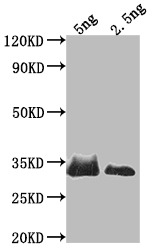
  • Western Blot
    Positive WB detected in Recombinant protein
    All lanes: SNF1 antibody at 1:2000
    Secondary
    Goat polyclonal to rabbit IgG at 1/50000 dilution
    Predicted band size: 38.2 kDa
    Observed band size: 36 kDa
Promotion Free Antibody trial simple
Have Questions? Leave a Message or Start an on-line Chat

Product Details

Uniprot No.
Target Names
SNF1
Alternative Names
Carbon catabolite-derepressing protein kinase (EC 2.7.11.1) (Sucrose nonfermentating protein 1) SNF1 CAT1 CCR1 GLC2 PAS14 YDR477W D8035.20
Species Reactivity
Saccharomyces cerevisiae (strain ATCC 204508 / S288c) (Baker's yeast)
Immunogen
Recombinant Saccharomyces cerevisiae (strain ATCC 204508 / S288c) (Baker's yeast) SNF1 protein (435-633aa)
Immunogen Species
Saccharomyces cerevisiae (strain ATCC 204508 / S288c) (Baker's yeast)
Conjugate
Non-conjugated
Clonality
Polyclonal
Isotype
IgG
Purification Method
Protein G
Concentration
It differs from different batches. Please contact us to confirm it.
Buffer
Preservative: 0.03% Proclin 300
Constituents: 50% Glycerol, 0.01M PBS, pH 7.4
Form
Liquid
Tested Applications
ELISA, WB
Troubleshooting and FAQs
Storage
Upon receipt, store at -20°C or -80°C. Avoid repeated freeze.
Lead Time
Basically, we can dispatch the products out in 1-3 working days after receiving your orders. Delivery time maybe differs from different purchasing way or location, please kindly consult your local distributors for specific delivery time.
Usage
For Research Use Only. Not for use in diagnostic or therapeutic procedures.

Customer Reviews and Q&A

 Customer Reviews

There are currently no reviews for this product.

Submit a Review here

 Q&A
Q:

I am interested in the Snf1 antibody (CSB-PA361945XA01SVG). However, I have a question about the antibody.Why does the WB band show size 36 kDa when Snf1 is a 72-kDa protein? Does it recognizes Snf1 specifically if I load yeast cell lysates?

A:

The antibody CSB-PA361945XA01SVG was tested for detecting the recombinant SNF1 protien (435-633aa) in our Western Blot, not the native SNF1 protein from cell lines. It should work for yeast cell lysates as well, but this has not been tested experimentally. If you would like to test this antibody, please contact our local distributor Cedrlane to request a sample. Our current promotion provides ONE free antibody sample(20ug/ul size) per end-user, the additional ones will be $49.9 each.

Target Background

Function
Serine/threonine protein kinase essential for release from glucose repression. Catalytic subunit of the AMP-activated protein kinase complex also known as the SNF1 kinase complex (Snf1c), a central regulator of cellular energy homeostasis, which, in response to a fall in intracellular ATP levels, activates energy-producing pathways and inhibits energy-consuming processes. The complex phosphorylates histone H3 to form H3S10ph, which promotes H3K14ac formation, leading to transcriptional activation through TBP recruitment to the promoters. The complex also negatively regulates the HOG1 MAPK pathway in ER stress response including unfolded protein response (UPR). Under nutrient/energy depletion, the complex phosphorylates and activates PAS kinase PSK1 which in turn activates PBS1, leading to the inhibition of the TORC1 signaling pathway. SNF1 also interacts and phosphorylates adenylate cyclase CYR1 and negatively regulates the protein kinase A signaling pathway. Also phosphorylates and regulates the transcriptional activator CAT8.
Gene References into Functions
  1. The deletion of Snf1 impairs the cell wall integrity by reducing the transcription of beta-glucan-related genes. PMID: 29733174
  2. The authors demonstrate that to permit long-term survival in response to sudden glucose depletion, yeast cells activate lipid-droplet (LD) consumption through micro-lipophagy (micro-lipophagy), in which fat is metabolized as an alternative energy source. AMP-activated protein kinase (AMPK) activation triggered this pathway, which required Atg14p. PMID: 28394250
  3. Here, the authors present evidence that Reg2 contributes to Snf1 Thr210 dephosphorylation. PMID: 27107116
  4. While SNF1 is essential for induction of gluconeogenesis, trehalose-6-phosphate/trehalose-6-phosphate synthesis is required for inactivation of gluconeogenesis in the presence of glucose, downstream and independent of SNF1 activity and the Cat8 and Sip4 transcription factors. PMID: 27189362
  5. Yeast have developed two distinct pathways for down-regulating Snf1 activity. The first is through direct dephosphorylation of the conserved activation loop threonine. The second is through phosphorylation of serine 214. PMID: 27524664
  6. The characteristics of SNF1 complex subunits, and the structure and regulation of the activity of the SNF1 complex has been presented. (Review) PMID: 27812987
  7. SNF1-dependent ADH2 promoter, or just the major transcription factor binding site, is sufficient to confer glucose-induced mRNA decay upon heterologous transcripts. PMID: 26667037
  8. these findings suggest that SNF1 (AMPK in mammalian systems) is the molecular target of RSV in S. cerevisiae. PMID: 26091703
  9. direct Arf activation by Snf1 regulates cellular responses to energy deprivation, in particular invasive cell growth PMID: 26198097
  10. the enhanced UBA-dependent longevity and oxidative stress response are at least partially dependent on the Fkh1 and Fkh2 stress response transcription factors, which in turn are shown to influence Snf1 gene expression. PMID: 25869125
  11. Snf1 Phosphorylates Adenylate Cyclase and Negatively Regulates Protein Kinase A-dependent Transcription in Saccharomyces cerevisiae PMID: 26309257
  12. Modulation of Snf1 phosphorylation and its protein level are important for adaptation to environmental stress. PMID: 25947383
  13. The Glc7-Reg1 complex takes part in the regulation of the AMP-activated serine/threonine protein kinase Snf1 in the regulation of the unfolded protein response. PMID: 25730376
  14. the AMPK Snf1p and ER stress kinase Ire1p regulated the HOG pathway. PMID: 25356552
  15. Xrn1 is required for Snf1-dependent mRNA homeostasis in response to nutrient availability. PMID: 25005228
  16. Data indicate that the Snf1-Mig1 signaling system monitors glucose concentration changes and absolute glucose levels to adjust the metabolism to a wide range of conditions. PMID: 24627493
  17. Epistasis analyses with mutants in cell wall integrity (CWI) signaling confirm that the SNF1 complex and the CWI pathway independently affect yeast cell integrity. PMID: 24486034
  18. Snf1 can be phosphorylated and activated in the presence of glucose without mediating glucose de-repression. PMID: 24529170
  19. the same kinases and phosphatase that regulate Snf1 also regulate Gpa1. PMID: 24003255
  20. Regulation of acetyl-CoA homeostasis represents another mechanism in the SNF1 regulatory repertoire. PMID: 24081331
  21. Findings indicate another way SNF1 function is regulated in response to carbon source. PMID: 24108357
  22. Snf1 is an AMPK family member that protects Saccharomyces cerevisiae cells upon glutathione oxidation PMID: 23472170
  23. Signalling pathways co-operate in the anticipatory Hxt5p activity in glucose-starved cells: as expected, the sucrose nonfermenting (Snf)1 AMP kinase pathway is a key element. PMID: 23495665
  24. Snf1 interacts with Por1 and Por2. PMID: 23104570
  25. we show that under derepressing conditions the recruitment of the histone acetyltransferase Gcn5 is abolished by SNF1 deletion, possibly explaining the lack of increased histone H3 acetylation and nucleosome remodelling. PMID: 22306658
  26. Snf1 is essential for glucose regulation of Hog1 MAPK and Sac1 traffic. PMID: 22882253
  27. The IL-1alpha-binding site was mapped to the HAT/Core module of the SAGA complex. PMID: 22879895
  28. Snf1 appears to affect multiple steps in gene regulation, including transcription factor binding, RNA polymerase II activity, and cytoplasmic mRNA stability. PMID: 22761425
  29. Data show that at the transcription level, Snf1 and inositol-choline interact directly through transcription factors. PMID: 22622761
  30. yeast Snf1 participates in metabolic checkpoint control that coordinates growth with nutrient availability. PMID: 22140226
  31. the role of Snf1 in tolerance to alkalinization is largely due to the function of the kinase in the adaptation of the cell to glucose scarcity, thus delineating with both the PKA and calcineurin pathways PMID: 22372618
  32. Snf1 has a role in upregulating the NADP(+)-dependent glutamate dehydrogenase under derepressing condition. direct interactions between Snf1 and TORC1 pathways are unlikely under nutrient-limited conditions. PMID: 22068328
  33. Subunit and domain requirements for adenylate-mediated protection of Snf1 kinase activation loop from dephosphorylation. PMID: 22065577
  34. Ubp8 can deubiquitinate Snf1, a highly conserved AMP-activated serine/threonine protein kinase that serves as an energy sensor in the cell. PMID: 21628526
  35. conformation of the SNF1 complex is crucial to maintenance of the inactive state during growth on high glucose and that the default state for SNF1 is one in which Thr(210) is phosphorylated and the kinase is active. PMID: 21561858
  36. The lack of Snf1 alpha-catalytic subunit down-regulates the growth rate and CLB5 expression, delaying Sld2 phosphorylation and G 1/S transition. PMID: 20505334
  37. C terminal of the Sak1 mediate interaction with Snf1 and activation of Snf1. PMID: 21216941
  38. The balance between the fermentative/oxidativein Saccharomyces cerevisiae is shifted by transcriptional deregulation of Snf1 via overexpression of the upstream activating kinase Sak1p. PMID: 21257817
  39. crystal structure of residues 41-440 of Snf1, which include the protein Ser/Thr kinase domain and auto-inhibitory domain, is reported at 2.4 A resolution PMID: 20823513
  40. This suggests that residues 450-500 may be constitutively associated with Snf4, and the remaining segments of the RS, as well as the AID, may be involved in regulating SNF1 activity. PMID: 20529674
  41. The expression of GPX1 is induced by glucose starvation and treatment with calcium chloride involving the Ras/cAMP pathway and Snf1. PMID: 20002498
  42. Data describe the role of the beta subunits in the regulation of Snf1 activity. PMID: 19897735
  43. Results suggest that Sak1 is involved in nitrogen signaling upstream of Snf1. PMID: 19880754
  44. Yeast Snf1 has a far more extensive function in controlling energy metabolism than reported earlier. PMID: 19888214
  45. Non-activated form of Snf1 regulates the Trk high-affinity potassium transporter, encoded by the TRK1 and TRK2 genes. PMID: 15642368
  46. hyperactivation of Snf1 kinase, as caused by reg1Delta, suppresses the Spt(-) phenotype of spt21Delta PMID: 15744051
  47. Gln3 phosphorylation levels are regulated as follows: (i) depends on Snf1 kinase as observed during carbon starvation, (ii) is Snf1-independent as observed during both carbon starvation and MSX treatment, and (iii) is rapamycin-induced dephosphorylation PMID: 15911613
  48. crystal structure at 2.2A resolution of the protein kinase domain (KD) of the catalytic subunit of yeast AMPK (commonly known as SNF1) PMID: 16236260
  49. Snf1p-dependent Spt-Ada-Gcn5-acetyltransferase (SAGA) recruitment and chromatin remodeling activities on the HXT2 and HXT4 promoters. PMID: 16368692
  50. analysis of Snf1-dependent and Snf1-independent pathways of constitutive ADH2 expression in Saccharomyces cerevisiae PMID: 16415371

Show More

Hide All

Subcellular Location
Cytoplasm. Nucleus. Nucleus membrane; Peripheral membrane protein.
Protein Families
Protein kinase superfamily, CAMK Ser/Thr protein kinase family, SNF1 subfamily
Database Links

KEGG: sce:YDR477W

STRING: 4932.YDR477W

icon of phone
Call us
301-363-4651 (Available 9 a.m. to 5 p.m. CST from Monday to Friday)

icon of address
Address
7505 Fannin St., Ste 610, Room 7 (CUBIO Innovation Center), Houston, TX 77054, USA
icon of social media
Join us with

Subscribe newsletter

Leave a message

* To protect against spam, please pass the CAPTCHA test below.
CAPTCHA verification
© 2007-2026 CUSABIO TECHNOLOGY LLC All rights reserved. 鄂ICP备15011166号-1



