• Call: 301-363-4651
  • Email: [email protected]
Cusabio Life Science – Your Biology Science Partner
All
  • All
  • ELISA Kit
  • Protein
  • Antibody
  • Molecular Biology Product
  • Small Molecule
  • Peptide
  • Home
  • Products
    Kits
    • ELISA Kits
    • Exosome Isolation Kits
    • ELISA Kits For Food Safety & Drug Residues
    • Plasmid DNA Purification Maxiprep Kit
    • HCP Detection ELISA Kit
    Proteins
    • Active Proteins*
    • Native Proteins
    • Recombinant Proteins
    • Transmembrane Proteins
    Antibodies
    • Recombinant Antibodies
    • Monoclonal Antibodies
    • Polyclonal Antibodies
    • Secondary Antibodies
    • Tag/Control Antibodies
    • Small Molecular Antibodies
    • ChIP Antibodies
    • Antibody Pairs
    • Custom Antibodies
    • Modified Histone Antibodies
    • Biosimilar Antibodies
    Biochemical Reagents
    • Cell Electrofusion Buffer
    Stable Cell Line Clone Peptide
    • Cosmetic Peptide
    • Amino Acids and Derivatives
    Small Molecule
    • Food Safety Small Molecular Antigens
    • Other Small Molecular Antigens

    Solutions
    • mRNA Vaccine Research Solutions
    • ADC Development Solutions
    • CAR-T Therapy Development Solutions
    Hot Categories
    • IS Series Cytokine Detection ELISA Kit*
    • Mini Sample ELISA kit*
    • Notch Receptors and Ligands
    • Claudin (CLDN) Family Proteins
    • Rare Species Antibodies
    • Anti-CAR Linker Antibody
    • Anti-payload Antibodies
    • Immunohistochemistry (IHC) Antibodies
    • Flow Cytometry Antibodies
    • Recombinant DT3C protein
    • Chemokine Receptors
    • G protein-Coupled Receptor
    • Recombinant Antibodies for Drug Discovery
    • Recombinant Proteins for ADCs
    • New Products Launch
  • CRO Service
    Quote for CRO Service Specialized CRO Services
    • Stable Cell Line Developmentm Service
    • Custom Peptide Synthesis
    • SPR Detection Service
    Protein Expression Services
    • Transmembrane Protein Expression Service*
    • E.coli Expression System
    • Yeast Expression System
    • In vitro E.coli Expression System
    • Insect Baculovirus Expression System
    • Mammalian Cell Expression System
    Oligo Synthesis Service Gene Synthesis Service
    Therapeutic Antibody Discovery Service*
    • Mouse hybridoma screening & sequencing
    • Single B Cell Antibody Discovery*
    • VHH library screening
    Custom Antibody Services
    • HTP Recombinant Antibody Production
    • Recombinant Ab Production
    • Monoclonal Ab Production
    • Polyclonal Ab Production
    • Modified Ab Production
    • Anti-idiotype Antibody Production*
      • Home
      • Kit
      • ELISA Kits
      • Human β-galactosidase,βGAL ELISA Kit

      Human β-galactosidase,βGAL ELISA Kit

      Citations (3) Protocol MSDS
      Code CSB-E09463h
      Size 96T,5×96T,10×96T
      Price Request a Quote
      Trial Size 24T ELISA Kit Trial Size (Only USD$150/ kit)
      * Sample kit cost can be deducted as a $30 credit for each 96-assay kit of the same analyte and brand you subsequently purchase within six months until depleted. More details >>
      Interested in a trial size? Please leave a message below.
      Have Questions? Leave a Message or Start an on-line Chat
      • Product Details
      • Citations (3)
      • Related Products
      • Customer Reviews and Q&A
      • Target Background

      Product Details

      Target Name
      galactosidase, beta 1
      Alternative Names
      Acid beta galactosidase ELISA Kit; Acid beta-galactosidase ELISA Kit; Beta galactosidase 1 ELISA Kit; Beta galactosidase ELISA Kit; Beta-galactosidase ELISA Kit; BGAL_HUMAN ELISA Kit; EBP ELISA Kit; EBP; included ELISA Kit; Elastin receptor 1 (67kD) ELISA Kit; Elastin receptor 1 67kDa ELISA Kit; Elastin receptor 1 ELISA Kit; Elastin receptor 1; included ELISA Kit; Elastin-binding protein; included ELISA Kit; ELNR1 ELISA Kit; Galactosidase beta 1 ELISA Kit; GLB 1 ELISA Kit; GLB1 ELISA Kit; Lactase ELISA Kit; MPS4B ELISA Kit; S-GAL; included ELISA Kit
      Abbreviation
      GLB1
      Uniprot No.
      P16278
      Species
      Homo sapiens (Human)
      Sample Types
      serum, plasma, urine, tissue homogenates
      Detection Range
      7.8 μlU/mL-500 μlU/mL
      Sensitivity
      1.95 μlU/mL
      Assay Time
      1-5h
      Sample Loading Volume
      50-100ul
      Detection Wavelength
      450 nm
      Research Area
      Immunology
      Assay Principle
      quantitative
      Measurement
      Sandwich
      Precision
      Intra-assay Precision (Precision within an assay): CV%<8%      
      Three samples of known concentration were tested twenty times on one plate to assess.  
      Inter-assay Precision (Precision between assays): CV%<10%      
      Three samples of known concentration were tested in twenty assays to assess.    
                   
      Linearity
      To assess the linearity of the assay, samples were spiked with high concentrations of human βGAL in various matrices and diluted with the Sample Diluent to produce samples with values within the dynamic range of the assay.
        Sample Serum(n=4)  
      1:5 Average % 100  
      Range % 95-110  
      1:10 Average % 97  
      Range % 92-101  
      1:20 Average % 86  
      Range % 82-90  
      1:40 Average % 93  
      Range % 86-98  
      Recovery
      The recovery of human βGAL spiked to levels throughout the range of the assay in various matrices was evaluated. Samples were diluted prior to assay as directed in the Sample Preparation section.
      Sample Type Average % Recovery Range  
      Serum (n=5) 95 89-98  
      EDTA plasma (n=4) 92 88-96  
                   
                   
      Typical Data
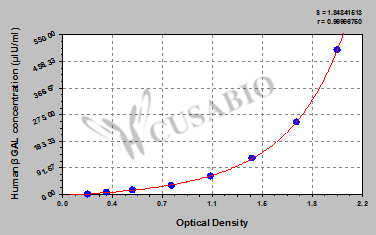
      These standard curves are provided for demonstration only. A standard curve should be generated for each set of samples assayed.
      µlU/ml OD1 OD2 Average Corrected  
      500 2.046 1.952 1.999 1.800  
      250 1.742 1.665 1.704 1.505  
      125 1.365 1.404 1.385 1.186  
      62.5 1.057 1.109 1.083 0.884  
      31.2 0.824 0.786 0.805 0.606  
      15.6 0.511 0.538 0.525 0.326  
      7.8 0.342 0.329 0.336 0.137  
      0 0.201 0.197 0.199    
      ELISA Data Analysis
      ELISA Standard Curve & Curve Expert software
      Troubleshooting
      and FAQs
      ELISA kit FAQs
      Storage
      Store at 2-8°C. Please refer to protocol.
      Shelf Life
      6 months
      Lead Time
      3-5 working days after you place the order, and it takes another 3-5 days for delivery via DHL or FedEx.
      Description

      This Human GLB1 ELISA Kit was designed for the quantitative measurement of Human GLB1 protein in serum, plasma, urine, tissue homogenates. It is a Sandwich ELISA kit, its detection range is 7.8 μlU/mL-500 μlU/mL and the sensitivity is 1.95 μlU/mL.

      Citations

      • Senolytic Effect of Cerium Oxide Nanoparticles (CeO2 NPs) by Attenuating p38/NF-кB, and p53/p21 Signaling Pathways H Haghi-Aminjan,Journal of Cluster Science,2021
      • Cannabinoids as anti-ROS in aged pancreatic islet cells M Baeeri,Life Sciences,2020
      • A novel method for banking stem cells from human exfoliatedDeciduous teeth: lentiviral TERT immortalization and phenotypical analysis. Yin Z.et al,Stem Cell Res Ther.,2016

      Related Products

      GLB1 Antibodies

      • GLB1 Antibody ( ELISA, WB, IHC, IF ) ( CSB-PA009476LA01HU )
      • GLB1 Antibody, FITC conjugated ( ) ( CSB-PA009476LC01HU )
      • GLB1 Antibody, Biotin conjugated ( ELISA ) ( CSB-PA009476LD01HU )
      • GLB1 Antibody, HRP conjugated ( ELISA ) ( CSB-PA009476LB01HU )
      • GLB1 Antibody ( WB, IHC, ELISA ) ( CSB-PA217171 )
      • More>>

      GLB1 Proteins

      • Recombinant Human Beta-galactosidase (GLB1) ( Yeast-CSB-YP009476HU E.coli-CSB-EP009476HU Baculovirus-CSB-BP009476HU In Vivo Biotinylation in E.coli-CSB-EP009476HU-B )

      Customer Reviews and Q&A

      ■ Customer Reviews

      There are currently no reviews for this product.

      Submit a Review here

      Target Background

      Function
      (From Uniprot)
      Cleaves beta-linked terminal galactosyl residues from gangliosides, glycoproteins, and glycosaminoglycans.; Has no beta-galactosidase catalytic activity, but plays functional roles in the formation of extracellular elastic fibers (elastogenesis) and in the development of connective tissue. Seems to be identical to the elastin-binding protein (EBP), a major component of the non-integrin cell surface receptor expressed on fibroblasts, smooth muscle cells, chondroblasts, leukocytes, and certain cancer cell types. In elastin producing cells, associates with tropoelastin intracellularly and functions as a recycling molecular chaperone which facilitates the secretions of tropoelastin and its assembly into elastic fibers.
      Gene References into Functions
      1. We confirmed a diagnosis of GM1 gangliosidosis based on GLB1 mutations and/or the deficiency of beta-galactosidase activity. We identified the first two cases by whole-exome sequencing, and then the other six cases by direct sequencing of GLB1 with enzyme analysis. The recurrent mutation, p.D448V in GLB1, accounted for 50.0% of total alleles in our cohort. PMID: 29439846
      2. GLB1 rs4678680 SNP contributes to susceptibility to develop HBV-related hepatocellular carcinoma PMID: 27489354
      3. beta-Gal expression in articular cartilage is associated with progressive knee osteoarthritis joint damage and is a potential indictor of disease severity. PMID: 26112901
      4. This study shows that moderate widespread expression of betagal in the CNS of GM1 gangliosidosis mice is sufficient to achieve significant biochemical impact with phenotypic amelioration and extension in lifespan PMID: 25964428
      5. The study proposes an explanation for ELNR1 uncoupling based on the age-related alterations of Neu-1 activity. PMID: 26086247
      6. Overexpression of the novel senescence marker GLB1 in prostate cancer predicts reduced recurrence of PSA-expressing tumors. PMID: 25876105
      7. Identification and analysis of GLB1 mutations in Indian patients with GM1 gangliosidosis. PMID: 25936995
      8. We observed significant lower values of beta-galactosidase, FUC and tendency to decrease of MAN and GLU concentration in nasal polyps PMID: 23911047
      9. This study analyzed patient cells with GM1 gangliosidosis and sialidosis. A novel mutation p.E186A is identified in GLB1 gene. PMID: 25600812
      10. The activity of serum GAL was significantly higher in colon cancer patients with a history of alcohol and nicotine dependence. PMID: 24018455
      11. beta-galactosidase, considered as a senescence marker, is over-expressed only in specific subtypes of pituitary adenomas, but is also present in carcinomas considered as a group PMID: 22908062
      12. In a Turkish population, mutations in GLB1 gene leads to severely deficient enzyme activity and result in infantile phenotype of the GM1 gangliosidosis. PMID: 22234367
      13. GLB alleles have a role in GM1-gangliosidosis and Morquio B disease, and fluorous iminoalditols act as effective pharmacological chaperones against their gene products PMID: 22033734
      14. Elastin derived peptides may play a role in neovascular age-related macular degeneration by binding to and inducing neovascular phenotypes in choroidal endothelial cells through their receptor, GLB1. PMID: 22178079
      15. The non-random distribution of plasma membrane-associated beta-hexosaminidase and beta-galactosidase and their localization within lipid microdomains, suggest a role of these enzymes in the local reorganization of glycosphingolipid-based signalling units. PMID: 21978926
      16. We show here that mouse GLB1 has greater stability when compared to human GLB1, and that human GLB1 activity is temperature and protective-dependent on protein cathepsin A, while that of mouse GLB1 is not PMID: 22001501
      17. Crystal structure of human beta-galactosidase: structural basis of Gm1 gangliosidosis and morquio B diseases. PMID: 22128166
      18. Plasma beta-galactosidase and beta-hexosaminidase levels are higher in patients with Alzheimer's disease-type 2 diabetes mellitus (T2DM) compared to those with T2DM alone. PMID: 21321400
      19. luciferase-based assay is a reliable and convenient method for screening and evaluation of chaperone effects on human beta-gal mutants PMID: 20826101
      20. Results describe four mutations in Han Chinese patients that induce significant suppression of beta-galactosidase activity, correlating with severity of GM1 gangliosidosis and presence of cardiomyopathy. PMID: 20920281
      21. Data show that four mutations of GLB1 could be correlated to a distinct GM1 gangliosidosis phenotype. PMID: 20175788
      22. The hyperthermia-enhanced association between tropoelastin and its 67-kDa chaperone results in better deposition of elastic fibers. PMID: 20947500
      23. Three new mutations in three Morquio B patients where the Trp 273 Leu mutation is absent PMID: 12393180
      24. This protein was expressed locally in the media and adventitia at injected arterial segments without any significant dissemination to remote areas. PMID: 12515396
      25. polymorphisms in beta 1 galactosidase is associted with type-II GM1 gangliosidosis PMID: 12644936
      26. the 67-kDa elastin receptor was specifically expressed in the epithelioid or multinucleated giant cells in giant cell granuloma PMID: 14987258
      27. 4 new GLB1 mutations were found: a premature stop codon in exon 2 (c.171C>G); a splicing error in intron 2 (c.245+1G>A); missense mutation in exon 4 (c.451G>T); & a splicing mutation in intron 8 (c.914+4A>G). PMID: 15365997
      28. 4 new and 10 known GLB1 mutations were studied. The c.1445G>A (p.Arg482His), c.175C>T (p.Arg59Cys), c.733+2T>C, c.1736G>A (p.Gly579Asp), & c.1051C>T (p.Arg351X) mutations, affect the stabilization of PPCA by hampering the interaction of GLB1/EBP & PPCA. PMID: 15714521
      29. expression and number of El-R on white blood cells using a specific 67 kDa El-R antibody, and presence of mRNA corresponding to the gene coding for El-R PMID: 15907791
      30. Infantile impaired elastogenesis arose from a primary elatin binding protein (ELNR1) defectin gangliosidosis, according to molecular analysis. PMID: 16314480
      31. effects of GLB1, PPCA and NEU1 gene mutations on elastogenesis in skin fibroblasts PMID: 16538002
      32. Senescence Associated-beta-gal activity is expressed from GLB1, the gene encoding lysosomal beta-D-galactosidase, the activity of which is typically measured at acidic pH 4.5. PMID: 16626397
      33. Twenty-one novel mutations in the GLB1 gene identified in a large group of GM1-gangliosidosis and Morquio B patients suggesting common origin for the prevalent p.R59H mutation among gypsies. PMID: 16941474
      34. 14 novel mutations in the GLB1 gene were identified in patients with GM1 gangliosidosis from Argentina PMID: 17309651
      35. Senescence-associated beta-galactosidase activity in human melanocytic nevi is absent in vivo. PMID: 17522702
      36. Here we report the new variant p.Arg595Trp in the GLB1 gene, which markedly reduces beta-galactosidase activity when expressed in COS-1 cells. The variant was identified in the healthy father of a girl with GM1 gangliosidosis PMID: 17661814
      37. GLB1 mutant alleles have roles in GM1-gangliosidosis and Morquio B patients PMID: 17664528
      38. canine model is an appropriate animal model for the human late infantile form and represents a versatile system to test gene therapeutic approaches for human and canine G(M1)-gangliosidosis PMID: 18088383
      39. Mutation responsible for feline G(M1) gangliosidosis was identified in beta-galactosidase resulting in an amino acid substitution at arginine 483, known to cause G(M1) gangliosidosis in humans. PMID: 18353697
      40. 102 mutations distributed along the beta-galactosidase gene have been reported in GM1 gangliosidosis patients. PMID: 18524657
      41. Report deregulation of versican and elastin binding protein in solar elastosis. PMID: 18704747
      42. Neuraminidase caused the desialylation of both PDGF and IGF-1 receptors and diminished the intracellular signals induced by the mitogenic ligands PDGF-BB and IGF-2. PMID: 18772331
      43. Elastin receptor-mediated monocyte chemoattraction induced by polysaccharide from Candida and seaweed. PMID: 18976701
      44. GLB1 mutation caused Morquio type B disease with mental regression in two siblings. PMID: 19091613
      45. missense mutations affecting the catalytic site of acid beta-galactosidase in Morquio B disease PMID: 19472408
      46. in skin, the activation of the S-Gal/Cath-A/Neu-1 "elastin receptor" complex might dictate cell survival and skin tissue repair PMID: 19769716

      Show More

      Hide All

      Involvement in disease
      GM1-gangliosidosis 1 (GM1G1); GM1-gangliosidosis 2 (GM1G2); GM1-gangliosidosis 3 (GM1G3); Mucopolysaccharidosis 4B (MPS4B)
      Subcellular Location
      [Isoform 1]: Lysosome.; [Isoform 2]: Cytoplasm, perinuclear region.
      Protein Families
      Glycosyl hydrolase 35 family
      Tissue Specificity
      Detected in placenta (at protein level). Detected in fibroblasts and testis.
      Database Links

      HGNC: 4298

      OMIM: 230500

      KEGG: hsa:2720

      STRING: 9606.ENSP00000306920

      UniGene: Hs.443031

      Promotions
      Reward For Reviews
      Free antibody trial
      Contact Us

        Email: [email protected]
        Distributors Worldwide

      Service

      Phage Display Service

      Antibody Service

      • −  Polyclonal Antibody Production
      • −  Monoclonal Antibody Production
      • −  Custom Recombinant Antibody Production
      • −  Modification-specific Antibody Production

      Protein Service

      • −  E.coli Expression Service
      • −  Yeast Expression Service
      • −  In vitro E.coli Expression System
      • −  Insect baculovirus expression system
      • −  Mammalian Cell Expression System

      Gene Synthesis Service

      Oligo Synthesis Service

      Related Articles
      Lysosomal Enzymes and Lysosomal Storage Disorders (LSDs) The Overview of Organelles ELISA Data Analysis How to Do The Pre-experiment before Your ELISA Experiment Four Types of ELISA 11 tips for choosing your right ELISA kit Do you Often Trouble in These Problems of ELISA? Problems and Solutions in ELISA Experiments
      CUSABIO guaranteed quality
    icon of phone
    Call us
    301-363-4651 (Available 9 a.m. to 5 p.m. CST from Monday to Friday)

    icon of email
    Email
    [email protected]
    icon of address
    Address
    7505 Fannin St., Ste 610, Room 7 (CUBIO Innovation Center), Houston, TX 77054, USA
    icon of social media
    Join us with

    Subscribe newsletter

    Leave a message

    * To protect against spam, please pass the CAPTCHA test below.
    CAPTCHA verification
    © 2007-2026 CUSABIO TECHNOLOGY LLC All rights reserved. 鄂ICP备15011166号-1
    Privacy Policy
    Message
    • *
    • *
    • Since emails may get flagged by spam filters occasionally, we recommend leaving your phone number as a precaution. Your information is safe with us.

    • *
    • *
    • CAPTCHA verification

      Please enter the characters shown. Click the image to refresh if unclear.

    •