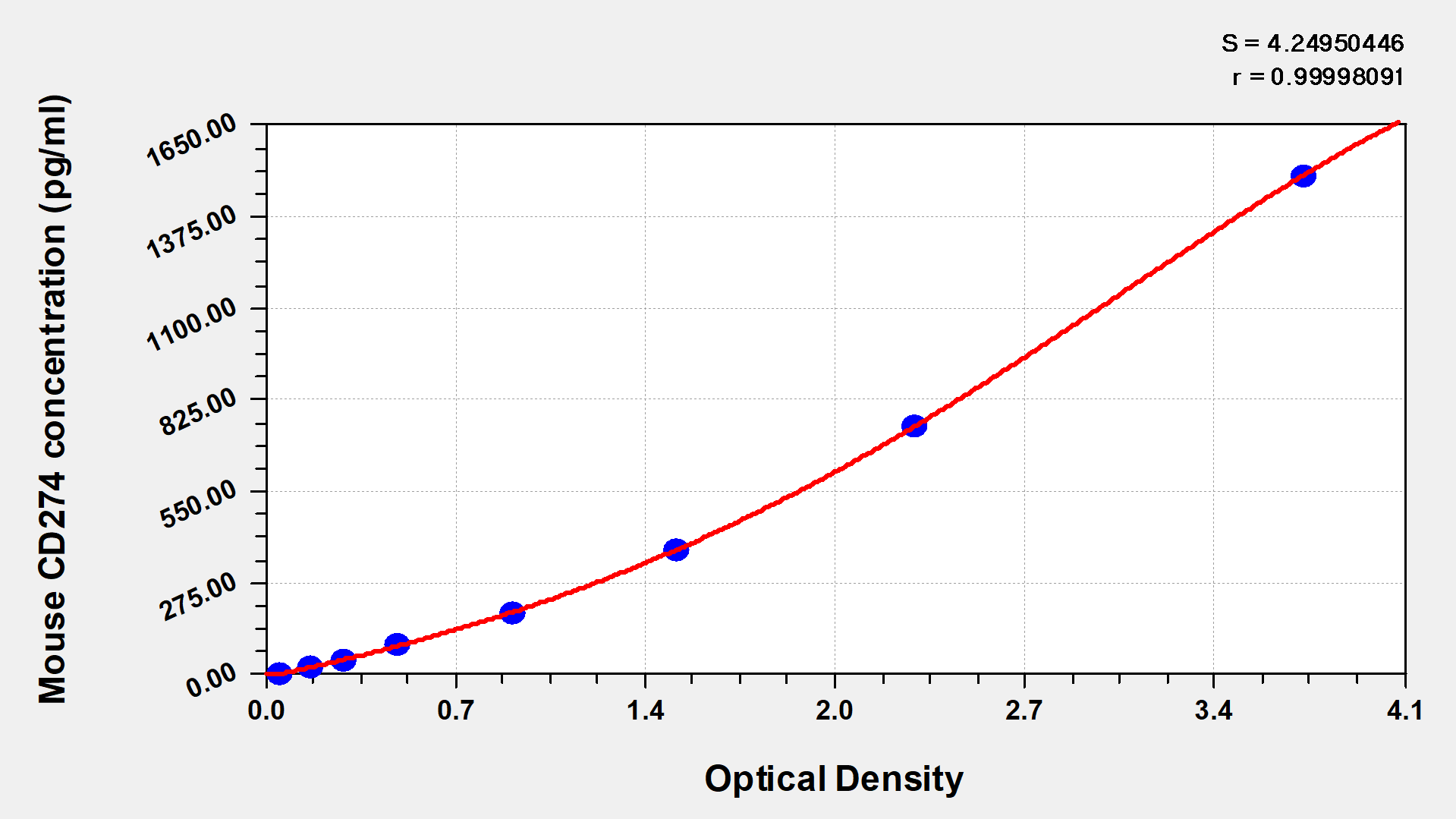
Mouse Programmed Cell Death 1 Ligand 1(CD274) ELISA kit

Code CSB-EL004911MO-IS
Size 96T,5×96T,10×96T
Price Request a Quote
Trial Size 24T ELISA Kit Trial Size (Only USD$150/ kit)
* Sample kit cost can be deducted as a $30 credit for each 96-assay kit of the same analyte and brand you subsequently purchase within six months until depleted. More details >>
Interested in a trial size? Please leave a message below.
Have Questions? Leave a Message or Start an on-line Chat

Product Details

Target Name
programmed cell death 1 ligand 1
Alternative Names
Cd274 ELISA Kit; B7h1 ELISA Kit; Pdcd1l1 ELISA Kit; Pdcd1lg1 ELISA Kit; Pdl1Programmed cell death 1 ligand 1 ELISA Kit; PD-L1 ELISA Kit; PDCD1 ligand 1 ELISA Kit; Programmed death ligand 1 ELISA Kit; B7 homolog 1 ELISA Kit; B7-H1 ELISA Kit; CD antigen CD274 ELISA Kit
Abbreviation
Uniprot No.
Species
Mus musculus (Mouse)
Sample Types
serum, plasma, cell culture supernates, tissue homogenates
Detection Range
23.5pg/ml-1500pg/ml
Sensitivity
11.75pg/ml
Assay Time
3.5h
Sample Loading Volume
50-100ul
Detection Wavelength
450 nm
Research Area
Others
Assay Principle
quantitative
Measurement
Sandwich
Troubleshooting
and FAQs
Storage
Store at 2-8°C. Please refer to protocol.
Shelf Life
6 months
Lead Time
3-5 working days after you place the order, and it takes another 3-5 days for delivery via DHL or FedEx.

Customer Reviews and Q&A

 Customer Reviews

There are currently no reviews for this product.

Submit a Review here

Target Background

Function
(From Uniprot)
Plays a critical role in induction and maintenance of immune tolerance to self. As a ligand for the inhibitory receptor PDCD1/PD-1, modulates the activation threshold of T-cells and limits T-cell effector response. Through a yet unknown activating receptor, may costimulate T-cell subsets that predominantly produce interleukin-10 (IL10).; The PDCD1-mediated inhibitory pathway is exploited by tumors to attenuate anti-tumor immunity and escape destruction by the immune system, thereby facilitating tumor survival. The interaction with PDCD1/PD-1 inhibits cytotoxic T lymphocytes (CTLs) effector function. The blockage of the PDCD1-mediated pathway results in the reversal of the exhausted T-cell phenotype and the normalization of the anti-tumor response, providing a rationale for cancer immunotherapy.
Gene References into Functions
  1. Immunogenic mouse neuroblastoma acquires adaptive immune resistance by up-regulating PD-L1 expression, whereas PD-L1 is of lesser consequence in nonimmunogenic neuroblastoma tumors. Combining PD-L1 checkpoint inhibition with whole tumor cell/anti-CTLA-4 vaccination enhanced tumor cell killing, cured mice with established tumors, and induced long-term immune memory (6 months). PMID: 29377881
  2. Data show that programmed cell death 1 ligand 1 (PD-L1) from disparate cellular sources, including tumour cells, myeloid or other immune cells can similarly modulate the degree of cytotoxic T-cell function and activity in the tumour microenvironment. PMID: 28220772
  3. IFNbeta activates neuronal PI3K/Akt signalling and Akt binds to transcription factor FoxA1 that translocates to the nucleus and induces PDL1. Conversely, inhibition of PI3K/Akt, FoxA1 and PDL1 blocked neuronal ability to generate FoxA1(+)Tregs. PMID: 28436428
  4. suppression of inflammatory responses and T cells apoptosis were observed with elevated expression of IRAK-M and PDL-1, and interference and neutralization of these 2 molecules led to partly reversed suppression of inflammation. PMID: 29995830
  5. The present work shows the role of SOCS1 in murine melanoma development and the potential of SOCS1-silenced tumor cells in raising an effective anti-melanoma immune response. PMID: 28079159
  6. miR-142 could attenuate cecal ligation and puncture-induced inflammation and thus sepsis via targeting PD-L1 in macrophages. PMID: 29793310
  7. T-cell activation mediates the immunopreventive effects of anti-PD-1; PD-1 on T cells interacts with the PD-1 ligand PD-L1 on cancer cells PMID: 29018057
  8. an enhanced expression of PD-L1 was observed besides an increased production of IFN-gamma by TH2 cells. PMID: 28917991
  9. Study demonstrated that PD-L1 expression is up-regulated in the salivary glands of female NOD mice during the developmental phase of Sjgren's syndrome, which in turn hinders the development and onset of this disease in a negative feedback fashion. PMID: 27966604
  10. PD-L1 expression on tumor cells suppressed antigen-driven TNF production by CD8(+) T cells, which could be antagonized through PD-1 blockade PMID: 28665401
  11. Anti-PD-1/PD-L1 therapy inhibited CMT167 orthotopic lung tumors by 95%. .Silencing PD-L1 expression in CMT167 cells resulted in smaller orthotopic tumors that remained sensitive to anti-PD-L1 therapy, whereas implantation of CMT167 cells into PD-L1(-) mice blocked orthotopic tumor growth, indicating a role for PD-L1 in both the cancer cell and the microenvironment. PMID: 28819064
  12. In estrogen receptor negative breast cancer cells targeting of IL-17A inhibited PDL1 expression in the tumor microenvironment, decreasing the percentage of Treg cells in tumor-infiltrating lymphocytes, and promoting CD4+ and CD8+ T cells to secrete interferon gamma. PMID: 27935862
  13. Squamous cell carcinomas escape immune surveillance via inducing chronic activation and exhaustion of CD8+ T Cells co-expressing PD-1 and LAG-3 inhibitory receptors. PMID: 27835902
  14. Genetic ablation of a single immune-regulatory molecule in this model [i.e., B7-homolog 1 (B7-H1, PD-L1)] not only significantly increased incidence of spontaneous CNS autoimmunity and aggravated disease course, especially in the later stages of disease, but also importantly resulted in encephalitogenic T-cell infiltration and lesion formation in normally unaffected brain regions. PMID: 27671636
  15. Studied the possible role of PD-L1 on malignant melanoma initiating cells (MMICs). Found blocking of PD-L1 in melanoma cell lines impaired tumorsphere formation and induced the apoptosis. Also, blocking PD-L1 inhibited tumor growth in vivo. PMID: 29250533
  16. B7-H1 induction in keratinocytes may play a crucial role in the protection from CD4+ T cell-mediated tissue inflammation by exogenous antigens delivered from the mucosal surface in oral cavity PMID: 27731324
  17. Interferon-related secretome from direct interaction between immune cells and tumor cells is required for upregulation of PD-L1 in tumor cells. PMID: 27295261
  18. Data (including data from studies in transgenic/knockout mice) suggest that T-cell expression of Mirn155 is required to limit melanoma growth; miR-155, Pdcd1, Pdcd1l1, and Ctla4 appear to regulate overlapping pathways promoting antitumor immunity. [Mirn155 = microRNA 155; Pdcd1 = programmed cell death 1 protein; Pdcd1l1 = programmed cell death 1 ligand 1 protein; Ctla4 = cytotoxic T-lymphocyte-associated protein 4] PMID: 28912267
  19. spleen-derived IFN-gamma induces generation of PD-L1(+)-suppressive neutrophils. PMID: 28974543
  20. It was concluded that down-regulated expression of miR-143 and up-regulation of its direct target B7H1 may indicate a novel therapeutic method for radiation-induced thymic lymphoma by increased expression of miR-143 or inhibition of B7H1. PMID: 28736328
  21. HDAC6 inhibition reduces tumor growth and PD-L1 production in vivo. PMID: 26775640
  22. mediates an innate checkpoint to control adaptive T helper responses PMID: 28747424
  23. PD-L1 selectively enhances T cell-mediated immune responses, driving graft-versus-host disease lethality and suggesting a context-dependent function of the PD-1/PD-L1 axis PMID: 27294527
  24. Mesenteric lymph node CD11b(-) CD103(+) PD-L1(High) dendritic cell subset probably takes up luminal antigens in the intestine, migrates to MLNs, and highly induces regulatory T cells through TGF-beta activation. PMID: 28423181
  25. These results indicate that the outcome of PD-L1-mediated signaling in CD8+ T cells depends on the presence or absence of CD4+ T cells, the nature of the interacting receptor expressed by CD8+ T cells, and the tissue environment in which the signaling occurs. PMID: 28414296
  26. findings identify a previously unrecognized role of PD-L1 as an endogenous pain inhibitor and a neuromodulator. PMID: 28530662
  27. reduced cytotoxicity as a key mechanism by which tumor PD-L1 suppresses antitumor immunity and demonstrate that tumor PD-L1 is not just a marker of suppressed antitumor immunity. PMID: 28302645
  28. Apigenin inhibits IFN-gamma-induced PD-L1 expression by breast cancer cells, potentially rendering BC cells that lack constitutive PD-L1 expression more susceptible to T cellmediated anti-tumor immune responses. PMID: 27378243
  29. results reveal a novel CD40-dependent regulation of PD-L1 trafficking induced upon TLR3 signaling that dictates its inhibitory activity. PMID: 27911948
  30. IL-6 and PD-L1 blockade combination inhibits hepatocellular carcinoma cancer development in a mouse model. PMID: 28254435
  31. PD-1/PD-L1 plays a crucial role in maintaining immune tolerance induced by UVB-iDCs, as well as in actively controlling effector T cells specific to alloantigens. PMID: 27556047
  32. Data show that Qiyusanlong decoction (QYSL) can moderately inhibit the growth of the transplanted tumor by decreasing programmed death 1 and programmed death ligand 1 (PD-1/PD-L1) level. PMID: 27371844
  33. Expression of PD-L1 is correlated with the severity of periodontitis in the mouse model of experimental periodontitis. PMID: 26847035
  34. Loss of Cdk5 results in persistent expression of the PD-L1 transcriptional repressors, the interferon regulatory factors IRF2 and IRF2BP2, which likely leads to reduced PD-L1 expression on tumors. PMID: 27463676
  35. addition to inhibiting T cells, hepatic stellate cells (HSCs) concurrently inhibit B cells via PD-L1; this direct B cell-inhibitory activity of HSCs should contribute to the mechanism by which HSCs maintain the liver's immune homeostasis PMID: 26755818
  36. The results demonstrated that blockade of PD-1/B7H1 pathway could promote mouse NK cells to kill the GL261GSCs, and the PD-1-inhibited NK cells could be a feasible immune therapeutic approach against Glioblastoma multiforme. PMID: 26266810
  37. These findings provide evidence for a novel immune escape mechanism during acute retroviral infection based on PD-L1 expression levels on virus infected target cells PMID: 26484769
  38. These results suggest a novel and specific role for PspA in modulating immune responses against S. pneumoniae by regulating PD-L1 expression. PMID: 26214513
  39. Upregulation of PD-1 and PD-L1 was associated with marked increases in GADD153 during myocardial ischemic reperfusion injury. PMID: 25902191
  40. Breg cells can suppress through the PD-1/PD-L1 pathway in limiting the differentiation and function of TFH cells PMID: 25609381
  41. Programmed death 1/programmed death ligand 1 pathway likely plays a crucial role in the mechanisms underlying spontaneous tolerization of B cells responding to ABO-blood group antigens in liver transplantation. PMID: 26247556
  42. B7-H1 Selectively Controls TH17 Differentiation and Central Nervous System Autoimmunity via a Novel Non-PD-1-Mediated Pathway. PMID: 26378076
  43. the upregulation of IFN-beta in DCs induces the up-regulation of coinhibitory molecules B7H1 and GITRL, which cause an impaired activation of naive Ag-specific T cells PMID: 25144375
  44. IL-10 released from 18-month old mice stimulated the expression of B7-H1 on myeloid-derived suppressor cells PMID: 25479230
  45. PD-L1 expression is increased on tumor cells by direct contact with BM-derived CD11b-positive cells through the p38 signaling pathway. PMID: 25889536
  46. Our study defines PD-1 upregulated on Treg cells and its interaction with PD-1 ligand on effector T cells as one cause for the potent T cell suppression and proposes the role of PD-1 on Treg cells. PMID: 25934860
  47. Transduction of T cells with this new PD-1-CD28 receptor has the potential of breaking the PD-1-PD-L1-immunosuppressive axis in ACT. PMID: 26105028
  48. data reveal that PD-L1 is a critical modulator of Tregs' ability to suppress iALI, and this appears to involve SHP-1 activation. PMID: 25057927
  49. In experimental autoimmune uveitis, inducible Tregs use a PD-1/PD-L1 mechanism to suppress the disease. PMID: 25877928
  50. Immunological in vivo effects of B7-H1 deficiency PMID: 25173046

Show More

Hide All

Subcellular Location
Cell membrane; Single-pass type I membrane protein. Early endosome membrane; Single-pass type I membrane protein. Recycling endosome membrane; Single-pass type I membrane protein.
Protein Families
Immunoglobulin superfamily, BTN/MOG family
Tissue Specificity
Highly expressed in the heart, thymus, skeletal muscle, and lung. Weakly expressed in the kidney, spleen, thyroid, and liver. Expressed on activated dendritic cells, B-cells and macrophages. Expressed in numerous tumor cells lines of lymphoid origin.
Database Links
CUSABIO guaranteed quality
icon of phone
Call us
301-363-4651 (Available 9 a.m. to 5 p.m. CST from Monday to Friday)

icon of address
Address
7505 Fannin St., Ste 610, Room 7 (CUBIO Innovation Center), Houston, TX 77054, USA
icon of social media
Join us with

Subscribe newsletter

Leave a message

* To protect against spam, please pass the CAPTCHA test below.
CAPTCHA verification
© 2007-2026 CUSABIO TECHNOLOGY LLC All rights reserved. 鄂ICP备15011166号-1