ACAD9 Monoclonal Antibody

Code CSB-MA828515
Size US$210
Order now
Image
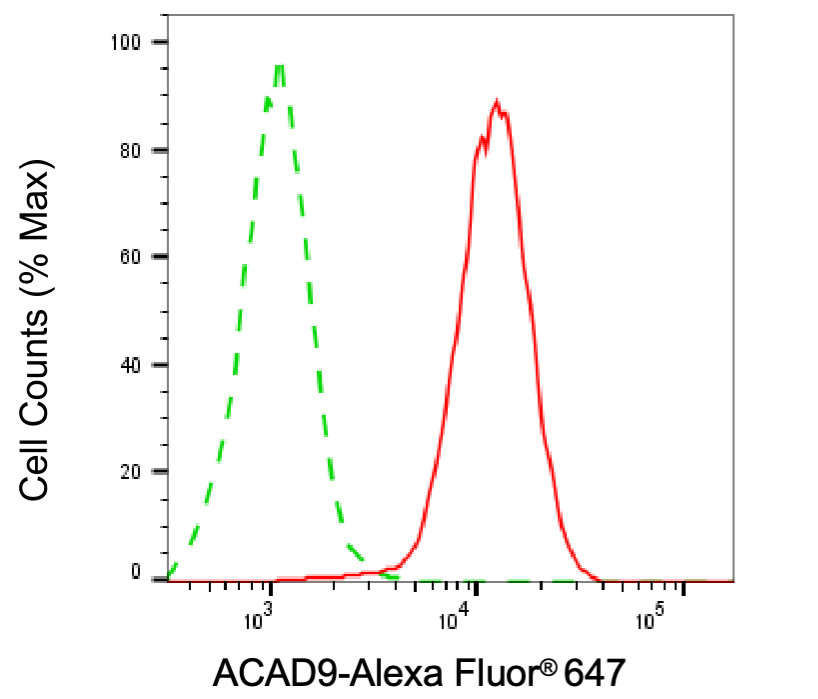
  • Flow cytometric analysis of ACAD9 expression in HepG2 cells using ACAD9 antibody. Green, isotype control; red, ACAD9.
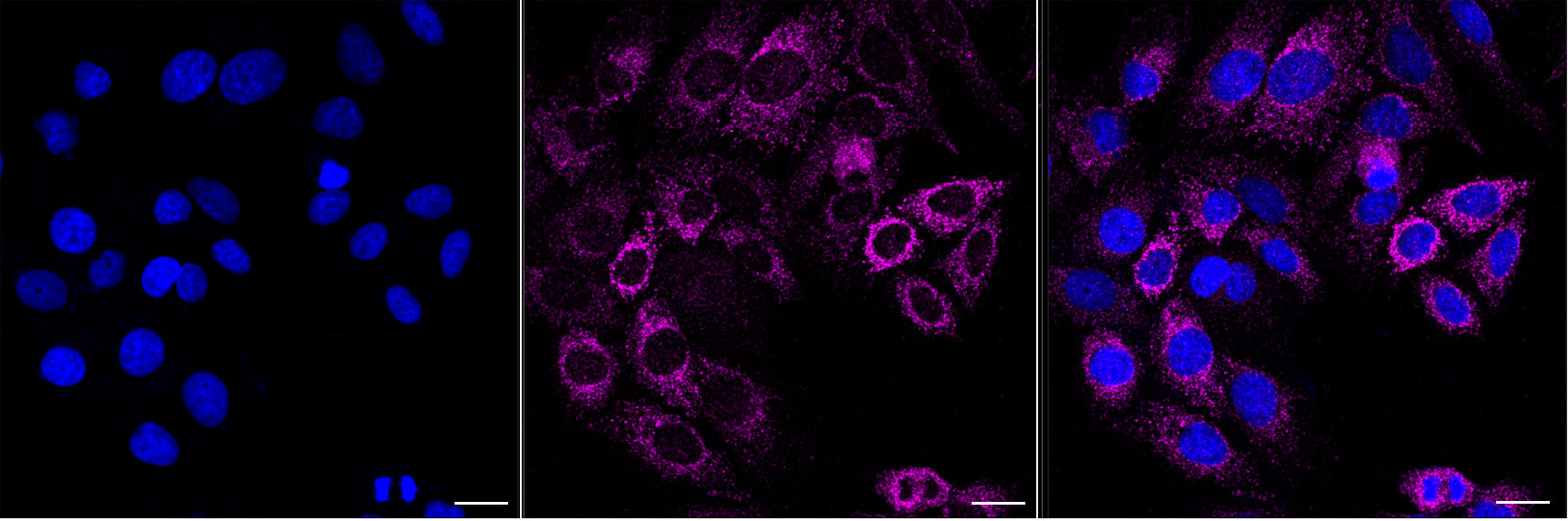
  • Immunocytochemical staining of HepG2 cells with ACAD9 antibody. Nuclei were stained blue with DAPI; ACAD9 was stained magenta with Alexa Fluor® 647. Images were taken using Leica stellaris 5. Protein abundance based on laser Intensity and smart gain: Medium. Scale bar, 20 μm.
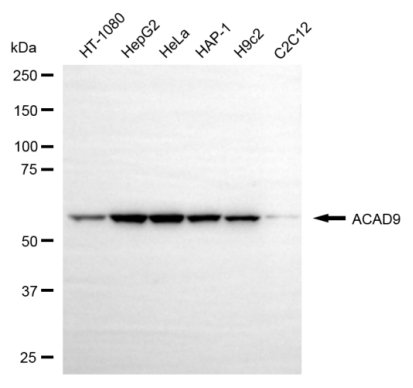
  • Western blotting analysis using ACAD9 antibody. Total cell lysates (30 μg) from various cell lines were loaded and separated by SDS-PAGE. The blot was incubated with ACAD9 antibody and HRP-conjugated goat anti-mouse secondary antibody respectively.
Have Questions? Leave a Message or Start an on-line Chat

Product Details

Full Product Name
Mouse anti-Homo sapiens (Human) ACAD9 Monoclonal antibody
Uniprot No.
Target Names
Alternative Names
ACAD9; Acyl-CoA Dehydrogenase Family Member 9; NPD002; Acyl-Coenzyme A Dehydrogenase Family, Member 9; Complex I Assembly Factor ACAD9, Mitochondrial; MGC14452; Very-Long-Chain Acyl-CoA Dehydrogenase VLCAD; Acyl-CoA Dehydrogenase Family, Member 9; EC 1.3.99.10; EC 1.3.8.-; EC 1.3.99; MC1DN20; ACAD-9
Raised in
Mouse
Species Reactivity
Human, Mouse, Rat
Immunogen
Recombinant Human ACAD9 protein
Immunogen Species
Homo sapiens (Human)
Conjugate
Non-conjugated
Clonality
Monoclonal
Isotype
Mouse IgG1
Clone No.
5F10
Purification Method
Affinity-chromatography
Concentration
It differs from different batches. Please contact us to confirm it.
Buffer
PBS (pH 7.4) containing 50% glycerol, and 0.02% sodium azide.
Form
Liquid
Tested Applications
ELISA, WB, FC, ICC
Recommended Dilution
Application Recommended Dilution
WB 1:500-1:2500
FC 1:200-1:2000
ICC 1:100-1:1000
Troubleshooting and FAQs
Storage
Upon receipt, store at -20°C or -80°C. Avoid repeated freeze.
Lead Time
Basically, we can dispatch the products out in 1-3 working days after receiving your orders. Delivery time maybe differs from different purchasing way or location, please kindly consult your local distributors for specific delivery time.
Usage
For Research Use Only. Not for use in diagnostic or therapeutic procedures.
Customer Reviews and Q&A

 Customer Reviews

There are currently no reviews for this product.

Submit a Review here

Target Background

Function
As part of the MCIA complex, primarily participates in the assembly of the mitochondrial complex I and therefore plays a role in oxidative phosphorylation. This moonlighting protein has also a dehydrogenase activity toward a broad range of substrates with greater specificity for long-chain unsaturated acyl-CoAs. However, in vivo, it does not seem to play a primary role in fatty acid oxidation. In addition, the function in complex I assembly is independent of the dehydrogenase activity of the protein.
Gene References into Functions
  1. Mutations in the ND6, NDUFV1 or ACAD9 genes are responsible for the mitochondrial complex I deficiency. PMID: 29348607
  2. Study identified new mutations in ACAD9 responsible for a wide spectrum of heart diseases in the presence of elevated serum lactate levels. PMID: 27233227
  3. ACAD9 mutation is the most frequent cause of cardiac hypertrophy and isolated complex I deficiency. PMID: 26669660
  4. Case Report: neonatal multiorgan failure due to ACAD9 mutation and complex I deficiency with mitochondrial hyperplasia in liver, cardiac myocytes, skeletal muscle, and renal tubules. PMID: 26826406
  5. In cells where it is strongly expressed, ACAD9 plays a physiological role in fatty acid oxidation. PMID: 25721401
  6. Our results underscore the importance of the ACAD9 protein in complex I assembly and suggest that the enzymatic activity is a rudiment of the duplication event. PMID: 24158852
  7. Our data support a new function for ACAD9 in complex I function, making this gene an important new candidate for patients with complex I deficiency, which could be improved by riboflavin treatment. PMID: 20929961
  8. ACAD9 screening of 120 additional complex I-defective index cases led us to identify two additional unrelated cases and a total of five pathogenic ACAD9 alleles. PMID: 21057504
  9. Data show that two closely related metabolic enzymes, ACAD9 and VLCAD, diverged at the root of the vertebrate lineage to function in two separate mitochondrial metabolic pathways and have clinical implications for the diagnosis of complex I deficiency. PMID: 20816094
  10. Very high activity of CPT2 and VCLAD, involved in the metabolism of long-chain fatty acids. Fatty acid oxidation may play role in energy generation in placenta, and deficiency in may result in placental dysfunction and gestational complications. PMID: 12971426
  11. ACAD9 may play a role in the turnover of lipid membrane unsaturated fatty acids that are essential for membrane integrity and structure PMID: 16020546
  12. acyl-CoA dehydrogenase 9 (ACAD 9)was identified as the long-chain ACAD in human embryonic and fetal brain and central nervous tissue, using in situ hybridization as well as enzymatic studies PMID: 16750164
  13. We now report three cases of ACAD9 deficiency. PMID: 17564966
  14. Accumulation of 3-hydroxylated intermediates of long-chain fatty acids may contribute to the pathogenesis of retinopathy in MTP deficiencies. PMID: 18385088
  15. Validated occurrence of an unusual TG 3' splice site in intron 10. PMID: 17672918

Show More

Hide All

Involvement in disease
Acyl-CoA dehydrogenase family, member 9, deficiency (ACAD9 deficiency)
Subcellular Location
Mitochondrion inner membrane; Peripheral membrane protein; Matrix side.
Protein Families
Acyl-CoA dehydrogenase family
Tissue Specificity
Ubiquitously expressed in most normal human tissues and cancer cell lines with high level of expression in heart, skeletal muscles, brain, kidney and liver. In the cerebellum uniquely expressed in the granular layer (at protein level).
Database Links

HGNC: 21497

OMIM: 611103

KEGG: hsa:28976

STRING: 9606.ENSP00000312618

UniGene: Hs.567482

icon of phone
Call us
301-363-4651 (Available 9 a.m. to 5 p.m. CST from Monday to Friday)
icon of address
Address
7505 Fannin St., Ste 610, Room 7 (CUBIO Innovation Center), Houston, TX 77054, USA
icon of social media
Join us with

Subscribe newsletter

Leave a message

* To protect against spam, please pass the CAPTCHA test below.
CAPTCHA verification
© 2007-2025 CUSABIO TECHNOLOGY LLC All rights reserved. 鄂ICP备15011166号-1
×
Place an order now

I. Product details

*
*
*
*

II. Contact details

*
*

III. Ship To

*
*
*
*
*
*
*

IV. Bill To

*
*
*
*
*
*
*
*