Recombinant Epstein-Barr virus Epstein-Barr nuclear antigen 2 (EBNA2), partial

Code CSB-EP319476EFAc7
Abbreviation Recombinant Epstein-Barr virus EBNA2 protein, partial
MSDS
Size $306
Order now
Image
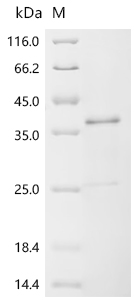
  • (Tris-Glycine gel) Discontinuous SDS-PAGE (reduced) with 5% enrichment gel and 15% separation gel.
Have Questions? Leave a Message or Start an on-line Chat

Product Details

Purity
Greater than 85% as determined by SDS-PAGE.
Activity
Not Test
Target Names
EBNA2
Uniprot No.
Research Area
Others
Alternative Names
EBNA-2;EBV nuclear antigen 2
Species
Epstein-Barr virus(strain B95-8)(HHV-4)(Human herpesvirus 4)
Source
E.coli
Expression Region
320-487aa
Target Protein Sequence
GPPWWPPICDPPQPSKTQGQSRGQSRGRGRGRGRGRGKGKSRDKQRKPGGPWRPEPNTSSPSMPELSPVLGLHQGQGAGDSPTPGPSNAAPVCRNSHTATPNVSPIHEPESHNSPEAPILFPDDWYPPSIDPADLDESWDYIFETTESPSSDEDYVEGPSKRPRPSIQ
Note: The complete sequence may include tag sequence, target protein sequence, linker sequence and extra sequence that is translated with the protein sequence for the purpose(s) of secretion, stability, solubility, etc.
If the exact amino acid sequence of this recombinant protein is critical to your application, please explicitly request the full and complete sequence of this protein before ordering.
Mol. Weight
25.1
Protein Length
Partial
Tag Info
C-terminal 6xHis-tagged
Form
Liquid or Lyophilized powder
Note: We will preferentially ship the format that we have in stock, however, if you have any special requirement for the format, please remark your requirement when placing the order, we will prepare according to your demand.
Buffer
If the delivery form is liquid, the default storage buffer is Tris/PBS-based buffer, 5%-50% glycerol. If the delivery form is lyophilized powder, the buffer before lyophilization is Tris/PBS-based buffer, 6% Trehalose.
Reconstitution
We recommend that this vial be briefly centrifuged prior to opening to bring the contents to the bottom. Please reconstitute protein in deionized sterile water to a concentration of 0.1-1.0 mg/mL.We recommend to add 5-50% of glycerol (final concentration) and aliquot for long-term storage at -20°C/-80°C. Our default final concentration of glycerol is 50%. Customers could use it as reference.
Troubleshooting and FAQs
Storage Condition
Store at -20°C/-80°C upon receipt, aliquoting is necessary for mutiple use. Avoid repeated freeze-thaw cycles.
Shelf Life
The shelf life is related to many factors, storage state, buffer ingredients, storage temperature and the stability of the protein itself.
Generally, the shelf life of liquid form is 6 months at -20°C/-80°C. The shelf life of lyophilized form is 12 months at -20°C/-80°C.
Lead Time
Delivery time may differ from different purchasing way or location, please kindly consult your local distributors for specific delivery time.
Notes
Repeated freezing and thawing is not recommended. Store working aliquots at 4°C for up to one week.
Datasheet & COA
Please contact us to get it.
Customer Reviews and Q&A

 Customer Reviews

There are currently no reviews for this product.

Submit a Review here

Target Background

Function
Plays a key role in the activation of the host resting B-cell and stimulation of B-cell proliferation. Acts by up-regulating the expression of viral EBNA1-6, LMP1, LMP2A and LMP2B genes, as well as several host genes including CD21, CD23 and MYC. Activates transcription by acting as an adapter molecule that binds to cellular sequence-specific DNA-binding proteins such as host CBF1, SMARCB1 and SPI1. Once EBNA2 is near promoter sites, its acidic activating domain recruits basal and activation-associated transcription factors TFIIB, TAF40, TFIIH components ERCC2 and ERCC3, and CBP in order to promote transcription. Alternatively, EBNA2 can affect activities of cell cycle regulators and retard cell cycle progression at G2/M phase. It also induces chromosomal instability, by disrupting mitotic checkpoints, multi-nucleation and formation of micronuclei in infected cells.
Gene References into Functions
  1. Identified three independent domains within EBNA2 that act through species-specific mechanisms. Importantly, the EBNA2 orthologues and species-specific EBNA2 domains separate unique roles for EBNA2 in the initiation of B cell immortalization from those responsible for maintaining the immortalized state. PMID: 29261800
  2. This study identifies the BS69 C-terminal domains as an inhibitor of EBNA2. PMID: 26845565
  3. Authors show that human herpesvirus 4 EBNA2 represses BIK in B-cell lymphoma-derived cell lines and that this host-virus interaction can inhibit the proapoptotic effect of transforming growth factor beta1. PMID: 24554662
  4. PRMT5 triggers the symmetric dimethylation of EBNA2 RG domain to coordinate with EBNA2-mediated transcription. PMID: 23261437
  5. present data suggest that EBNA2 might contribute to EBV-induced B-cell transformation by increasing oncomiR-like miR-21 and by affecting the antiviral responses of the innate immune system through downregulation of its key regulator miR-146a PMID: 22614176
  6. The subtypes E2-A and E2-C were the dominant genotypes of the EBNA-2 gene in nasopharyngeal and gastric carcinomas. PMID: 22348267
  7. mechanism by which the PhiW PhiP motif of RAM and EBNA2 compete with one another for binding at the hydrophobic pocket of the beta-trefoil domain (BTD) of CSL using overlapping but specific interactions that are unique to each BTD ligand. PMID: 20028974
  8. Inhibition of methylation in EBV-infected cells results in reduced expression of the EBNA2-regulated viral gene LMP1, evidencing that methylation is a prerequisite for DNA-binding by EBNA2 via association with the transcription factor RBPJkappa. PMID: 19969318
  9. data implicate EBNA2 Ser243 as a cdc2/cyclin B1 site of phosphorylation important for EBNA2's cotranscriptional function in mitosis PMID: 16439560
  10. results identify FcRH5 as a novel, direct target of EBNA2 that may contribute to the development of Epstein-Barr virus-associated tumors (Epstein-Barr virus nuclear antigen 2) PMID: 16439682
  11. EBNA2 trans-activates bfl-1, which requires CBF1 (or RBP-J kappa). PMID: 16873269
  12. p55alpha is thus a functional target of EBNA2 in EREB2.5 cells PMID: 16963743
  13. broad spectrum of EBNA-2 functions involved in virus-host interactions, including cell signaling molecules, adapters, genes involved in cell cycle regulation, and chemokines PMID: 16973580
  14. In EBV-negative diffuse large B-cell lymphoma and Burkitt lymphoma-derived cell lines infected in vitro with a recombinant EBV, high expression of EBNA2 inversely correlated with expression of germinal center-associated genes, BCL6 and TCL1. PMID: 17151114
  15. results indicate that differential gene regulation by Epstein-Barr virus type 1 and type 2 EBNA2 may be the basis for the much weaker B-cell transformation activity of type 2 Epstein-Barr virus strains compared to type 1 strains. PMID: 18480445
  16. EBNA2 is a transcriptional coactivator of STAT3 by influencing its DNA-binding activity. PMID: 19032945
  17. EBNA2 was shown to be able to downregulate mitotic arrest deficient 2 (MAD2) approximately 2- to 3-fold and upregulate polo-like kinase 1 (PLK1) approximately 2-fold. PMID: 19126642
  18. Both EBNA2 and Notch-IC induced the expression of proapoptotic genes, but only in EBNA2-expressing cells were antiapoptotic genes strongly up-regulated. PMID: 19339697

Show More

Hide All

Subcellular Location
Host nucleus matrix. Note=Associated with the nuclear matrix.
Protein Families
Herpesviridae EBNA2 family
Database Links

KEGG: vg:3783761

icon of phone
Call us
301-363-4651 (Available 9 a.m. to 5 p.m. CST from Monday to Friday)
icon of address
Address
7505 Fannin St., Ste 610, Room 7 (CUBIO Innovation Center), Houston, TX 77054, USA
icon of social media
Join us with

Subscribe newsletter

Leave a message

* To protect against spam, please pass the CAPTCHA test below.
CAPTCHA verification
© 2007-2026 CUSABIO TECHNOLOGY LLC All rights reserved. 鄂ICP备15011166号-1
Place an order now

I. Product details

*
*
*
*

II. Contact details

*
*

III. Ship To

*
*
*
*
*
*
*

IV. Bill To

*
*
*
*
*
*
*
*



